


How to Build Trust Signals That AI Search Engines Value and Recommend
You can publish great content, earn solid rankings, and still not appear in a single AI-generated answer. That is because AI platforms like ChatGPT, Perplexity, and Google AI Overviews do not just surface what ranks. They surface what they trust.
This guide covers the trust signals AI platforms evaluate, how to build them systematically, and the mistakes that quietly prevent brands from earning AI recommendations.
What Are Trust Signals in AI Search?
Trust signals are credibility markers that AI platforms analyze before recommending your content to users. They tell answer engines your brand is reliable, accurate, and safe to cite.
AI systems like Google AI Overviews and Perplexity cross-reference multiple data points before surfacing a source. They evaluate authorship credentials, brand mention consistency, user reviews, verified business information, and third-party validation.
| Signal Type | What AI Systems Evaluate |
| Author credentials | Qualifications, professional profiles, publication track record |
| Brand consistency | Matching NAP data across all platforms |
| Third-party validation | Awards, media mentions, expert citations |
| User reviews | Volume, recency, sentiment, and response quality |
| Technical markers | HTTPS, privacy policy, contact transparency |
Traditional SEO focused on ranking. AI search optimization focuses on being recommended.
Why Do AI Answer Engines Prioritize Trust Over Traditional Rankings?
AI platforms prioritize user safety and accuracy above click volume or keyword relevance. A wrong recommendation damages an AI system’s credibility, so answer engines vet sources thoroughly before citing them. Gartner predicts traditional search engine volume will drop 25% by 2026 as users shift to AI-powered answers, which means the stakes of not being recommended are growing.
| Why AI Systems Rely on Trust | What It Means for Your Brand |
| A wrong recommendation damages AI credibility | Platforms vet sources before citing them, not after |
| AI models need verified sources to generate accurate answers | Weak trust signals increase your risk of being skipped |
| Multi-source cross-referencing confirms authority | Your website, reviews, and third-party mentions must align |
| Trust signals reduce AI hallucination risk | Authoritative content is safer for AI systems to cite |
What Core Trust Signals Influence AI Platform Recommendations?
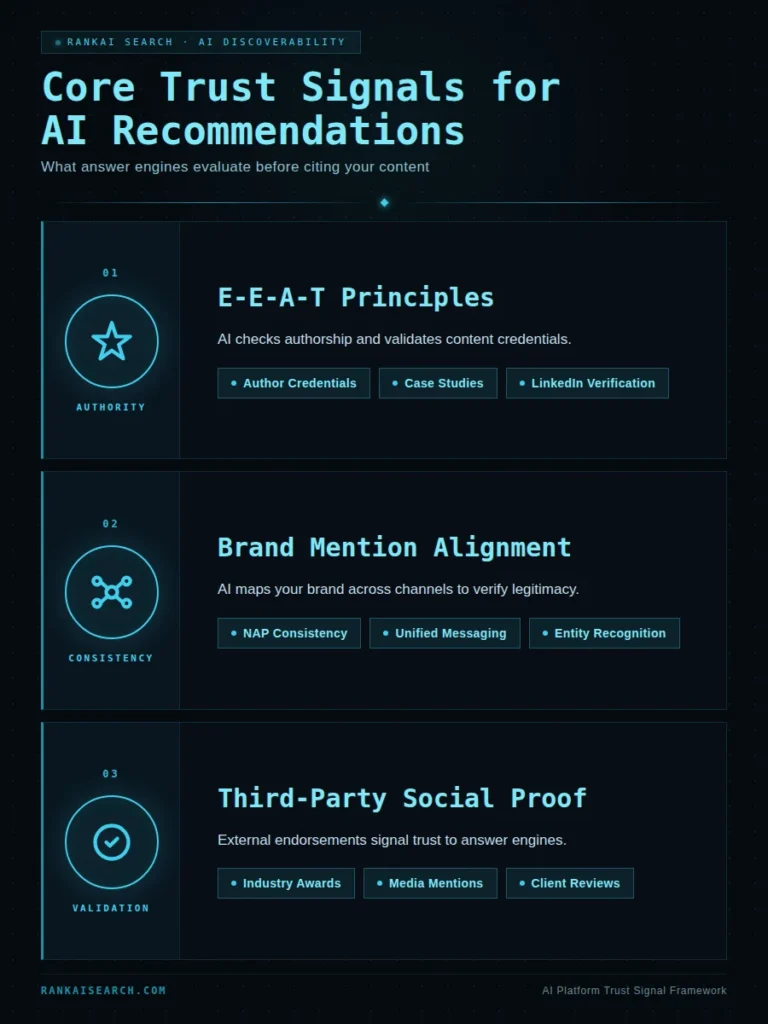
The highest-impact trust signals combine E-E-A-T principles, consistent brand presence, and third-party validation. AI platforms weight signals differently by query type, but all three categories matter consistently.
These three signal categories drive the most impact for AI recommendation visibility.
How Do E-E-A-T Signals Affect AI Recommendations?
E-E-A-T stands for Experience, Expertise, Authoritativeness, and Trustworthiness. These four principles help AI answer engines separate credible sources from unreliable ones, and they form the foundation of every trust-building strategy.
| E-E-A-T Component | How to Signal It |
| Experience | Document specific client outcomes and results with verifiable detail |
| Expertise | Author bios listing credentials, certifications, and professional affiliations |
| Authoritativeness | Publish expert insights and original research consistently in a defined niche |
| Trustworthiness | Fact-check all claims, cite sources with active links, and update content regularly |
Link authors to verified LinkedIn profiles and industry-specific platforms so AI systems can validate credentials independently.
Why Does Brand Mention Consistency Matter for AI Systems?
AI systems use entity recognition to match your brand across platforms. Inconsistent business information breaks that recognition and weakens your trust profile.
Consistent NAP (Name, Address, Phone) data signals to AI systems that your business is legitimate and stable. Your messaging, expertise areas, and value proposition should align everywhere a user might find you.
- Standardize your exact business name, address format, and phone number across all platforms
- Align brand descriptions and expertise claims across your website, LinkedIn, and third-party directories
- Audit listings quarterly to catch drift or outdated information before it confuses entity recognition
How Does Third-Party Validation Strengthen AI Trust Signals?
Third-party validation is external proof that your brand delivers on its claims. AI platforms treat endorsements from recognized organizations as trust votes.
- Industry awards and certifications signal credibility to answer engines
- Media mentions and guest contributions from reputable publications carry significant weight
- Expert quotes and co-authored content show AI systems that respected professionals trust your brand
- Client testimonials with specific, measurable results provide verifiable social proof
How Do You Establish Author Authority for AI Answer Engines?
Author authority is built through verified credentials, consistent publication in a defined niche, and a clear link between your content and your professional identity. AI platforms use AuthorRank-style signals to assess whether a writer has genuine expertise on a topic before surfacing their content in recommendations.
- Create comprehensive author bios listing credentials, years of experience, and specific knowledge areas
- Link every author profile to verified LinkedIn accounts and professional networks
- Publish consistently in a focused niche rather than spreading across unrelated topics
- Contribute original research, data analysis, or unique perspectives that add new knowledge to a topic
RankAISearch principle: AI platforms favor authors who add new knowledge to a topic, not those who repackage what already exists. A consistent publication track record in a specific subject area is the clearest AuthorRank signal you can build.
Anonymous or under-credentialed content carries almost no AuthorRank value. Attribution is not optional for AI visibility.
How Do You Create Content That AI Platforms Will Cite?
Citation-worthy content gives AI systems complete, accurate answers they can extract and surface with confidence. Content that answers questions partially or vaguely is less likely to be recommended.
Structure articles as definitive resources, not overview pieces. BrightEdge research shows AI-generated answers disproportionately pull from sources that directly answer the query rather than sources that merely discuss the topic. Include original research, proprietary data, or unique industry perspectives that give AI platforms a reason to cite your source over a competitor’s.
- Provide complete, direct answers to user questions in the opening lines of each section
- Cite all statistics with active links to original sources, not homepages
- Update content on a defined schedule to prevent accuracy drift
- Avoid aggregating existing information without adding a layer of original analysis
How Do Reviews and User-Generated Content Build AI Trust?
Reviews and user-generated content provide real-world validation that AI systems weigh independently of your own brand claims. Platforms treat verified reviews as social proof that your brand delivers what it promises.
BrightLocal’s Consumer Review Survey found that 98% of consumers read online reviews for local businesses, a behavior pattern AI systems are trained to recognize as a trust signal. Positive reviews across Google, industry-specific directories, and social platforms create a consistent reputation pattern that answer engines can verify.
- Encourage authentic reviews on Google Business Profile, Trustpilot, and industry-relevant platforms
- Respond professionally to all reviews, including negative ones
- Feature detailed client testimonials with specific, measurable results rather than generic praise
- Use case studies and success stories to convert customer experience into citable content
How you handle negative reviews matters as much as the volume of positive ones. AI platforms analyze response patterns to gauge business credibility and customer service quality.
What Technical Trust Signals Do AI Systems Check?
Technical trust signals confirm your website is secure, transparent, and professionally maintained. AI platforms treat these as baseline requirements, not differentiators, and sites that fail them are less likely to be recommended regardless of content quality.
Several technical factors affect how AI systems evaluate source reliability.
Do Security and Performance Signals Affect AI Recommendation Likelihood?
Yes. HTTPS encryption is a minimum trust requirement. Non-secure sites are consistently deprioritized in AI recommendation algorithms. Site performance follows the same logic: poor load speeds and broken UX suggest neglect, which correlates with lower content quality in AI evaluation models.
| Technical Signal | What to Do |
| HTTPS encryption | Implement SSL across all pages; treat it as a non-negotiable baseline |
| Privacy policy and terms of service | Display clearly and write in plain language |
| Site speed and mobile responsiveness | Maintain fast performance as an indirect credibility indicator |
| Clean user experience | Minimize intrusive ads, pop-ups, and disruptive UX elements |
Why Is Contact Transparency Important for AI Verification?
AI systems verify business legitimacy by checking whether contact information is accessible, current, and consistent with what appears on other platforms. Missing or outdated contact details raise flags in AI entity validation.
- Provide a physical address, phone number, email address, and contact form
- Publish an About page with team information, company history, and mission
- Display business registration details, licenses, and industry affiliations where applicable
How Do You Monitor Whether Your Trust Signals Are Working?
Monitoring trust signals means tracking brand mention consistency, citation frequency in AI-generated answers, and content accuracy over time. Without measurement, trust-building has no feedback loop.
Use tools like Google Alerts, Mention, or Brand24 to catch inconsistencies across platforms. Specialized AEO monitoring platforms can track whether AI systems cite your content for relevant queries.
- Audit brand mentions monthly for NAP inconsistencies across directories and social profiles
- Review all content quarterly to catch outdated statistics, broken links, or accuracy issues
- Analyze which competitor sources AI platforms recommend in your niche and identify gaps in their trust profiles
- Track brand sentiment proactively so reputation problems do not compound before they affect AI recommendations
- Watch for increasing citation frequency in AI-generated answers as the clearest sign of improving trust signals
What Advanced Strategies Build AI Search Trust Faster?
Strategic partnerships and collaborative content compound trust signals faster than solo publishing. When established organizations associate with your brand, AI platforms extend a portion of that authority to you.
- Partner with recognized industry organizations for co-branded content or official certifications
- Co-author articles with acknowledged experts or run expert interview series
- Speak at industry conferences to generate event page mentions, social coverage, and publication references
- Publish original whitepapers or research reports that other sites naturally cite over time
- Build a knowledge base or resource center that functions as a reference destination in your niche
Each of these tactics generates third-party mentions across authoritative domains. Those mentions multiply the trust signals your brand accumulates without requiring proportionally more content output.
What Trust Signal Mistakes Hurt AI Search Visibility?
The most damaging trust signal mistakes are preventable. Most stem from inconsistency, thin content, or neglected reputation management.
| Mistake | Why It Hurts AI Visibility |
| Inconsistent NAP data | Breaks entity recognition across platforms |
| Thin or duplicate content | Signals low reliability to answer engines |
| Anonymous author attribution | Eliminates AuthorRank potential |
| Unaddressed negative reviews | Creates a negative credibility pattern AI systems register |
| Promotional language over substance | Lacks the credibility markers AI platforms require |
| Missing or outdated contact information | Fails AI business verification checks |
| Static, never-updated content | Suggests inaccuracy and site neglect |
Fixing these issues does not require large-scale content production. It requires systematic auditing and disciplined consistency across every platform where your brand appears.
Frequently Asked Questions
What trust signals do AI search engines value most?
AI search engines weight E-E-A-T signals, consistent brand mentions, author credentials, positive reviews, and transparent business information most heavily. Original research, third-party validation from reputable sources, and verified security markers also carry significant weight. The strongest trust profiles combine multiple signal types across multiple platforms simultaneously.
How long does it take to build trust signals strong enough for AI recommendations?
Building visible trust signals typically takes three to six months of consistent effort. Established brands with existing domain authority may see initial improvements sooner, while new businesses generally need longer to accumulate sufficient signals across platforms. Trust-building is ongoing maintenance, not a one-time setup.
Can small businesses compete with large brands for AI recommendations?
Small businesses can compete by building deep niche authority rather than broad coverage. Specialized credentials, strong local reviews, and community involvement give smaller brands advantages that AI platforms recognize and reward. Relevant expertise from verified authors consistently outperforms brand size alone in AI recommendation algorithms.
How do reviews and ratings directly impact AI answer engine recommendations?
AI platforms analyze review volume, recency, sentiment, and response quality when building a brand’s trust profile. Businesses with consistently positive reviews and professional responses to all feedback demonstrate stronger credibility signals. Reviews also help AI systems verify that your brand delivers on its published claims.
What is the core difference between traditional SEO and AI search trust optimization?
Traditional SEO prioritizes backlinks, keyword density, and technical optimization. AI search optimization prioritizes author credentials, brand consistency, and real-world external validation. Both matter, but AI platforms perform multi-source cross-referencing that traditional ranking algorithms do not, making reputation management more central to AI visibility.
How can I tell if my trust signals are improving AI platform visibility?
Monitor whether AI platforms cite your content when answering relevant queries in your niche. Track increases in referred traffic from AI platforms and watch for rising brand mention sentiment. Improved citation frequency and growing author recognition are reliable indicators that trust signals are strengthening.
Do social media profiles count as trust signals for AI search?
Verified social media profiles strengthen trust signals when linked to author bios and business information. AI platforms use social presence to confirm entity legitimacy and author credentials. Consistent professional engagement and content quality matter more than follower count.
What should I do first if I want to start building trust signals today?
Audit your NAP consistency across all directories, social profiles, and your website as the first priority. Inconsistent business information is the most common and most damaging trust signal error. Once consistency is established, build author profiles, gather authentic reviews, and develop citation-worthy content in parallel.