


How to Optimize E-commerce Product Pages for AI Search
A shopper may never start with a search engine result page. They may ask ChatGPT, Gemini, Perplexity, or Copilot which product fits their budget, size, style, or problem. Optimizing ecommerce product pages for AI search helps your products appear in those AI-assisted buying journeys.
Product visibility depends on how clearly the page explains the item. AI systems need clean facts, consistent data, buyer-focused answers, and proof from reviews. This guide explains how to structure product pages so AI tools can interpret and recommend them more confidently.
How Do You Optimize Product Pages for AI Search?
To optimize product pages for AI search, present clear specifications and answer common buyer questions up front. Add Product and Review schema, include genuine reviews, and use plain, factual descriptions that AI can easily extract and recommend.
AI search systems need clean product facts before they can confidently recommend a product. A product page should clearly state what the product is, who it is for, what it includes, how it differs from alternatives, and whether it is available.
Product pages also need structured product data. Google says product structured data can help product information appear in richer ways across Google Search, including product snippets, merchant listings, image results, and Google Lens. (Source: Google Search Central, 2026)
AI product visibility depends on both page clarity and source trust. A page with strong specs, visible reviews, current pricing, accurate availability, and clean structured data gives AI systems more reliable material to extract.
| Optimization Area | What To Improve | Why It Helps AI Search |
|---|---|---|
| Product facts | Name, specs, size, material, use case, compatibility | Helps AI classify the product |
| Buyer answers | Fit, use, care, comparisons, limitations | Matches conversational prompts |
| Structured data | Product, Offer, Review, AggregateRating | Clarifies machine-readable facts |
| Reviews | Verified feedback and real use cases | Supports trust and recommendation logic |
| Images and media | Alt text, multiple angles, demos, scale | Improves product understanding |
| Variants | Size, color, material, SKU, stock | Reduces confusion across options |
| Internal links | Related products, categories, guides | Helps discovery and context |
What Information Should Every Product Page Make Clear?
Every product page should make the product name, specifications, price, availability, delivery details, returns, use cases, compatibility, and proof points clear. AI systems need these facts to compare products and answer buyer questions.
A product page should not force users or machines to infer basic details. If the product size, material, use case, included items, or compatibility is missing, the page becomes weaker for AI recommendations.
The most important product details should appear near the top of the page. AI systems and buyers both benefit when core facts are visible before long marketing copy.
| Product Information | What To Include | Why It Matters |
|---|---|---|
| Product name | Exact name and model | Identifies the item |
| Brand | Manufacturer or store brand | Supports entity clarity |
| Specs | Size, weight, material, dimensions, capacity | Enables comparison |
| Use case | Who the product is for | Matches buyer intent |
| Price | Current price and currency | Supports transactional accuracy |
| Availability | In stock, out of stock, preorder | Prevents misleading answers |
| Delivery | Shipping cost, timing, pickup, regions | Supports buying decisions |
| Returns | Return window and conditions | Reduces purchase risk |
Product details should be written in consistent language across the page, feed, schema, and catalog. Conflicting product names, prices, or attributes can reduce trust.
Core Specifications and Attributes
Core specifications are the factual attributes that define what the product is. These include size, dimensions, color, material, weight, model number, compatibility, capacity, and included components.
Specifications should be scannable and complete. AI systems can extract a clean spec table more reliably than buried details inside long paragraphs.
| Attribute Type | Example |
|---|---|
| Physical size | 12 in x 8 in x 4 in |
| Weight | 1.5 lb |
| Material | Stainless steel, cotton, leather |
| Color | Black, blue, natural wood |
| Compatibility | iPhone 16, USB-C, queen mattress |
| Capacity | 32 oz, 2 TB, 6 seats |
| Model or SKU | ABC-123 |
| Included items | Product, cable, manual, case |
Use the same attribute names across similar products. A catalog that uses “dimensions” on one page and “product size” on another may create unnecessary inconsistency.
Price, Availability, and Delivery Details
Price, availability, and delivery details tell AI systems whether the product can be bought now and under what conditions. These details are essential for recommendations that compare products by cost, urgency, or location.
Availability should match the live purchase experience. If the page says “in stock” but checkout shows unavailable, AI systems and buyers receive conflicting signals.
| Detail | Best Practice |
|---|---|
| Price | Show current price and currency |
| Sale price | Show discount and valid dates where relevant |
| Availability | Use clear stock status |
| Delivery | Include shipping regions and estimated timing |
| Pickup | Show local pickup options where relevant |
| Returns | State return window and conditions |
| Warranty | Include warranty length and coverage |
| Taxes or fees | Clarify required extra charges |
Delivery details should be page-specific when possible. A general shipping policy is useful, but product-level delivery constraints are clearer for bulky, fragile, restricted, or made-to-order products.
How Should You Write Product Descriptions for AI Answers?
You should write product descriptions in plain, factual language that explains what the product is, who it is for, what problem it solves, and why it differs from alternatives. AI systems extract product meaning more easily from direct sentences than from vague promotional copy.
A strong product description should answer buyer intent before it tries to persuade. The first few lines should identify the product category, key feature, ideal user, and primary benefit.
Product descriptions should be specific enough to support comparison. A phrase like “premium quality” is weaker than a visible fact such as “made with 18/8 stainless steel and designed for hot drinks up to 12 hours.”
| Description Element | AI-Ready Example |
|---|---|
| Product identity | “This is a 32 oz insulated stainless steel water bottle.” |
| Primary use | “It is designed for commuting, workouts, and travel.” |
| Key feature | “The double-wall body keeps drinks cold for up to 24 hours.” |
| Ideal buyer | “It fits buyers who want a leak-resistant daily bottle.” |
| Differentiator | “The slim base fits most car cup holders.” |
| Limitation | “It is not dishwasher safe.” |
| Included items | “The bottle includes a straw lid and cleaning brush.” |
Good product copy should include:
- Clear category name
- Main use case
- Specific attributes
- Buyer fit
- Product limitations
- Compatibility details
- Care instructions
- What is included
How Can Buyer Questions Improve Product Visibility?
Buyer questions improve product visibility by giving AI systems direct answers to the prompts shoppers ask before buying. A product page that answers real questions can match more conversational AI queries.
AI search often starts with natural-language prompts. Shoppers may ask which product is best for sensitive skin, small apartments, outdoor use, beginners, travel, gifting, or a specific budget.
Buyer questions should be placed where users can find them. Product FAQs, comparison sections, fit guides, care notes, and shipping answers can all help a page match AI search prompts.
| Buyer Question | Product Page Answer |
|---|---|
| “Is this good for beginners?” | Explain skill level and ease of use |
| “Will this fit my device?” | List compatible models |
| “Is this safe for sensitive skin?” | State materials, ingredients, and testing |
| “How long does delivery take?” | Provide shipping estimate |
| “What size should I choose?” | Add size guide and measurements |
| “How does this compare with another model?” | Add comparison table |
| “What comes in the box?” | List included items |
| “How do I care for it?” | Add cleaning or maintenance instructions |
A product FAQ should answer questions with direct language. Avoid using FAQ sections only for sales claims.
Which Structured Data Should Ecommerce Product Pages Use?
The structured data that ecommerce product pages should use are Product, Offer, Review, AggregateRating, BreadcrumbList, and Organization schema when the visible content supports those fields. Structured data helps machines identify product facts, seller details, ratings, availability, and page hierarchy.
Structured data should describe the page accurately. It should not add ratings, prices, reviews, or availability details that users cannot see on the page.
Schema is most effective when it reinforces visible product facts. The markup should match the product title, price, currency, SKU, GTIN, availability, brand, reviews, and variant details shown on the page.
| Schema Type | What It Clarifies | Best Use |
|---|---|---|
| Product | Product name, brand, SKU, image, description | Product detail pages |
| Offer | Price, currency, availability, condition | Current purchase details |
| Review | Individual customer or expert review | Visible review content |
| AggregateRating | Average rating and review count | Verified visible rating summary |
| BreadcrumbList | Category and page hierarchy | Product discovery |
| Organization | Merchant or publisher identity | Brand clarity |
Product and Offer Markup
Product and Offer markup identify the item and the current purchase conditions. Product markup describes what the item is, while Offer markup describes price, availability, currency, condition, and purchase URL.
Google’s Product structured data documentation says merchants can provide rich product data through structured data, Merchant Center feeds, or both. This makes product markup useful as part of a broader product data system. (Source: Google Search Central, 2026)
| Property | What It Should Match |
|---|---|
| name | Visible product name |
| image | Main product image |
| description | Visible product description |
| sku | Product SKU |
| gtin | Valid product identifier |
| brand | Visible brand name |
| offers.price | Current visible price |
| offers.availability | Current stock status |
Product identifiers should be accurate. Wrong SKUs, missing GTINs, or inconsistent brand names can make product matching harder.
Review and AggregateRating Markup
Review and AggregateRating markup identify visible review content and rating summaries. They should only be used when real reviews or ratings appear on the product page.
| Review Field | Best Practice |
|---|---|
| Reviewer | Use real reviewer details where allowed |
| Rating | Match visible rating |
| Review text | Keep review content visible |
| Date | Include review date |
| Product match | Tie review to correct product |
| Aggregate rating | Match visible average rating |
| Review count | Match visible count |
Do not use fake reviews or mark up reviews that users cannot see. Review markup should strengthen trust, not create artificial credibility.
How Do Customer Reviews Support AI Recommendations?
Customer reviews support AI recommendations by providing real buyer language, use cases, concerns, comparisons, and trust signals. Reviews help AI systems understand how shoppers experience the product after purchase.
Reviews often contain details that product descriptions miss. Buyers mention sizing, durability, comfort, installation, scent, texture, packaging, fit, and real-world limitations.
Reviews should be organized by theme where possible. AI systems and users both benefit when review content supports common buying questions.
| Review Theme | Why It Helps |
|---|---|
| Fit and sizing | Supports size-related prompts |
| Quality and durability | Supports trust and comparison prompts |
| Ease of use | Supports beginner or convenience prompts |
| Delivery and packaging | Supports purchase confidence |
| Compatibility | Supports device or part matching |
| Customer support | Supports seller trust |
| Repeat purchase | Supports loyalty signals |
Use review summaries carefully. A summary should reflect real review patterns and should not hide negative feedback that affects buyer expectations.
How Can Images and Media Strengthen Product Understanding?
Images and media strengthen product understanding by showing the product’s appearance, scale, use, features, packaging, and real-world context. AI systems and shoppers need visual evidence to confirm what text describes.
Product media should show more than one angle. A strong product page includes the main image, alternate angles, close-ups, scale references, lifestyle images, videos, and diagrams where relevant.
Google Merchant Center says product images must meet quality standards and that improving image quality can support a better shopping experience. (Source: Google Merchant Center Help, 2026)
Image alt text should describe the product accurately. It should include useful attributes such as product type, color, material, size, and visible features when relevant.
| Media Type | What It Shows |
|---|---|
| Main image | Clear product identity |
| Alternate angles | Shape and details |
| Close-up image | Material, texture, finish, controls |
| Scale image | Size in real use |
| Lifestyle image | Product context |
| Video | Setup, movement, or function |
| Diagram | Parts, dimensions, or compatibility |
| Packaging image | Included items and condition |
Useful product media practices include:
- Use stable image URLs
- Show the actual product variant
- Add descriptive alt text
- Include scale where size matters
- Avoid misleading editing
- Match image data to feed data
- Use videos for setup or movement
How Should Product Variants Be Organized?
Product variants should be organized so each size, color, material, model, or configuration is easy to understand and connect to the main product. AI systems need to know which attributes change and which product facts stay the same.
Variant organization matters because similar products can confuse AI systems. A shopper asking for a “black leather size 9 boot” needs a page that clearly connects color, material, size, SKU, stock, and price.
A good variant setup should prevent duplicate or conflicting pages. Each variant should have a clear relationship to the parent product and accurate stock data.
| Variant Element | Best Practice |
|---|---|
| Parent product | Use one clear product family name |
| Variant attributes | Define size, color, material, pattern, or model |
| SKU | Use unique SKU per variant |
| Price | Show variant-specific price where relevant |
| Availability | Show variant-specific stock |
| Images | Match images to selected variant |
| URL | Use consistent canonical rules |
| Schema | Use ProductGroup where appropriate |
Avoid mixing unrelated products as variants. A true variant changes attributes of the same product, not the product category itself.
What Role Do Comparison and Buying Guidance Play?
Comparison and buying guidance help AI systems understand when one product is a better fit than another. They also help shoppers make decisions when several products look similar.
AI answers often compare products by use case, price, features, quality, fit, reviews, and limitations. Product pages that include comparison guidance can better match prompts such as “which one is better for travel” or “best option for beginners.”
Comparison content should be factual. It should help the buyer choose instead of making unsupported claims against competitors.
| Buying Guidance Element | What It Explains |
|---|---|
| Best for | Ideal use case |
| Not best for | Product limitations |
| Compare with | Similar product alternatives |
| Feature differences | Material, size, performance, compatibility |
| Price difference | Why one option costs more |
| Care requirements | Maintenance needs |
| Upgrade path | Better model or bundle |
| Beginner fit | Ease of use and learning curve |
Strong comparison sections include:
- “Best for” statements
- “Choose this if” guidance
- Side-by-side product tables
- Feature differences
- Limitations
- Related alternatives
- Buyer FAQs
How Can Internal Links Help AI Discover Related Products?
Internal links help AI discover related products by showing relationships between product pages, categories, buying guides, comparisons, and support content. Clear links help crawlers and AI systems understand how products fit into a catalog.
Internal links also guide buyers from research to purchase. A visitor who lands on a buying guide should be able to reach the right product page, and a product page should connect to relevant accessories, alternatives, and care content.
Internal links should use descriptive anchor text. “Shop waterproof hiking boots” is more useful than “click here” because it explains the destination.
| Link Type | Example Destination |
|---|---|
| Category link | Running shoes, office chairs, skincare serums |
| Related product link | Matching accessory or refill |
| Comparison link | Product A vs Product B |
| Buying guide link | Best laptops for students |
| Support link | Setup, sizing, or care guide |
| Review link | Customer stories or testimonials |
| Bundle link | Product kit or package |
| Alternative link | Lower-cost or premium option |
Internal linking should support product context. Do not add unrelated links just to increase crawl paths.
How Do You Keep Product Information Accurate Across Channels?
You keep product information accurate across channels by syncing website content, product feeds, structured data, ads, marketplaces, reviews, and inventory systems from the same source of truth. Product accuracy matters because AI systems can retrieve information from more than one source.
Channel inconsistency creates confusion. A product page may show one price, Merchant Center may show another, and a marketplace listing may show an old description.
A product data source of truth should control titles, descriptions, prices, SKUs, GTINs, availability, images, and variant details. Manual edits across separate systems increase the risk of conflicting facts.
| Channel | What Must Match |
|---|---|
| Product page | Title, price, stock, specs, images |
| Product feed | SKU, GTIN, price, availability, shipping |
| Schema markup | Product, Offer, Review details |
| Marketplace listing | Name, price, variant, delivery |
| Ads | Price, offer, landing page |
| Email campaigns | Current product and promotion details |
| Social commerce | Product image, price, availability |
| Reviews platform | Correct product identifiers |
Run product data checks after major updates. Pricing changes, variant changes, new bundles, seasonal offers, and discontinued products should trigger a data sync review.
Which Product Page Problems Can Limit AI Visibility?
Product page problems that limit AI visibility include vague descriptions, missing specs, thin content, duplicate manufacturer copy, inaccurate schema, weak reviews, poor internal links, and inconsistent product data. These issues make the page harder to retrieve, understand, compare, or trust.
AI systems need clear, current, and verifiable product evidence. If the page lacks facts, the AI may rely on competitors, marketplaces, review sites, or third-party summaries instead.
Many product page problems are fixable at the template level. Improving specification tables, FAQ blocks, schema output, review display, and internal link modules can raise quality across thousands of pages.
| Problem | Why It Limits AI Visibility |
|---|---|
| Missing specs | Reduces comparison value |
| Vague description | Makes product purpose unclear |
| Duplicate manufacturer copy | Weakens uniqueness |
| No reviews | Reduces buyer evidence |
| Outdated price | Creates trust issues |
| Out-of-sync stock | Confuses availability |
| Poor variant logic | Mixes product options |
| Missing schema | Weakens machine-readable context |
| Thin images | Reduces product understanding |
| Weak internal links | Limits discovery and context |
Fix the highest-value products first:
- High-margin products
- Bestsellers
- Products already earning AI referrals
- Products with strong reviews
- Products in competitive categories
- Products with comparison potential
- Products with outdated feed issues
What Should You Remember About Optimizing Product Pages for AI Search?
You should remember that AI-ready product pages are clear, structured, specific, and trustworthy. The goal is to make the product easy for AI systems to identify, compare, verify, and recommend.
Product page optimization should combine visible content and machine-readable data. Specs, descriptions, reviews, images, schema, feeds, and internal links all support AI understanding.
| Principle | Practical Action |
|---|---|
| Make facts clear | Add specs, attributes, and buyer answers |
| Use structured data | Add Product, Offer, Review, and rating markup |
| Support trust | Show genuine reviews and proof |
| Clarify variants | Connect sizes, colors, SKUs, and stock |
| Improve media | Use images, alt text, videos, and diagrams |
| Build context | Link products to guides and comparisons |
| Keep data current | Sync pages, feeds, schema, and marketplaces |
AI product visibility is not only a content task. It is a product data, technical SEO, ecommerce operations, and conversion strategy task.
Are You Ready to Make Your Products Easier for AI to Recommend?
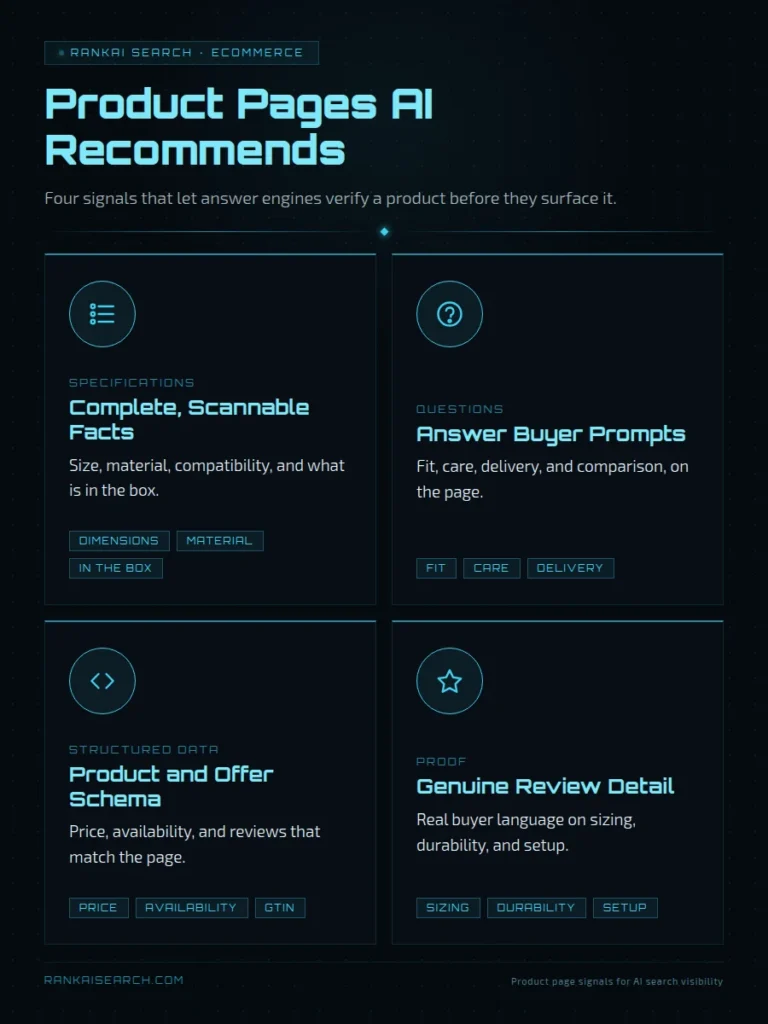
AI systems recommend what they can verify. That means complete product facts, clear buyer guidance, current availability, and proof they can trace back to a source. Product pages that supply all four show up in comparison and purchase-focused prompts. Pages that leave gaps get passed over, even when the product is the better fit.
RankAISearch helps e-commerce brands close those gaps across content, structured data, and product signals, giving AI systems stronger reasons to understand, trust, and surface your offers.
Book a consultation and we will review your product pages, identify the signals that are missing, and map out what to fix first.
Frequently Asked Questions About Optimizing Product Pages for AI Search
Can AI search engines recommend products from small ecommerce stores?
Yes, AI search engines can recommend products from small ecommerce stores when the product page is clear, specific, trustworthy, and accessible. Small stores can win narrow prompts that match their product strengths.The page needs enough evidence to support the recommendation. Specs, reviews, schema, images, delivery details, and helpful buyer answers all improve the case.
How detailed should product specifications be?
Product specifications should be detailed enough for a buyer to compare the item with alternatives. Include dimensions, materials, weight, compatibility, capacity, model numbers, care details, and included items where relevant. A simple product does not need unnecessary technical detail. The rule is to include every fact that affects fit, trust, use, price, or purchase confidence.
Do product reviews need schema markup?
Product reviews should use Review or AggregateRating schema when the reviews are visible on the page and follow platform guidelines. Schema helps machines connect ratings and reviews to the correct product. Review schema should match the visible review content. Fake, hidden, or mismatched ratings can create trust and compliance problems.
Should product descriptions be different from manufacturer copy?
Yes, product descriptions should be different from generic manufacturer copy. Original descriptions can answer customer questions, explain use cases, and add store-specific buying guidance. Manufacturer copy is often duplicated across many retailers. Unique product content helps the page provide value beyond the same shared description.
How should out-of-stock products be handled?
Out-of-stock products should show clear availability, expected restock timing where possible, and relevant alternatives. The page should not pretend the product is available. Keep useful out-of-stock pages live when they have search value, reviews, or restock demand. Add alternatives and back-in-stock options to preserve user value.
Can AI understand products with multiple sizes or colors?
Yes, AI can understand products with multiple sizes or colors when variants are organized clearly. Each variant should have accurate attributes, images, SKU, price, and availability. Use consistent variant naming. If variants have separate URLs, keep canonical, internal link, feed, and schema signals aligned.
Do product comparison pages help AI search visibility?
Yes, product comparison pages can help AI search visibility when they provide fair, factual buying guidance. They answer prompts where shoppers ask which product is better for a specific need. A comparison page should include specs, strengths, limitations, use cases, pricing, and review context. Avoid unsupported claims against competitors.
How often should ecommerce product pages be updated?
Ecommerce product pages should be updated whenever price, availability, specs, images, variants, reviews, delivery details, or product status changes. High-value pages should also be reviewed on a regular schedule. Fast-changing categories need more frequent checks. Seasonal items, electronics, apparel, and products with frequent promotions need tighter data maintenance.