


How to Create an AI-Optimized FAQ Strategy That Answer Engines Recommend
A potential customer opens ChatGPT and types a question your business answers better than anyone. The platform replies in a few sentences, names three sources, and never mentions you. Your FAQ page held the perfect answer, but it was buried in prose the AI could not extract, so a competitor with cleaner structure got cited instead. An AI-optimized FAQ strategy fixes this by formatting your answers so answer engines can lift them, trust them, and recommend them directly to users.
This guide covers how answer engines process FAQ content, how to phrase questions and write answers AI platforms cite, how to implement schema, and how to maintain visibility as search behavior keeps shifting.
Why does FAQ optimization matter for AI answer engines?
FAQ optimization matters because the question-and-answer format maps directly onto how AI systems extract and present information. Answer engines reply in conversational sentences, and FAQ content already exists in that shape.
The traffic at stake is no longer marginal. AI-referred sessions rose 527% in 2025, and those visitors convert at higher rates than traditional organic traffic (Source: Averi, 2026). Three forces make FAQs the strongest format for capturing this shift:
- Conversational alignment: Around 80% of voice and assistant queries are phrased in natural, question-like language rather than keyword fragments.
- Extraction efficiency: Question-answer pairs require minimal processing for an AI system to verify and quote.
- Citation density: FAQ blocks with self-contained answers appear in AI responses at roughly 3x the rate of non-FAQ sections.
Being cited inside an AI-generated answer is now more valuable than ranking in a traditional blue-link result. The FAQ is the cleanest unit of content an answer engine can lift and trust.
How do AI answer engines process FAQ content differently?
Answer engines process FAQ content through semantic understanding, not keyword matching. A large language model reads the intent behind a question, evaluates whether the answer is complete, and decides whether the response genuinely resolves the query before citing it.
This shift changes what wins. Traditional search rewarded exact-match terms. AI search rewards meaning, coherence, and informativeness. Keyword stuffing now actively suppresses visibility because answer engines flag unnatural text as low quality.
The platforms also weigh trust signals before recommending an answer:
| Trust signal | What answer engines check | How to satisfy it |
| Specificity | Concrete figures, examples, or steps versus vague claims | Replace “results vary” with named figures and ranges |
| Comprehensiveness | Whether the answer covers likely follow-ups | Address the core question plus the obvious next one |
| Consistency | Whether facts match across your site and external sources | Keep statistics and claims uniform sitewide |
| Authority | Citations to credible sources and demonstrated expertise | Attribute data inline and link to the original report |
Answer engines cross-reference information across sources, so factual contradictions reduce recommendation frequency. One inconsistent answer lowers trust in the whole page.
How should you phrase FAQ questions to match user intent?
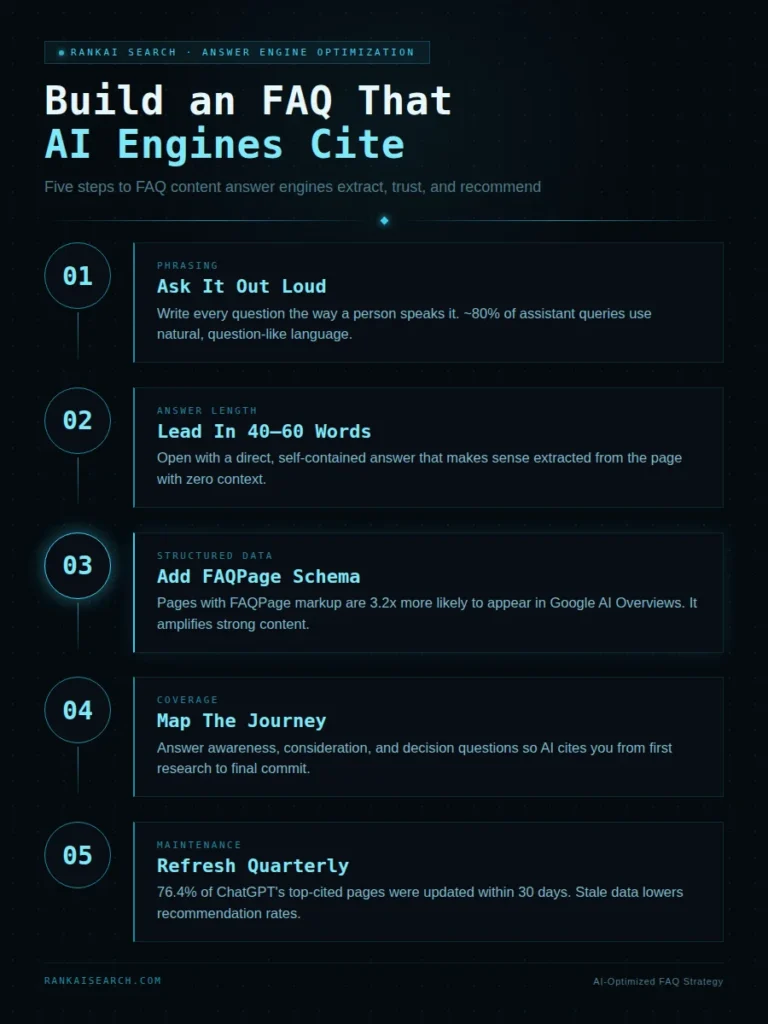
Phrase every FAQ question the way a real person would speak it out loud. Natural, conversational phrasing matches the query patterns answer engines recognize, while robotic labels do not.
Around 70% of voice searches use natural conversational language, and voice queries run roughly 10% longer than typed ones (Source: Marketing LTB, 2026). Your question phrasing has to absorb that length and rhythm.
| Robotic phrasing | Conversational phrasing |
| Product Return Policy Information | How do I return a product if I’m not satisfied? |
| FAQ Schema Implementation | How do I add FAQ schema markup to my website? |
| AI Optimization Service Selection Criteria | What should I consider when choosing an AI optimization service? |
Build questions around the openers users actually speak. These patterns signal genuine queries to answer engines:
- “How do I…” for process and implementation questions
- “What’s the difference between…” for comparison queries
- “Why should I…” for justification and decision queries
- “When is the best time to…” for timing and sequencing queries
Source real questions instead of inventing them. Customer support tickets, chat logs, review sites, and social conversations carry the exact wording your audience uses, which is the wording answer engines match against.
How long should FAQ answers be to get cited?
Lead with a direct answer of 40 to 60 words, then add supporting context up to roughly 150 words total. The opening block must make complete sense when extracted from the page and dropped into an AI response with zero surrounding context.
Self-contained answers with statistics earn the most citations. Content with one hyperlinked statistic per 150 to 200 words consistently outperforms lower-density content in AI citation frequency (Source: Averi, 2026). Match the length to the question rather than forcing a uniform count:
- Simple factual questions: 50 to 75 words. State the fact and stop.
- Standard questions: 75 to 150 words. Answer, add context, give one actionable detail.
- Complex process questions: 150 to 200 words, or split into multiple linked FAQ items.
Context turns a fact into a citable answer. Do not only state that schema helps AI platforms; explain that FAQ schema provides structured data identifying each question and answer, which lets engines like Google AI Overviews extract and display your content with confidence.
How do you implement FAQ schema markup correctly?
Implement FAQPage schema using JSON-LD that explicitly pairs each question with its full answer text. The markup removes ambiguity, telling answer engines exactly which text is a question and which is its answer rather than forcing them to guess from page structure.
Schema effectiveness is real but conditional. Pages with FAQPage markup are 3.2x more likely to appear in Google AI Overviews, and one ChatGPT retrieval study found JSON-LD pages cited at 38.5% versus 32.0% without it (Source: Frase, 2025). The caveat: schema amplifies content that is already strong. It cannot rescue thin or vague answers.
Avoid the three errors that break extraction:
- Incomplete markup that tags only some FAQ items on the page
- Improper nesting of schema elements that confuses parsers
- False FAQ markup applied to content that is not actually a question-answer format
Validate every implementation with a structured-data testing tool before publishing. Only about 12.4% of domains use structured data, so correct implementation is a direct competitive advantage rather than table stakes.
How do you map FAQs to the customer journey?
Map FAQs to the three stages buyers move through, because answer engines surface different question types at different points in a research path. Each stage needs its own phrasing and depth.
A complete FAQ strategy covers all three stages so AI platforms can recommend your content from first research to final decision:
| Stage | Question type | Example | Goal |
| Awareness | Definitional, “what is” | What is answer engine optimization? | Introduce the topic to newcomers |
| Consideration | Comparative, “how does X compare” | How does AEO differ from traditional SEO? | Demonstrate depth of expertise |
| Decision | Objection-handling, “how much / how long” | How long does an AEO project take? | Remove final barriers to action |
Decision-stage FAQs deliver the highest business value. When an answer engine optimization effort gets your pricing, timeline, or guarantee answer recommended, the user is usually close to committing, which makes that citation more valuable than a top-of-funnel one.
How do you find gaps in competitor FAQ coverage?
Find gaps by auditing competitor FAQ sections for questions users clearly have but no competitor answers thoroughly. These unanswered questions are the openings answer engines reward, since AI platforms favor content that reduces the need to search elsewhere.
Cross-reference multiple sources to confirm a real gap rather than a guess:
- Keyword tools that surface question-based queries and their volume
- Social listening that captures concerns users discuss but rarely ask directly
- Review analysis that reveals recurring complaints and confusion points
Then out-answer the gap. If every competitor handles a question in one paragraph, write the version that covers follow-ups, adds an example, and gives actionable guidance. Comprehensive coverage earns higher recommendation rates than surface-level answers.
What technical factors affect FAQ visibility in answer engines?
Technical performance directly affects whether answer engines recommend your FAQ content, regardless of how well the answers are written. A strong answer on a slow, poorly structured page underperforms a good answer on a fast, clean one.
Four technical factors carry the most weight:
- Header hierarchy: One H1, FAQ questions as H2, sub-questions as H3, so crawlers can map question relationships.
- Core Web Vitals: Strong Largest Contentful Paint, interactivity, and layout stability scores, especially on mobile.
- Internal linking: Descriptive anchor text connecting related FAQs and supporting articles to reinforce topical authority.
- Anchor links: Jump links to individual question-answer pairs so engines can send users straight to the relevant answer.
Mobile performance is non-negotiable. Most answer-engine interactions happen on mobile, and pages that load slowly on mobile connections get deprioritized. Compress images, cut unnecessary scripts, and confirm your FAQ content renders quickly on slower networks.
What FAQ optimization mistakes reduce AI visibility?
The mistakes that most often suppress AI visibility are technical errors, thin content, and stale information. Each one signals low quality to answer engines and lowers your recommendation frequency.
| Mistake | Why it hurts | Fix |
| Keyword stuffing | Flags content as low quality to AI parsers | Write for humans first, add terms naturally |
| Insufficient depth | Forces users to search elsewhere | Cover the core question plus follow-ups |
| Overly promotional answers | Reads as marketing, not help | Lead with genuine value, not selling |
| Broken internal links | Signals unreliability | Audit links on a regular schedule |
| Outdated statistics | Reduces perceived authority | Refresh data and add timestamps |
| Ignoring long-tail questions | Misses low-competition citations | Answer specific, detailed queries |
Freshness is a measurable ranking factor. One analysis found that 76.4% of ChatGPT’s top-cited pages were updated within the prior 30 days (Source: Averi, 2026). Review FAQ content at least quarterly, update individual answers the moment a fact changes, and add new questions as customer inquiries and industry trends emerge.
Frequently Asked Questions (FAQs)
How do AI answer engines decide which FAQ content to recommend?
AI answer engines weigh relevance, answer completeness, authority, and structural clarity. They check whether your FAQ addresses the query in natural language with specific, actionable detail. Technical factors count too: schema, page speed, mobile optimization, and factual consistency all influence citation.
What is the ideal length for FAQ answers to maximize AI visibility?
Lead with a 40 to 60 word direct answer, then extend to roughly 150 words for standard questions. Simple factual questions can run 50 to 75 words. Match length to complexity, not a fixed target, since answer engines prioritize completeness over word count.
Should every page on my website have an FAQ section?
No. Add FAQ sections only where users naturally have questions, such as product pages, service pages, and complex topic explanations. Keep a central FAQ hub for general business questions, and avoid forcing FAQs onto pages where they do not fit, since that hurts user experience and AI platform trust.
Can FAQ schema markup alone improve my visibility on AI platforms?
No. Schema markup helps answer engines extract your content accurately, but answer quality and depth matter most. Schema amplifies strong content rather than fixing weak content, so pair correct markup with comprehensive answers, good page speed, and topical authority.
How often should I update my FAQ content?
Review FAQ content at least quarterly, and more often in fast-moving industries. Update individual answers immediately when a statistic, process, or referenced tool changes, and add new questions continuously as customer inquiries shift. Answer engines favor current, accurate information and demote stale content.
What types of questions work best for voice and AI assistant optimization?
Natural, conversational questions that mirror real speech perform best. Favor openers like who, what, where, when, why, and how over keyword fragments. Long-tail questions covering specific scenarios also perform well, so use everyday language unless your audience genuinely speaks in technical terms.
How do I measure whether my FAQs are being recommended by answer engines?
Search your FAQ questions directly on ChatGPT, Google AI Overviews, and Perplexity to see if your content appears, and set alerts for your brand name combined with key topics. Watch analytics for patterns too: increases in direct traffic, branded search, and FAQ-page engagement often correlate with AI citations, and specialized AEO tools now track this directly.
Should I create separate FAQ pages or embed FAQs within content?
Use both. Maintain a comprehensive FAQ hub for general business questions, then embed topic-specific FAQs on relevant pages. This distribution matches queries to the most relevant content: product pages get product FAQs, service pages get service FAQs, and articles get follow-up FAQs about that topic.