


How Should a SaaS Company Approach AI Search Optimization?
Your SaaS product may solve the right problem but still be missing from AI-generated shortlists. The issue may be unclear category content, thin integration pages, weak comparison pages, or outdated third-party profiles. A SaaS company should approach AI search optimization by making its product easier to evaluate from every trusted source.
AI tools need more than a homepage and feature list. They need clear answers about use cases, pricing logic, integrations, implementation, limitations, and proof. This guide explains how SaaS companies can build stronger visibility across AI search and generative answer engines.
How Should a SaaS Company Approach AI Search Optimization?
A SaaS company should approach AI search optimization by owning its category’s questions: publish clear comparison content, answer use-case and integration queries directly, keep documentation crawlable, and build third-party authority. AI engines favor SaaS sources that explain trade-offs honestly.
SaaS buyers use AI tools to compress research, compare options, and create shortlists before they speak with sales. G2’s 2026 buyer research reported that 8 out of 10 buyers had sourced software recommendations from tools like ChatGPT or Google AI Mode in the previous two years. (Source: G2, 2026)
AI search optimization for SaaS should focus on the full buying journey. A buyer may ask about the best tools, integrations, pricing models, onboarding time, security needs, feature trade-offs, and alternatives before they ever visit a vendor site.
SaaS AI visibility depends on clarity and evidence. The strongest pages explain who the product is for, what problem it solves, how it integrates, where it falls short, and why buyers trust it.
| SaaS AI Search Priority | What To Build | Why It Helps |
|---|---|---|
| Category ownership | Definitions, guides, frameworks, and benchmarks | Helps AI connect the brand to the category |
| Use-case answers | Role, industry, and workflow pages | Matches specific buyer prompts |
| Comparison content | Alternative, versus, and shortlist pages | Supports evaluation queries |
| Integration content | Integration pages and setup docs | Matches tool-stack questions |
| Documentation access | Crawlable help docs and product guides | Gives AI accurate technical context |
| Customer evidence | Case studies, reviews, and outcomes | Supports recommendation trust |
| Third-party authority | Review sites, analyst mentions, partner pages | Validates brand claims |
Which SaaS Buyer Questions Should Your Content Answer?
Your SaaS content should answer buyer questions about use cases, features, integrations, pricing, implementation, security, alternatives, limitations, proof, and fit. These questions shape whether AI systems can recommend your software for a specific situation.
SaaS buyers rarely ask only one generic category question. They ask layered questions such as “best CRM for a small B2B team,” “project management software that integrates with Slack,” or “HubSpot alternative for agencies.”
SaaS pages should map to real evaluation stages. A buyer needs different answers when learning a category, building a shortlist, validating ROI, checking integrations, and preparing for procurement.
| Buyer Question Type | Example SaaS Prompt | Content To Create |
|---|---|---|
| Category fit | “What is the best tool for customer onboarding?” | Category guide |
| Use case | “Best CRM for agencies” | Use-case page |
| Integration | “Which tools integrate with Slack and Salesforce?” | Integration page |
| Comparison | “Tool A vs Tool B” | Comparison page |
| Alternative | “Best alternatives to [competitor]” | Alternative page |
| Pricing | “How much does [category] software cost?” | Pricing guide |
| Security | “Is this software SOC 2 compliant?” | Security page |
| Proof | “Which tool has case studies for enterprise teams?” | Case study hub |
How Can You Build Authority Around Your Software Category?
You build authority around your software category by publishing complete, accurate, and useful content that explains the problem, buyer options, evaluation criteria, and trade-offs. AI systems need repeated evidence that your brand understands the category beyond its own product.
Category authority is not built from one definition page. It comes from a connected content system that covers the main problems, workflows, buyer roles, integrations, competitors, objections, and proof points.
A SaaS company should explain the category in buyer language. Buyers search for outcomes and workflows more often than they search for internal product terminology.
| Authority Asset | What It Proves |
|---|---|
| Category guide | The brand understands the market |
| Buyer checklist | The brand knows evaluation criteria |
| Comparison page | The brand can explain trade-offs |
| Integration hub | The product fits real stacks |
| Security page | The product can pass risk review |
| Case study hub | Customers achieve outcomes |
| Research report | The brand contributes original insight |
| Glossary | The brand defines category language clearly |
Category authority should be connected with internal links. AI systems and crawlers need to see how definitions, use cases, comparisons, documentation, and customer proof relate to one another.
What Types of SaaS Content Are Most Useful to AI Engines?
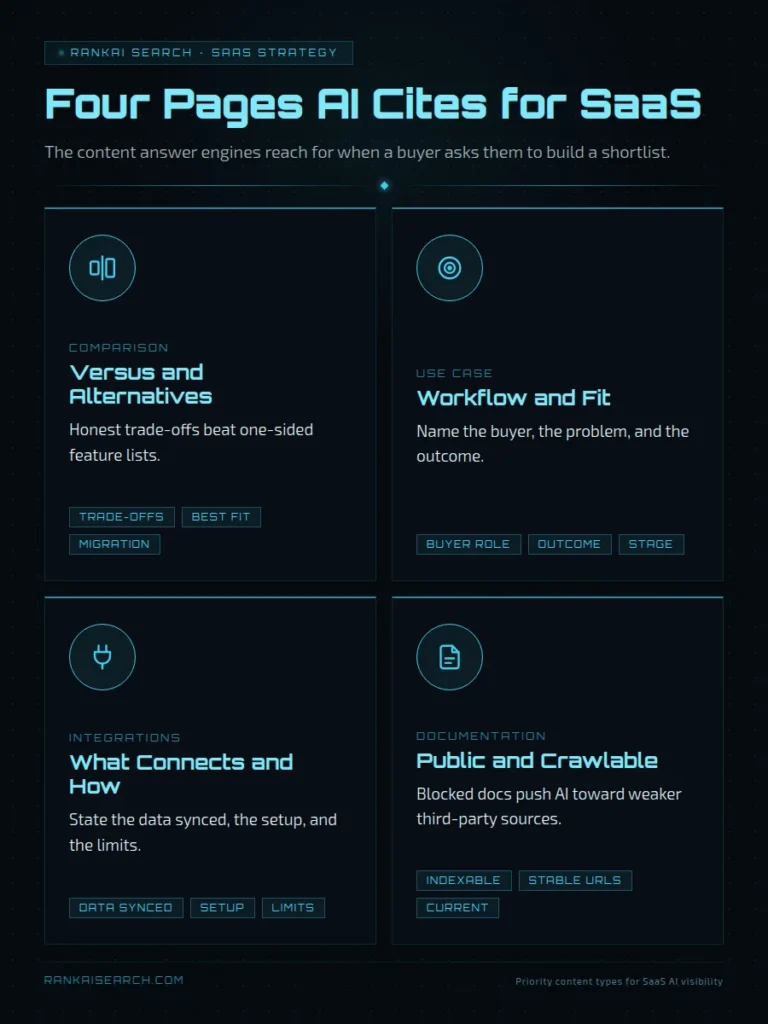
The most useful SaaS content for AI engines includes comparison pages, alternative pages, use-case pages, integration content, product documentation, help resources, security pages, case studies, and pricing explainers. These pages answer the commercial questions buyers ask during software evaluation.
AI engines often surface pages that explain differences clearly. A SaaS brand that avoids all trade-offs gives AI systems less useful material than a brand that states best-fit and not-best-fit scenarios honestly.
The most useful SaaS content is specific. A page about “project management software” is weaker than a page about “project management software for agencies managing client approvals.”
| SaaS Content Type | AI Search Role | Buyer Value |
|---|---|---|
| Comparison page | Explains trade-offs | Supports shortlist decisions |
| Alternative page | Captures competitor-intent prompts | Helps buyers find substitutes |
| Use-case page | Matches workflow-specific needs | Shows product fit |
| Integration page | Connects product to tech stack | Reduces compatibility risk |
| Documentation | Provides technical accuracy | Helps implementation research |
| Case study | Shows measurable proof | Reduces buying risk |
| Pricing guide | Explains cost structure | Helps budget planning |
| Security page | Supports procurement review | Helps enterprise validation |
These content types should work together. Comparison pages should link to use cases, use cases should link to integrations, and integrations should link to documentation.
Comparison and Alternative Pages
Comparison and alternative pages explain how your SaaS product differs from competitors and substitutes. They help AI systems answer buyer prompts that include “best,” “versus,” “alternative,” “competitor,” or “compare.”
A strong comparison page should not pretend every buyer is a perfect fit. It should explain where your product wins, where a competitor may fit better, and which buyer profile should choose each option.
| Page Type | Best Use |
|---|---|
| “A vs B” page | Direct competitor comparison |
| “Alternatives to X” page | Competitor replacement intent |
| “Best tools for X” page | Category shortlist intent |
| “X for Y teams” page | Segment-specific comparison |
| “Free vs paid” page | Pricing and feature trade-off |
| “Enterprise vs SMB” page | Buying context difference |
Use-Case and Integration Content
Use-case and integration content explains how the product fits a real workflow or software stack. These pages help AI systems match the product to specific buyer prompts.
A use-case page should describe the workflow, buyer role, problem, required features, integration needs, and measurable outcome. An integration page should explain what connects, what data syncs, what setup requires, and what limits exist.
| Content Type | Example |
|---|---|
| Role use case | CRM for sales operations teams |
| Industry use case | Compliance software for healthcare companies |
| Workflow use case | Customer onboarding automation |
| Integration page | Slack integration for support alerts |
| Stack page | CRM and marketing automation stack |
| API page | Developer integration documentation |
Product Documentation and Help Resources
Product documentation and help resources give AI systems the most accurate view of how the software works. They support technical prompts about setup, features, limits, integrations, permissions, and troubleshooting.
Documentation should be crawlable when it is meant for public discovery. If docs are blocked, gated, or hidden behind heavy JavaScript, AI systems may rely on weaker third-party explanations.
| Documentation Asset | AI Value |
|---|---|
| Setup guide | Explains implementation steps |
| API docs | Supports developer prompts |
| Integration docs | Clarifies stack compatibility |
| Feature docs | Explains product functionality |
| Permissions docs | Supports admin evaluation |
| Troubleshooting docs | Answers support-style queries |
| Changelog | Shows product freshness |
How Should You Explain Product Features and Limitations?
You should explain product features and limitations in plain language that connects each feature to a buyer problem, workflow, outcome, and boundary. AI systems need feature explanations that are specific enough to summarize and compare.
A feature page should not be a list of product labels. It should explain what the feature does, who uses it, when it matters, what it connects to, and what it does not cover.
Limitations should be visible because they reduce buyer mismatch. AI systems can recommend a product more safely when the product’s boundaries are clear.
| Feature Explanation Element | What To Include |
|---|---|
| Feature name | Clear product term |
| Buyer problem | The task or pain point it solves |
| Workflow context | Where it fits in daily use |
| Required setup | Permissions, data, or integrations needed |
| Outcome | What improves after use |
| Limitation | What the feature does not do |
| Plan availability | Which plans include it |
| Related docs | Setup or API reference |
How Can You Make SaaS Documentation Easier for AI to Access?
You make SaaS documentation easier for AI to access by keeping public docs crawlable, indexable, well-linked, fast, text-readable, and organized around clear tasks. AI systems need documentation they can retrieve and interpret accurately.
Documentation often contains the most reliable product details. If AI systems cannot access it, they may answer technical questions from outdated blog posts, third-party tutorials, or competitor comparisons.
Google says generative AI features on Search use publicly accessible, crawlable content to learn patterns and provide relevant grounded responses. This makes public documentation access a technical AI search requirement. (Source: Google Search Central, 2026)
Documentation should use simple HTML, direct headings, stable URLs, and current update dates. Complex rendering, blocked assets, authentication walls, and poor internal search can weaken retrieval.
| Documentation Requirement | Why It Matters |
|---|---|
| Crawlable pages | Lets search systems access the docs |
| Indexable URLs | Allows discovery through search-based retrieval |
| Stable URL structure | Preserves citations and links |
| Clear headings | Helps passage extraction |
| Plain text instructions | Reduces rendering issues |
| Internal links | Connects related docs |
| Changelog | Shows product freshness |
| Version labels | Prevents old-version confusion |
Documentation should also separate public and private content. Public docs can support AI discovery, while account-specific or security-sensitive content should stay protected.
Why Do Integration Pages Matter for AI Search Visibility?
Integration pages matter because SaaS buyers often evaluate software by whether it fits their existing stack. AI systems need clear integration pages to answer prompts that combine categories, workflows, and tools.
An integration page should explain more than “we integrate with X.” It should state what data syncs, what triggers actions, what setup requires, what plan includes it, and what limitations apply.
Integration content also supports partner visibility. A strong integration page can be cited by AI tools, partner directories, marketplace pages, and developer docs.
| Integration Page Element | What It Answers |
|---|---|
| Integration summary | What the connection does |
| Data flow | What syncs between tools |
| Setup steps | How to connect the tools |
| Requirements | Plan, permissions, API keys, or admin access |
| Use cases | Why teams use the integration |
| Limitations | What does not sync |
| Security notes | How data is handled |
| Related docs | Detailed setup or API reference |
Integration pages should be grouped by category. Buyers often ask for “CRM integrations,” “Slack integrations,” “analytics integrations,” or “marketing automation integrations.”
How Can Customer Evidence Support SaaS Recommendations?
Customer evidence supports SaaS recommendations by proving that real users achieved measurable outcomes with the software. AI systems can use customer proof to support claims about fit, performance, trust, and adoption.
SaaS buyers need evidence because software claims are easy to make and harder to validate. Case studies, reviews, ratings, testimonials, analyst mentions, and partner proof help reduce uncertainty.
Customer proof should be tied to use cases. A generic quote is weaker than a case study showing the customer type, problem, implementation path, and measurable result.
| Evidence Type | What It Supports |
|---|---|
| Case study | Outcome and business value |
| Review platform | Independent customer sentiment |
| Testimonial | Customer trust |
| Analyst mention | Market validation |
| Logo proof | Adoption credibility |
| Usage benchmark | Product performance |
| Security certification | Procurement confidence |
| Partner proof | Ecosystem validation |
Case Studies and Measurable Outcomes
Case studies and measurable outcomes show what changed after a customer used the software. They help AI systems connect the product to specific results.
A strong case study should identify the customer segment, challenge, product use, timeline, and measurable result. It should also explain the workflow in enough detail to support buyer prompts.
| Case Study Element | Strong Example |
|---|---|
| Customer type | Mid-market SaaS company |
| Problem | Slow onboarding handoffs |
| Product use | Automated customer success workflows |
| Timeline | 90-day rollout |
| Result | 32% faster onboarding completion |
| Proof | Customer quote and metric source |
Reviews and Independent Validation
Reviews and independent validation show how customers describe the software outside the vendor’s own website. These sources can support AI recommendations because they provide third-party evidence.
| Validation Source | Why It Matters |
|---|---|
| G2 | Peer reviews and category comparison |
| Capterra | Software discovery and ratings |
| TrustRadius | Detailed B2B reviews |
| Gartner Digital Markets | Software buyer research ecosystem |
| Partner marketplace | Integration credibility |
| App stores | User experience feedback |
| Analyst content | Market-level validation |
How Should You Position Your SaaS Against Competitors?
You should position your SaaS against competitors by explaining best-fit buyers, trade-offs, strengths, limitations, integrations, pricing logic, and migration paths. Honest positioning gives AI systems a safer and more useful comparison source.
Competitor content should be factual, not attack-driven. AI tools can use comparison pages more confidently when claims are specific, fair, and supported.
A SaaS company should not position itself as best for every buyer. Clear exclusions help AI systems understand when not to recommend the product.
| Positioning Element | What To Explain |
|---|---|
| Best-fit customer | Team size, role, industry, or use case |
| Core strength | Where the product clearly wins |
| Limitation | Where another option may fit better |
| Pricing logic | Why the product costs what it costs |
| Integration fit | Which stacks it supports |
| Migration path | How buyers switch from another tool |
| Proof | Case study, review, benchmark, or certification |
| Decision guide | Who should choose which option |
Comparison pages should include direct answers. A buyer should not need to read 2,000 words before understanding the difference.
How Can You Strengthen Your SaaS Brand Across Third-Party Sources?
You can strengthen your SaaS brand across third-party sources by keeping review profiles, partner pages, analyst listings, app marketplaces, directories, social profiles, and integration marketplaces accurate. AI systems can use third-party sources to validate or challenge your own claims.
A SaaS website is only one source in the AI search ecosystem. AI tools may cite G2, Capterra, Product Hunt, marketplace listings, documentation mirrors, partner pages, Reddit, analyst content, or customer blogs.
Google’s guidance on creating helpful content emphasizes experience, expertise, authoritativeness, and trust as useful considerations for evaluating content quality. (Source: Google Search Central, 2026)
Third-party consistency matters because AI systems compare source trails. If your site says one thing and review platforms, partner listings, or directories say another, the brand becomes harder to summarize accurately.
| Third-Party Source | What To Maintain |
|---|---|
| Review profiles | Category, description, screenshots, and reviews |
| Integration marketplaces | Setup details and compatibility |
| Partner pages | Accurate joint solution descriptions |
| App stores | Product naming and feature summaries |
| Analyst listings | Category and product descriptions |
| Customer blogs | Correct use case and results |
| Social profiles | Brand name, URL, and positioning |
| Developer communities | Technical clarity and support quality |
Third-party source cleanup should be part of SaaS AI optimization. Update old descriptions, broken screenshots, outdated categories, and retired feature claims.
How Should Product-Led and Editorial Content Work Together?
Product-led and editorial content should work together by connecting category education to product proof, use cases, integrations, documentation, and conversion pages. Editorial content should create understanding, while product-led content should prove fit.
A SaaS blog that never links to product pages leaves AI systems with category context but weak product connection. A product site with no educational content may fail to answer early-stage research prompts.
The best SaaS content architecture shows the path from problem to product. A buyer can move from category guide to use-case page, then to integration docs, comparison content, and a demo or trial page.
| Content Layer | Role |
|---|---|
| Editorial guide | Explains the problem and category |
| Use-case page | Shows product fit for a workflow |
| Feature page | Explains product capability |
| Integration page | Shows stack compatibility |
| Documentation | Gives technical detail |
| Case study | Proves outcome |
| Comparison page | Supports evaluation |
| Pricing page | Supports budget decision |
Product-led content should still answer first. A page that only promotes the product without explaining the buyer’s question is less useful for AI search.
How Can You Measure AI Search Performance for a SaaS Brand?
You can measure AI search performance for a SaaS brand by tracking brand mentions, citations, share of voice, sentiment accuracy, prompt coverage, referral traffic, and conversion quality across AI tools. Measurement should show both visibility and business impact.
SaaS AI performance is not captured by rankings alone. A brand can appear in an AI answer without earning a click, or it can be cited from a third-party source that shapes the buyer before the visit.
Prompt tracking should reflect the buying journey. Measure category prompts, competitor prompts, integration prompts, pricing prompts, security prompts, and use-case prompts separately.
| AI Search Metric | What It Measures | Why It Matters |
|---|---|---|
| Brand mentions | How often AI names the SaaS brand | Shows visibility |
| Citations | Which sources AI links or references | Shows source influence |
| AI share of voice | Brand presence versus competitors | Shows competitive strength |
| Sentiment accuracy | Whether descriptions are correct | Protects brand trust |
| Prompt coverage | Which buyer prompts surface the brand | Shows content gaps |
| Referral traffic | Visits from AI tools where available | Shows demand movement |
| Conversion quality | Trials, demos, signups, or pipeline | Shows business impact |
| Source freshness | Whether AI cites current pages | Protects accuracy |
Measurement should combine manual testing and analytics. AI tools change answers, so repeated prompt testing is more useful than one screenshot.
Which Mistakes Can Weaken a SaaS AI Search Strategy?
SaaS AI search strategies fail when content is vague, documentation is blocked, comparison pages are biased, integration pages are thin, third-party profiles are outdated, and measurement is limited to traffic. These mistakes make the brand harder to cite or recommend.
The biggest mistake is writing only for branded demand. AI tools often answer category and competitor prompts before the buyer knows which vendor to search.
A SaaS company should avoid hiding important answers behind forms. Gated PDFs can help lead generation, but they provide less value to AI systems than crawlable pages that answer buyer questions directly.
| Mistake | Why It Weakens AI Visibility |
|---|---|
| Thin comparison pages | Gives AI little useful trade-off detail |
| Blocked documentation | Forces AI to rely on weaker sources |
| Vague use-case pages | Fails to match specific prompts |
| Outdated review profiles | Creates inconsistent source data |
| Overpromised feature claims | Reduces trust |
| No integration detail | Misses stack-based prompts |
| No customer proof | Weakens recommendation confidence |
| Traffic-only measurement | Misses zero-click AI influence |
Fix the most visible gaps first. Prioritize pages and sources that already appear in AI answers or competitor citations.
What Should SaaS Companies Remember About AI Search Optimization?
SaaS companies should remember that AI search optimization is a category, content, documentation, and authority strategy. The goal is to make the product easier for AI systems to understand, compare, validate, and recommend.
| Principle | Practical Action |
|---|---|
| Own category questions | Publish definitions, guides, and frameworks |
| Answer use cases | Create role, industry, and workflow pages |
| Explain comparisons | Build honest versus and alternative pages |
| Make docs crawlable | Keep public docs accessible and current |
| Show integrations | Publish detailed integration pages |
| Prove outcomes | Add case studies and review validation |
| Track AI visibility | Measure prompts, mentions, citations, and sentiment |
SaaS AI search optimization should be maintained as the product changes. New features, pricing changes, integrations, security updates, and customer proof should flow into the content system.
Building a Winning AI Search Strategy for Your SaaS Brand
SaaS visibility in AI answers depends on more than publishing feature pages. Clear use-case content, honest comparisons, accessible documentation, detailed integration pages, and measurable customer proof help AI tools understand where your product fits and why buyers should consider it.
RankAISearch can identify gaps across your category content, product documentation, third-party profiles, and buyer journey. Bringing these assets into one connected strategy gives AI systems stronger evidence when comparing, citing, and recommending your SaaS brand.
Plan your next steps with RankAISearch to prioritize the content and authority improvements that can strengthen your visibility across AI search platforms.
Frequently Asked Questions About AI Search Optimization for SaaS Companies
What does GEO mean for SaaS companies?
GEO means generative engine optimization, which improves how SaaS brands appear in AI-generated answers. For SaaS companies, GEO focuses on category ownership, buyer prompts, comparison content, integration pages, documentation, and customer proof. GEO does not replace SEO. It builds on search fundamentals and adapts them to AI answer engines.
Which SaaS pages are most likely to appear in AI answers?
Comparison pages, alternative pages, use-case pages, integration pages, product documentation, review profiles, and case studies are often the strongest candidates. These pages answer the questions buyers ask during software evaluation. The best pages are clear and specific. A page that explains trade-offs directly is easier for AI tools to cite than a generic product page.
Should SaaS companies create competitor comparison pages?
Yes, SaaS companies should create competitor comparison pages when they can do it honestly and factually. These pages match high-intent buyer prompts and can help AI systems understand product differences. A comparison page should include strengths, limitations, fit, pricing logic, integrations, and proof. Unsupported claims can weaken trust.
Can gated content support AI search visibility?
Gated content is weak for AI search visibility because AI systems usually need crawlable, accessible content to retrieve and cite. A gated report can support demand generation, but it should not contain the only answer to an important buyer question. A better model is to publish a crawlable summary page. Keep the full report gated only when lead capture is necessary.
How important are software review platforms for AI recommendations?
Software review platforms are important because they provide third-party validation and buyer language. AI systems can use review platforms to understand sentiment, category placement, comparisons, and customer proof. G2, Capterra, TrustRadius, Gartner Digital Markets, and other category sources can influence how buyers and AI tools evaluate SaaS brands. Keep profiles accurate and current.
Should integration documentation be indexed by search engines?
Integration documentation should be indexed when it is public, safe, and useful for buyer or developer research. Indexed docs can help AI tools answer compatibility and setup questions accurately. Private, security-sensitive, or account-specific docs should stay protected. Public documentation should be crawlable, current, and clearly structured.
How can a SaaS company track mentions across AI tools?
A SaaS company can track mentions by testing repeatable prompts across ChatGPT, Gemini, Perplexity, Copilot, Claude, and Google AI experiences. Record whether the brand appears, which competitors appear, and which sources are cited. Tracking should include category, competitor, integration, pricing, security, and use-case prompts. Monthly testing is a practical starting point.
How long does it take for a SaaS brand to improve its AI visibility?
A SaaS brand can improve AI visibility over months when it publishes stronger content, fixes documentation access, improves third-party sources, and earns customer proof. Some updates may appear faster in retrieval-based AI tools. Competitive categories take longer. AI visibility usually improves when multiple sources start confirming the same strong brand story.