


How Long Should an Article Be to Get Cited by AI Search?
A site owner publishes a 3,000-word guide and expects AI search tools to notice it. The page is long, but the clearest answer is buried under repeated context and broad explanations. Article length can help AI visibility, but only when every section answers a specific question clearly.
AI search tools do not cite an article because it reaches a certain word count. They cite useful passages that are easy to understand, verify, and extract. This guide explains how long an article should be for AI search and how to judge length by intent, completeness, and structure.
How Long Should an Article Be for AI Search?
There is no fixed word count that guarantees AI citation. AI search tools pull short, self-contained passages, not entire articles, so length matters less than whether each section answers one specific question completely. A well-structured 800-word article can get cited more often than a padded 3,000-word one.
Article length should follow the topic’s complexity. A simple definition needs fewer words than a detailed comparison, setup guide, product review, or technical explanation.
Google’s SEO Starter Guide states that content length alone does not matter for ranking and that there is no magical word count target, minimum, or maximum. That same principle applies to AI search because length is useful only when it improves usefulness, clarity, and completeness. (Source: Google Search Central, 2026)
The best target is not a word count. The best target is enough detail to answer the main question, cover necessary subquestions, support claims, and avoid confusing gaps.
| Article Type | Practical Length Range | Why That Range Works |
|---|---|---|
| Simple definition | 600 to 1,000 words | Explains the term and answers basic follow-ups |
| How-to guide | 1,200 to 2,500 words | Covers steps, tools, mistakes, and examples |
| Comparison article | 1,500 to 3,000 words | Explains differences across several criteria |
| Technical guide | 2,000 to 4,000 words | Needs setup details, edge cases, and troubleshooting |
| Original research article | 1,500 to 5,000 words | Needs methodology, findings, and interpretation |
| Local service page | 700 to 1,500 words | Answers location, service, proof, and contact intent |
| Product page | 600 to 1,800 words | Covers features, specs, use cases, and buying details |
Why Is There No Ideal Word Count for AI Citations?
There is no ideal word count for AI citations because AI systems select useful source material, not pages that hit a universal length target. The right length depends on intent, topic depth, evidence needs, and whether the article gives a clear answer.
A short article can be strong when the query is narrow. A long article can be weak when it repeats points, adds unrelated subtopics, or hides the answer below filler.
Google’s helpful content guidance asks site owners to avoid writing to a particular word count because they believe Google has a preferred word count. The guidance focuses on whether content is helpful, reliable, and created for people. (Source: Google Search Central, 2026)
AI search adds another reason to avoid arbitrary length. A generated answer may cite one paragraph, one table, or one section from a page, so the usefulness of each section matters more than the total word count.
| Weak Length Rule | Better Rule |
|---|---|
| “Every article should be 2,000 words.” | Match length to search intent. |
| “Longer always ranks better.” | Longer works only when it adds useful detail. |
| “Short content is thin.” | Short content can work when the question is narrow. |
| “AI cites comprehensive pages only.” | AI can cite a specific passage from any useful page. |
| “Add more words to improve visibility.” | Add missing answers, evidence, examples, or structure. |
A page is too short when it leaves important user questions unanswered. A page is too long when users or AI systems must work through unnecessary text to find the answer.
How Do AI Search Tools Extract Information From Articles?
AI search tools extract information by retrieving pages or source documents, identifying relevant passages, and using those passages to support a generated answer. The cited source is often the page that provides the clearest support for the specific claim being made.
AI systems do not need the full article to be perfect for every possible user. They need the relevant section to be clear, accurate, accessible, and easy to connect to the question.
A section becomes easier to extract when it answers one question directly. The answer should not depend on several unrelated paragraphs scattered across the page.
| Extraction Factor | Why It Matters |
|---|---|
| Clear heading | Signals the section’s question |
| Direct first sentence | Gives the answer immediately |
| Self-contained paragraph | Lets the passage stand alone |
| Evidence near claim | Supports citation confidence |
| Simple structure | Helps systems parse the answer |
| Tables and lists | Clarify comparisons and steps |
| Fresh date or context | Helps time-sensitive answers |
| Consistent terminology | Reduces ambiguity |
AI extraction rewards clarity. A useful 120-word section can be more citable than a 600-word section that never states the answer cleanly.
What Makes a Section Complete Enough to Be Cited?
A section is complete enough to be cited when it answers one specific question, gives necessary context, and supports the answer with evidence, examples, or clear reasoning. The section should make sense even when quoted or summarized outside the full article.
A complete section should not force the reader to search the page for the basic answer. It should state the answer first, then explain why the answer is true.
A 2026 GEO measurement paper found that high-influence cited pages tended to be longer, more structured, and semantically aligned. They also contained more extractable evidence, including definitions, numerical facts, comparisons, and procedural steps. (Source: GEO Citation Lab, 2026)
Completeness does not mean adding every related idea. It means including the details required to satisfy the searcher’s intent for that specific subsection.
| Complete Section Element | What It Does |
|---|---|
| Direct answer | States the core point |
| Context | Explains scope and conditions |
| Evidence | Supports the claim |
| Example | Makes the answer concrete |
| Limitation | Prevents overgeneralization |
| Next step | Shows what to do with the answer |
| Internal link | Connects deeper related content |
| Updated detail | Keeps the answer current |
A Direct Answer
A direct answer is a sentence that resolves the section’s question without delay. It should appear at the start of the section so readers and AI systems can identify the main claim quickly.
The answer should include the subject, action, and condition where needed. A vague opening sentence makes extraction harder because the passage needs more surrounding text to make sense.
| Weak Answer | Stronger Answer |
|---|---|
| “Length is something many people ask about.” | “Article length should match the question’s complexity.” |
| “AI citations are changing content.” | “AI citations usually depend on passage usefulness, not total word count.” |
| “There are many ways to structure an article.” | “A citation-ready section should answer one question before adding examples.” |
Necessary Context and Evidence
Necessary context and evidence explain why the direct answer is true. Context sets the scope, while evidence gives the answer credibility.
Evidence can include a source, statistic, example, table, process, screenshot, methodology, or expert explanation. The best evidence sits near the claim it supports.
| Evidence Type | Best Use |
|---|---|
| Statistic | Supports measurable claims |
| Named source | Builds trust |
| Example | Shows the claim in practice |
| Table | Compares related options |
| Step list | Explains a process |
| Definition | Clarifies technical terms |
| Methodology | Supports original research |
| Screenshot | Shows interface-level proof |
When Does a Longer Article Perform Better?
A longer article performs better when the topic needs depth, multiple subquestions, comparison criteria, procedural steps, examples, and evidence. Length helps when it improves completeness without making the article harder to use.
Longer articles are useful for complex topics because one short answer cannot cover the full decision path. A reader may need background, definitions, trade-offs, examples, mistakes, and next steps.
A 2026 competitive GEO study across 252,000 trials found that topical relevance and list position were the biggest drivers of being cited first, while completeness and trust cues added smaller gains. This supports longer content only when the added material improves relevance and completeness. (Source: Vishwakarma, Kumar, and Jamidar, 2026)
A longer article should be built from complete sections. Each section should earn its place by answering a distinct question.
| Longer Article Works Best When | Why More Detail Helps |
|---|---|
| The topic has many subquestions | Each section can answer one part |
| The reader must compare options | Tables and criteria need space |
| The process has steps | Instructions need order and detail |
| Claims need evidence | Sources and examples need context |
| The decision is high-value | Readers need proof before acting |
| The subject is technical | Terms and edge cases need explanation |
| The page targets multiple intents | Sections can serve different needs |
Long articles should not rely on one long narrative. They should use headings, tables, examples, and concise passages to make the depth usable.
When Is a Shorter Article the Stronger Choice?
A shorter article is stronger when the question is narrow, the answer is simple, and extra detail would distract from the user’s goal. Short content works when it is complete, clear, and specific.
A short article can answer a definition, quick comparison, feature explanation, policy update, or direct how-to question. The article should stop when the user has enough information to understand or act.
Perplexity describes itself as an answer engine that searches the web, identifies trusted sources, and synthesizes information into clear, up-to-date responses. A concise page can support that kind of answer when it gives a clean and trustworthy explanation. (Source: Perplexity Help Center, 2026)
Shorter content becomes weak when it skips important context. The test is not whether the page is short, but whether the user’s next obvious question is still unanswered.
| Short Article Works Best When | What It Should Include |
|---|---|
| The term is simple | Definition and one example |
| The task is quick | Steps and common mistake |
| The answer is factual | Source and date |
| The page supports a larger hub | Internal link to deeper guide |
| The query is narrow | Direct answer and scope |
| The user needs confirmation | Clear explanation and proof |
A short article should still be structured. A 700-word page can use H2s, bullets, tables, and a brief FAQ if those elements help the answer.
How Should Article Length Match Search Intent?
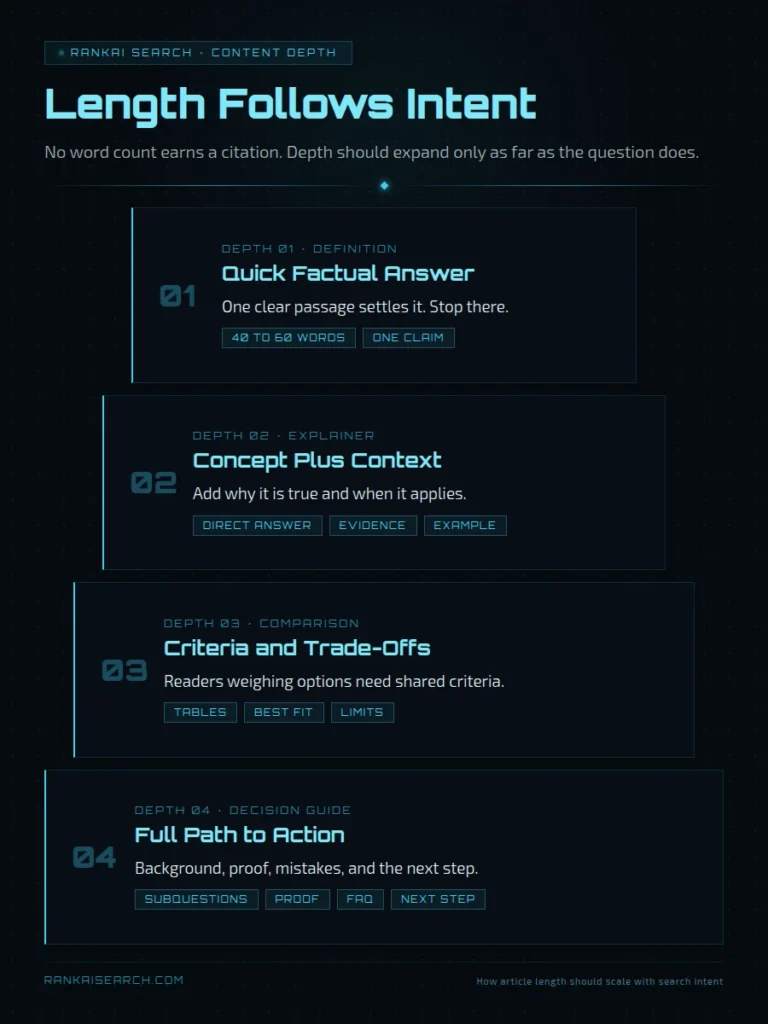
Article length should match search intent by giving the user exactly enough information to complete the task behind the query. A broad research query needs more coverage than a quick factual query.
Search intent is the user’s purpose behind the search. AI search makes intent more visible because prompts often include audience, goal, use case, and constraint.
Google says ranking systems sort through hundreds of billions of webpages and other content to present relevant and useful results for each query. Relevance depends on the match between the page and the user’s need, not the page’s word count alone. (Source: Google Search Central, 2026)
Intent should guide the number of sections. A guide for “what is X” needs definition, examples, benefits, limitations, and FAQs, while “X pricing” needs current pricing details, inclusions, and buying guidance.
| Search Intent | Best Length Approach |
|---|---|
| Definition | Short to medium with examples |
| How-to | Medium to long with steps |
| Comparison | Medium to long with tables |
| Product research | Medium with specs and proof |
| Local service | Medium with location and trust details |
| Troubleshooting | Medium with causes and fixes |
| Technical setup | Long with prerequisites and edge cases |
| Original research | Long with methodology and findings |
Length should expand only when the intent expands. A page should not add history, definitions, or broad background if the user only needs a specific answer.
How Much Detail Should Each Section Include?
Each section should include enough detail to answer the heading fully, explain the condition, and support the claim. Most citation-ready sections need one direct answer, one context paragraph, and one structured element such as a list or table.
A section should answer one question, not several unrelated questions. If a section needs many directions, split it into smaller H2 or H3 subsections.
OpenAI’s ChatGPT Search help says responses can include inline citations that users can hover over and click to see the source. This means a cited page should make the linked source worth opening for deeper detail. (Source: OpenAI Help Center, 2026)
Good section detail should create confidence without bloating the page. The reader should understand the answer and know whether they need to continue.
| Section Component | Practical Target |
|---|---|
| Direct answer | 1 to 2 sentences |
| Context | 1 to 2 short paragraphs |
| Evidence | 1 source, example, or reasoned support |
| Structured element | 1 table or bullet list |
| Edge case | 1 short limitation where needed |
| Next step | 1 practical action where useful |
A section is complete when removing any major part would make the answer less useful. It is bloated when several sentences repeat the same idea.
How Can You Cover a Topic Thoroughly Without Adding Filler?
You can cover a topic thoroughly without adding filler by mapping each section to a real user question and cutting anything that does not answer, explain, prove, compare, or guide. Thoroughness comes from useful coverage, not extra wording.
A thorough article should include all important subtopics. It should not add decorative history, repeated definitions, vague transitions, or paragraphs that only restate the heading.
Google’s guidance on generative AI content warns creators to watch for main content created with little effort, little originality, or little added value. This applies to filler because filler can make a page longer without making it more useful. (Source: Google Search Central, 2026)
A strong outline prevents filler. Every heading should have a reason to exist before drafting begins.
| Filler Type | Replace It With |
|---|---|
| Long historical setup | Current definition or use case |
| Repeated answer | New condition or example |
| Generic benefits | Specific outcome |
| Vague best practices | Concrete step |
| Unsupported claim | Evidence or source |
| Decorative transition | Next useful section |
| Keyword variation paragraph | Intent-matched subsection |
| Broad summary | Practical takeaway |
Use a simple rule during editing. If a paragraph does not help the reader understand or act, cut it.
Why Can Excessive Length Make Content Harder to Use?
Excessive length can make content harder to use because it hides the answer, increases scanning effort, and adds noise around the most useful passages. AI systems and readers both benefit from clear structure and concise sections.
A long article becomes a problem when the length is not organized. The issue is not the number of words alone, but the amount of unnecessary text between the question and the answer.
Excessive length also weakens citation potential when it makes the page less precise. A passage buried under several setup paragraphs is harder to use than a concise answer placed directly under a clear heading.
| Excessive Length Problem | User and AI Impact |
|---|---|
| Buried answers | Readers leave before finding value |
| Repeated points | AI systems find less distinct information |
| Mixed intent | Page becomes harder to classify |
| Long paragraphs | Scanning becomes harder |
| Weak headings | Sections lose meaning |
| Unrelated subtopics | Topical focus becomes diluted |
| Outdated add-ons | Freshness becomes unclear |
| Thin expansion | More words add no proof |
Length should reduce uncertainty. If length creates uncertainty, the article needs editing, not expansion.
How Should You Organize a Long Article for AI Extraction?
You should organize a long article for AI extraction by using question-based headings, direct opening answers, short paragraphs, tables, examples, source-backed claims, and clear internal links. The structure should make each section usable without requiring the whole page.
A long article should act like a library of answers. Each section should cover one subtopic and connect logically to the next.
Google’s AI optimization guide says site owners should ensure Google can access content, including important text, structured data, images, and videos. Accessible and well-organized content gives search systems more useful material to understand. (Source: Google Search Central, 2026)
Long articles also need internal navigation. A table of contents, descriptive headings, and clear section order help readers reach the exact answer faster.
| Organization Element | Why It Helps |
|---|---|
| Question H2s | Match natural search prompts |
| Direct answer paragraph | Gives AI and readers the core claim |
| Short paragraphs | Improve scanning and extraction |
| Tables | Structure comparisons and criteria |
| Bullets | Clarify simple parallel points |
| Examples | Make abstract ideas concrete |
| Source links | Support verifiable claims |
| Internal links | Move readers to deeper pages |
| Summary section | Reinforces main decisions |
A long article should avoid giant sections. If one section grows too large, it usually contains several questions that deserve separate headings.
How Can You Tell Whether an Article Is Too Short?
An article is too short when it answers the main question but misses the context, proof, examples, or follow-up questions needed for the user to trust the answer. Shortness becomes a problem when it creates unresolved doubt.
A short article may look clean but still fail search intent. A reader should not need to open another page to understand the basic answer.
Google’s Search Essentials identify key best practices such as creating helpful, reliable, people-first content and making sure Google can access and understand pages. A page that is too short often lacks the signals needed to show usefulness and clarity. (Source: Google Search Central, 2026)
The easiest test is to list the user’s next five questions. If the article cannot answer them, it needs more detail or better internal links.
| Too-Short Signal | What To Add |
|---|---|
| No definition | Add a clear meaning |
| No example | Add a practical scenario |
| No evidence | Add a source or proof point |
| No comparison | Add a table if choices exist |
| No process | Add steps if action is needed |
| No caveat | Add limits or conditions |
| No next step | Add practical guidance |
| No related coverage | Add internal links or sections |
A page can stay short if it links to deeper support. Short pages work best when they answer one narrow question and direct users to the next useful resource.
How Can You Tell Whether an Article Is Too Long?
An article is too long when it includes sections, paragraphs, or examples that do not help the reader answer the query or make a better decision. Length becomes a weakness when it adds friction instead of clarity.
A long article should earn its length through structure and usefulness. If multiple sections repeat the same point with different wording, the page needs compression.
Google’s spam policies warn against pages that are created to manipulate rankings rather than help users. This includes scaled or low-value content patterns that create pages without enough original value. (Source: Google Search Central, 2026)
The strongest edit is often subtraction. Removing repeated or irrelevant content can make the remaining passages easier to cite.
| Too-Long Signal | What To Cut or Fix |
|---|---|
| Repeated definitions | Keep one strong definition |
| Long setup | Start with the answer |
| Unrelated history | Move to a separate article or remove |
| Generic examples | Replace with one specific example |
| Weak sections | Merge or delete |
| Overlapping FAQs | Combine similar questions |
| Unsupported claims | Add evidence or remove |
| Long paragraphs | Split or compress |
A page is not too long because it has many words. It is too long when those words make the answer harder to find.
What Should You Remember About Article Length for AI Search?
You should remember that article length for AI search should be determined by intent, completeness, structure, and evidence, not a fixed word count. AI-citable articles answer specific questions in clear, self-contained sections.
| Article Length Principle | Practical Rule |
|---|---|
| No fixed word count | Match length to intent |
| Complete sections matter | Answer one question per section |
| Structure matters | Use headings, tables, and short paragraphs |
| Evidence matters | Support claims near the answer |
| Filler hurts clarity | Cut repeated or unrelated content |
| Longer can help | Use length for complex topics |
| Shorter can win | Use short content for narrow questions |
| Measurement matters | Track citations, traffic, and engagement |
A strong AI-search article should feel complete, not inflated. It should make each answer easy to find, trust, and cite.
Ready to Create Content That Earns AI Citations?
AI citation potential does not depend on reaching a specific word count. Strong articles give every important question enough space for a direct answer, useful context, reliable evidence, and practical guidance without adding repetition or unrelated details.
RankAISearch can help evaluate whether your articles are too thin, unnecessarily long, or difficult for AI systems to extract. Refining the structure and depth around real search intent creates content that feels complete to readers while offering clearer citation opportunities.
Talk to RankAISearch to improve your article length, passage structure, and answer quality for stronger visibility across AI search.
Addressing Common Myths About AI Search Citations and Length
Is 800 words enough for an article to be cited by AI?
Yes, 800 words can be enough for an article to be cited by AI when the topic is narrow and the answer is complete. A concise article can work if it gives a clear answer, useful context, and supporting evidence. An 800-word article is weak when the topic needs comparison, steps, data, or detailed examples. The right question is whether the article satisfies the search intent.
Do longer articles receive more AI citations?
Longer articles do not automatically receive more AI citations. They perform better only when the extra length adds structure, relevance, evidence, and useful subtopics. A padded article can be harder to cite. AI systems need clear passages, not repeated paragraphs.
Can a short article outrank and out-cite a longer one?
Yes, a short article can outrank and out-cite a longer one when it answers the query more clearly. Search and AI systems value relevance and usefulness over length alone. A shorter article can also win when it is easier to scan. Clear headings, direct answers, and specific evidence make short content stronger.
How long should each answer section be?
Each answer section should be long enough to answer one question fully. Many strong sections use one direct answer, one context paragraph, and one table or list. Complex sections need more detail. Simple sections should stay short and avoid repeating the same point.
Does every article need an FAQ section for AI search?
No, every article does not need an FAQ section for AI search. An FAQ is useful only when it answers real follow-up questions that the main article does not cover cleanly. A weak FAQ can add filler. A strong FAQ improves clarity and helps capture natural-language questions.
Should similar questions be answered on one page or separate pages?
Similar questions should be answered on one page when they share the same intent. Separate pages work better when each question has a different audience, task, or decision point. Combining unrelated questions can weaken topical focus. Splitting nearly identical questions can create thin or repetitive pages.
Can unnecessary content reduce an article’s citation potential?
Yes, unnecessary content can reduce citation potential by making the useful answer harder to find. Extra paragraphs can dilute the section’s focus and add noise around the claim. Cutting filler can improve clarity. The best article keeps context, evidence, and examples while removing repetition.
Should old articles be expanded to improve AI visibility?
Old articles should be expanded only when they have missing answers, outdated facts, weak examples, or poor structure. Expansion should solve a real usefulness gap. Some old articles need trimming instead. If the article is long but unclear, restructure it before adding more words.