

Understanding AI Search Traffic: A Guide for Modern Brands
You check your analytics and notice visits from ChatGPT, Perplexity, and other unfamiliar sources. Some appear as referrals, while others are grouped under organic or direct traffic. AI search traffic is the website traffic created when someone clicks a link inside an AI-generated answer.
These visitors often arrive after reading a summary, comparison, or recommendation. That earlier context can shape which page they choose and what they do next. This guide explains where AI search traffic comes from, how analytics classifies it, and how it differs from organic, direct, and referral traffic.
What Is AI Search Traffic?
AI search traffic is the visits that arrive when someone clicks a source link inside an AI tool’s answer, such as a citation in ChatGPT, Perplexity, or Google AI Overviews. It differs from organic traffic, which comes from traditional search result clicks, direct traffic, which has no referring source, and referral traffic, which comes from other websites linking to you.
The term describes the visitor’s journey before reaching the website. It does not guarantee that an analytics platform will place the session inside a channel named “AI Search.”
Google Analytics 4 now includes an AI Assistants channel for recognized sources such as ChatGPT, Gemini, DeepSeek, Copilot, and Grok. Google’s AI Overviews and AI Mode remain classified under Organic Search because they operate inside Google Search. (Source: Google Analytics, 2026)
AI search traffic is also different from AI visibility. AI visibility occurs when a company, page, product, or source appears inside a generated answer, even when the user does not click.
RankAISearch principle: AI traffic begins with a click, but AI influence begins before the visitor reaches the website.
| Measurement | What Happened | Website Visit Required? |
|---|---|---|
| AI mention | The answer names a company, product, or source | No |
| AI citation | The answer attributes information to a page | No |
| AI impression | A link appears inside an AI search feature | No |
| AI search traffic | The person clicks and visits the website | Yes |
| AI-assisted conversion | The AI answer influences a later action | Not always |
| Direct conversion | The person completes an action during the AI-referred visit | Yes |
Where Does AI Search Traffic Come From?
AI search traffic comes from standalone AI assistants, answer engines, conversational search tools, and generated summaries inside conventional search platforms. Each source uses its own citation interface and can pass different attribution data with the click.
Standalone assistants include ChatGPT, Claude, Gemini, Microsoft Copilot, and Grok. These platforms can display linked citations, source panels, or supporting resources after generating a response.
Answer engines such as Perplexity place visible citations beside claims. Generated search features such as Google AI Overviews and AI Mode present links inside a search environment rather than a separate assistant.
Semrush analyzed 17 months of clickstream data and found that outbound referral traffic from ChatGPT grew 206% during 2025. The study also found that more than 30% of ChatGPT referral traffic went to ten domains, showing that traffic distribution remained concentrated. (Source: Semrush, 2026)
A multi-platform AI search strategy accounts for the different ways these systems retrieve information and display sources. Visibility on one platform does not guarantee visibility on another.
| AI Source | How the Link Commonly Appears | Possible Analytics Classification |
|---|---|---|
| ChatGPT | Inline citation, source panel, or linked answer | AI Assistants or Referral |
| Perplexity | Numbered citation beside a claim | AI Assistants or Referral |
| Claude | Source link inside a web-enabled response | AI Assistants or Referral |
| Gemini | Supporting link or source card | AI Assistants or Referral |
| Microsoft Copilot | Citation or linked source card | AI Assistants or Referral |
| Grok | Web citation inside a generated answer | AI Assistants or Referral |
| Google AI Overviews | Supporting link in a generated summary | Organic Search |
| Google AI Mode | Link inside a conversational search response | Organic Search |
How Is AI Search Traffic Different From Other Traffic Channels?
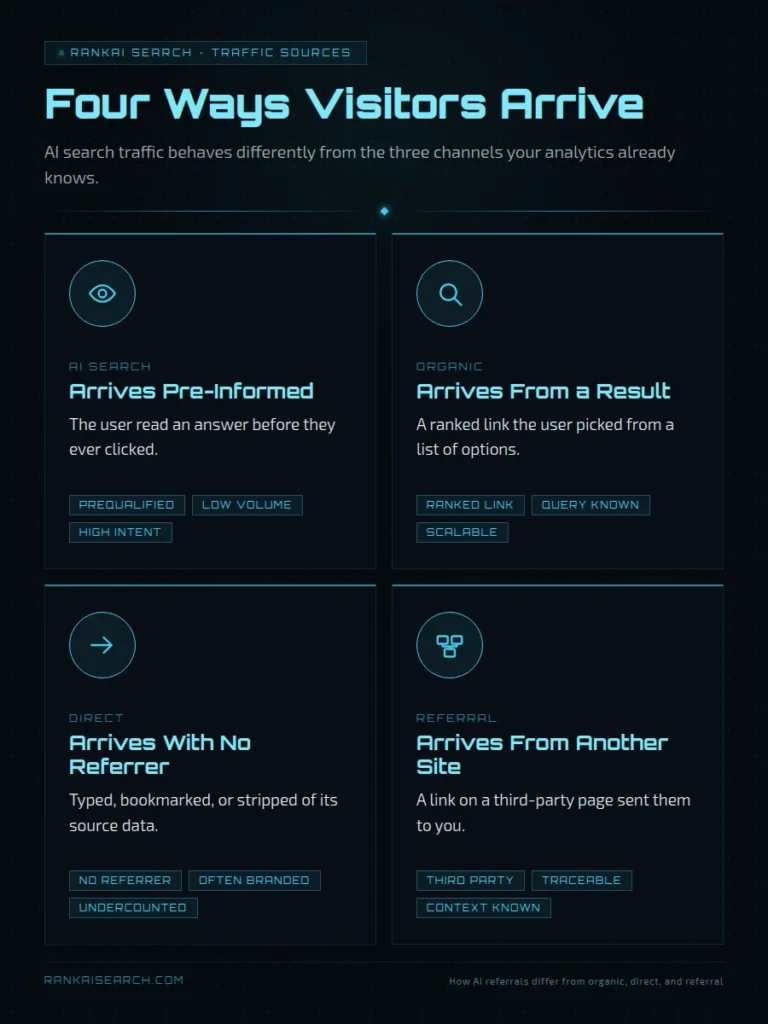
AI search traffic differs because the user normally receives a synthesized answer before opening the website. Organic, direct, and ordinary referral visitors reach the page through different interfaces and arrive with different attribution signals.
Traffic channels are reporting categories. They describe how an analytics platform interpreted the available source data, not every influence that shaped the visitor’s decision.
The same landing page can receive visits through every major channel. The path before the click determines how each session should be understood.
| Traffic Type | Immediate Origin | Pre-Click Experience | Common Analytics Label |
|---|---|---|---|
| AI search traffic | AI answer or citation | Reads a generated explanation | AI Assistants, Organic Search, Referral, Direct, or Unassigned |
| Organic traffic | Unpaid search result | Reviews a search results page | Organic Search |
| Direct traffic | No recognized source | Uses a URL, bookmark, or untracked path | Direct |
| Referral traffic | Link on another website | Reads a fixed page containing the link | Referral |
Organic and Direct Traffic
Organic traffic comes from unpaid search results, while direct traffic represents sessions without a clear referring source. The two channels describe different attribution conditions even when both visitors reach the same page.
A conventional organic visitor submits a query and chooses from titles, snippets, URLs, and other search features. The visitor normally reaches the website before receiving the page’s full explanation.
A person clicking from Google AI Overviews or AI Mode has already read a generated summary. Google Analytics still places that session under Organic Search because the click occurred within Google’s unpaid search environment.
Direct traffic is less precise. Some direct visitors type the address or use a bookmark, while others enter the channel because their original source information was lost.
| Signal | Organic Traffic | Direct Traffic |
|---|---|---|
| Recognized source | Search engine | None |
| Recognized medium | Organic | None |
| Search involved | Usually | Unknown |
| Referrer available | Normally | No |
| Can include AI visits | Google AI features can | Yes, when attribution is lost |
| Main interpretation | Search discovery | Intentional or unidentified navigation |
Referral and AI-Generated Traffic
Referral traffic comes through a link on another website or app, while AI-generated traffic comes through a link selected and presented within a generated response. The click can look technically similar even though the visitor’s preparation is different.
An ordinary referral link appears inside a fixed article, directory, discussion, review, or resource page. The page author or publisher decides where the link appears and what surrounds it.
An AI citation is selected during retrieval and answer generation. The system can combine information from several sources before presenting one page as support for a specific statement.
| Attribute | Ordinary Referral | AI-Generated Referral |
|---|---|---|
| Link selected by | Website author or publisher | AI retrieval system |
| Surrounding content | Fixed webpage | Generated response |
| Context | Article, directory, or discussion | Synthesized answer |
| Sources combined | Defined by the page | Often several sources |
| User prompt visible to destination | No | Usually no |
| Analytics source | Referring website | AI platform or campaign parameter |
| Pre-click education | Varies by page | Often extensive |
AI-generated visits remain useful as a separate behavioral category even when an analytics platform labels them Referral. The visitor may arrive after comparing several options, learning the basic facts, and narrowing the original question.
Why Is AI Traffic Often Classified as Referral Traffic?
AI traffic is often classified as referral traffic because the visitor moves from an external AI platform to the website through a standard web link. The browser can identify the AI platform as the domain that referred the session.
Google Analytics defines referral traffic as visits that arrive through another source, such as a link on a third-party domain. Analytics reads the visitor’s previous domain and records it as the referral source. (Source: Google Analytics, 2025)
This technical definition does not distinguish between a manually written article and a generated AI answer. Both can send the visitor through an external link.
The dedicated AI Assistants channel improves reporting by separating recognized assistants from ordinary referrals. Older data, unsupported platforms, custom analytics systems, and unrecognized source domains can still place AI sessions under Referral.
| Technical Signal | Example | Possible Classification |
|---|---|---|
| Recognized AI source | chatgpt.com | AI Assistants |
| Recognized AI source | gemini.google.com | AI Assistants |
| Unrecognized AI source | New or uncommon assistant domain | Referral |
| Referring website | Industry publication | Referral |
| Google search source | google.com / organic | Organic Search |
| Missing referrer | No source information | Direct |
| Unmatched source or medium | Reporting rule cannot categorize it | Unassigned |
When Can an AI Visit Appear as Direct or Unassigned Traffic?
An AI visit can appear as Direct when its original source information is missing. It can appear as Unassigned when the available source or medium does not match a channel rule.
Referrer data can disappear when a visitor opens a link through an app, redirect, privacy tool, copied URL, or browser environment that does not preserve the original source.
Google Analytics defines (direct) / (none) as traffic without a clear referral source. It identifies missing campaign parameters, redirects, URL shorteners, offline documents, and some tracking restrictions as possible causes. (Source: Google Analytics, 2026)
Unassigned traffic has a different cause. Google Analytics places traffic under Unassigned when source and medium information does not match any rule in the selected channel group. A (not set) session source or medium can also create this result. (Source: Google Analytics, 2025)
| Attribution Problem | What Happens | Likely Classification |
|---|---|---|
| AI app removes the referrer | Source information never reaches the site | Direct |
| User copies the cited URL | The original platform is disconnected | Direct |
| Redirect strips campaign parameters | Source details disappear | Direct or Referral |
| Privacy setting limits referrer data | Analytics cannot identify the origin | Direct |
| Source exists without a usable medium | Channel rule cannot match the visit | Unassigned |
| Tag does not fire on the landing page | Session data is incomplete | Unassigned or Direct |
| Unsupported source pattern | Platform is not recognized | Referral or Unassigned |
| Invalid campaign values | Default rules fail to categorize the session | Unassigned |
What Happens Before Someone Clicks an AI Citation?
Before someone clicks an AI citation, the platform interprets the question, retrieves relevant information, generates an answer, and attaches sources that support or extend that answer. The website visit begins after the platform has already completed part of the research process.
A complex prompt can contain several information needs. A user asking for the best option may also imply a budget, location, use case, experience level, deadline, or technical requirement.
Google explains that its generative search features can use query fan-out. The system issues multiple related searches across subtopics and data sources before building the response. (Source: Google Search Central, 2026)
Conversational tools can also preserve information from earlier messages. A follow-up such as “Which one works for a small apartment?” changes the context without repeating the original list of products.
Understanding context in AI recommendations helps explain why one page appears for a specific conversation but not for a broader version of the same question.
| Pre-Click Stage | What the System Does | Effect on the User |
|---|---|---|
| Prompt interpretation | Identifies the main question and constraints | Clarifies the information need |
| Query expansion | Searches related subtopics | Broadens the evidence considered |
| Source retrieval | Finds potentially useful pages | Creates a candidate source set |
| Source comparison | Evaluates relevance and support | Filters weaker sources |
| Answer generation | Synthesizes the retrieved information | Provides an immediate explanation |
| Citation placement | Connects links to claims or sections | Shows where more detail exists |
| Follow-up interaction | Applies new conversational context | Narrows the decision |
| Website click | Opens a selected source | Creates measurable traffic |
Which Pages Are Most Likely to Receive AI Search Traffic?
Pages are most likely to receive AI search traffic when they answer a specific question and provide useful information beyond the generated summary. A page needs enough additional value to make leaving the AI interface worthwhile.
A short definition can earn a citation but produce few visits. The user may receive the complete answer without opening the source.
Pages with original data, detailed comparisons, calculators, examples, visual evidence, instructions, or current availability give the user a stronger reason to click.
Google recommends creating unique, useful, non-commodity content for generative search. Its guidance favors firsthand knowledge and original viewpoints over pages that only repeat information found elsewhere. (Source: Google Search Central, 2026)
| Page Type | Why an AI System May Cite It | Why the User May Click |
|---|---|---|
| Direct answer page | Resolves a defined question | Needs examples or conditions |
| Comparison page | Explains differences between options | Wants the full decision criteria |
| Cost guide | Provides price variables | Needs a realistic estimate |
| Original research | Supplies unique findings | Wants methodology or complete data |
| Case study | Documents firsthand experience | Wants evidence and process details |
| Product page | Confirms specifications or availability | Wants to evaluate or purchase |
| Service page | Explains scope and suitability | Wants to contact a provider |
| Documentation | Provides authoritative instructions | Needs exact steps |
| Troubleshooting guide | Connects symptoms with solutions | Needs the complete fix |
| Local guide | Supplies geographic information | Needs a local rule or provider |
How Does AI Search Traffic Behave After Landing on a Website?
AI search visitors often arrive with a narrower purpose because the generated answer has already completed part of their research. Their behavior can show stronger engagement, although the pattern differs by subject, website, and landing page.
An AI-referred visitor may skip introductory explanations and move directly to specifications, evidence, pricing, comparisons, or contact information. The person already knows why the page was cited.
Adobe reported that AI-referred retail visitors showed 15% higher engagement than non-AI traffic in May 2026. They spent 53% more time on the site, viewed 23% more pages, and were 36% less likely to bounce. (Source: Adobe Digital Insights, 2026)
Those findings describe Adobe’s retail dataset. A technical support site, professional service company, local provider, or publication can produce a different pattern.
| Behavior Signal | Possible AI Traffic Pattern | What It Can Mean |
|---|---|---|
| Longer visit | User studies detailed evidence | Strong research intent |
| More pages viewed | User compares related options | Active evaluation |
| Lower bounce rate | Landing page matches the citation | Relevant source selection |
| High return rate | User continues research over time | Considered decision |
| Immediate conversion | AI answer resolved major questions | Strong action readiness |
| Short converting visit | User arrived knowing the next step | Efficient decision path |
| Short non-converting visit | Page failed to provide expected detail | Citation mismatch |
| Later direct visit | User remembers the company and returns | AI influence outside referral reporting |
Is AI Search Traffic More Valuable Than Traditional Search Traffic?
AI search traffic can be more valuable per visit when the generated answer has already narrowed the user’s choices. It is not universally more valuable because performance depends on the question, page, audience, and conversion goal.
A person clicking after a detailed AI comparison can arrive closer to a decision than someone using a broad search query. The visitor may already understand the available options and their main trade-offs.
Ahrefs reported that AI search produced 0.5% of its visits but 12.1% of its sign-ups during one 30-day period in 2025. That created a conversion rate 23 times higher than traditional organic search for Ahrefs, but the company stated that the result was specific to its own website. (Source: Ahrefs, 2025)
A verification click can have little immediate commercial value. The user may open the page only to check a statistic or confirm that the AI answer represented the source accurately.
| Value Factor | AI Search Traffic | Traditional Organic Traffic |
|---|---|---|
| Pre-click education | Often detailed | Usually limited to result snippets |
| Traffic volume | Smaller | Much larger |
| Intent | Can be highly specific | Ranges from broad to transactional |
| Attribution | Frequently incomplete | Usually more consistent |
| Conversion path | Can begin inside the AI response | Usually begins on the search page |
| Brand exposure without clicks | Common | Common in zero-click search |
| Growth pattern | Fast and volatile | Mature and stable |
| Performance evidence | Limited and website-specific | Supported by longer historical data |
How Can You Identify AI Search Traffic in Analytics?
You can identify AI search traffic by reviewing channel groups, session source and medium, referring domains, campaign parameters, landing pages, and conversion paths. No single report captures every AI-influenced visit.
A source identifies the platform or website that sent the session. A medium describes the broad method through which the visitor arrived, such as organic, referral, or none.
Google Analytics can place recognized assistant traffic under AI Assistants. Historical data and additional platforms may remain inside Referral, Direct, or Unassigned.
ChatGPT automatically adds utm_source=chatgpt.com to referral URLs from ChatGPT search. OpenAI states that website owners can use this parameter in analytics platforms to track measurable inbound visits. (Source: OpenAI, 2026)
| Analytics Field | What to Review | Example |
|---|---|---|
| Default channel group | Recognized channel classification | AI Assistants |
| Session source | Platform that sent the visit | chatgpt.com |
| Session medium | Broad traffic method | Referral |
| Campaign source | Passed UTM value | chatgpt.com |
| Full referrer | Immediate external origin | AI platform domain |
| Landing page | First page opened | Comparison or cost guide |
| Conversion path | Channels preceding the action | AI Assistant, Direct, conversion |
| First user source | Original acquisition source | AI assistant or search engine |
Referral Domains and Source Data
Referral domains and source data identify which AI platform passed information with a measurable click. They provide the clearest evidence that a session originated from an assistant or answer engine.
Begin with the traffic acquisition report. Review the default channel group, Session source, and Session source/medium dimensions.
Recognized platforms should then be compared with the property’s Referral, Direct, and Unassigned traffic. This review can reveal sources that are missing from the dedicated AI Assistants channel.
| Source Pattern | Platform |
|---|---|
| chatgpt.com | ChatGPT |
| perplexity.ai | Perplexity |
| claude.ai | Claude |
| gemini.google.com | Gemini |
| copilot.microsoft.com | Microsoft Copilot |
| grok.com | Grok |
| you.com | You.com |
| search.brave.com | Brave Search |
| google.com / organic | Google search, AI Overviews, or AI Mode |
Landing Pages and Conversion Paths
Landing pages and conversion paths show what AI visitors wanted and what they did after arrival. A source count cannot reveal whether the visit created a useful outcome.
A landing-page report can identify which comparisons, products, services, tools, studies, or guides receive AI traffic. Those pages provide indirect evidence about the questions for which the website has source value.
A conversion path shows the sequence of recorded channels before an action. A person can first arrive through an AI assistant and return later through Organic Search or Direct.
| Analysis | Question It Answers |
|---|---|
| AI source by landing page | Which pages attract AI visitors? |
| AI source by conversion | Which platforms produce actions? |
| Landing page by engagement | Which pages satisfy AI-referred visitors? |
| First source versus session source | Did AI acquire or re-engage the visitor? |
| Path exploration | What pages did the visitor open next? |
| Assisted conversion review | Did AI appear earlier in the journey? |
| Return-visitor analysis | Did the visitor come back through another channel? |
| Page comparison | Do AI and organic visitors prefer different destinations? |
Which AI Platforms Can Send Measurable Website Visits?
ChatGPT, Perplexity, Claude, Gemini, Microsoft Copilot, Grok, You.com, Brave Search, and Google’s generative search features can send measurable visits. The available attribution data differs across platforms, browsers, apps, and analytics systems.
A platform sends measurable traffic only when an external link is present and the user opens it. A text-only mention creates no website session.
ChatGPT currently produces a large share of measurable assistant traffic across many datasets. Ahrefs reported in 2025 that ChatGPT generated more than 80% of the AI traffic in its study, although the dominant source can differ for an individual website. (Source: Ahrefs, 2025)
Platform interfaces also affect click behavior. Prominent inline citations can produce a different traffic pattern from hidden source panels or links displayed only after an additional action.
| Platform | Common Domain | Link Format | Likely GA4 Channel |
|---|---|---|---|
| ChatGPT | chatgpt.com | Citation or source panel | AI Assistants |
| Perplexity | perplexity.ai | Numbered citation | AI Assistants or Referral |
| Claude | claude.ai | Web citation | AI Assistants or Referral |
| Gemini | gemini.google.com | Supporting source | AI Assistants |
| Microsoft Copilot | copilot.microsoft.com | Citation or source card | AI Assistants |
| Grok | grok.com | Web source | AI Assistants |
| You.com | you.com | Search citation | Referral or custom AI channel |
| Brave Search | search.brave.com | AI answer source | Organic Search or Referral |
| Google AI Overviews | google.com | Summary source link | Organic Search |
| Google AI Mode | google.com | Conversational result link | Organic Search |
What Can Traffic Reports Not Tell You About AI Visibility?
Traffic reports cannot show unclicked citations, text-only mentions, AI impressions, exact prompts, or later visits influenced by an AI answer. They measure activity on the website rather than the complete discovery experience inside the AI platform.
A person can see a company recommended, remember its name, and search for it later. That visit may appear as Organic Search or Direct without any recorded connection to the original AI answer.
A page can also supply information to an AI response without receiving a click. The source influenced the answer, but the analytics platform has no session to measure.
Pew Research Center found that users clicked a cited source in a Google AI summary during only 1% of visits to search pages containing such a summary. Users clicked a traditional search result in 8% of those visits, compared with 15% when no AI summary appeared. (Source: Pew Research Center, 2025)
| Missing Insight | Why Traffic Reports Cannot Show It |
|---|---|
| Unclicked citation | No website request occurred |
| Company mention without a link | No session was created |
| Exact prompt | The platform normally does not pass it |
| Full answer wording | Analytics sees the visit, not the response |
| Citation position | Referrer data does not describe placement |
| Competing sources | Other citations remain outside the destination site |
| AI-influenced brand search | The later search receives organic attribution |
| AI-influenced direct return | The original source is disconnected |
| Incorrect AI statement | No click is required for misinformation |
| Recommendation frequency | Traffic counts only users who opened a link |
How Should You Evaluate the Growth of AI Search Traffic?
AI search traffic growth should be evaluated through volume, traffic share, platforms, landing pages, engagement, and conversions. Percentage growth alone can exaggerate the importance of a channel with a small starting value.
A change from two monthly sessions to six represents 200% growth. The increase is real, but the total remains too small to support broad conclusions.
Semrush analyzed more than 50,000 websites and found that AI traffic grew 66% during 2025. It still accounted for less than 0.15% of total visits, while organic search generated more than one trillion visits. (Source: Semrush, 2026)
Reporting rules must remain stable across the comparison period. Moving recognized assistants from Referral to AI Assistants can create apparent growth that comes from reclassification.
A complete approach to measuring AI search performance also tracks citation frequency, recommendation context, and answer accuracy.
| Growth Metric | What It Measures | Why It Matters |
|---|---|---|
| AI sessions | Total measurable visits | Shows channel size |
| Monthly growth | Short-term direction | Detects recent change |
| Annual growth | Longer trend | Reduces seasonal distortion |
| Share of total traffic | Relative contribution | Places the channel in context |
| Number of AI sources | Platform diversity | Reveals concentration risk |
| AI landing pages | Breadth of cited content | Shows where source value exists |
| Engagement rate | Meaningful on-site interaction | Tests landing-page relevance |
| Conversion rate | Actions per visit | Measures traffic quality |
| Revenue or inquiry value | Commercial outcome | Measures practical contribution |
| Assisted conversions | Later actions influenced by earlier visits | Captures longer journeys |
| Citation frequency | Visibility across tracked questions | Measures exposure before clicks |
| Answer accuracy | Correctness of AI descriptions | Protects trust |
A practical review schedule includes:
- Check source data for tracking problems each month.
- Compare traffic and landing-page outcomes each quarter.
- Review citations and answer accuracy across a fixed prompt set.
- Update platform domains and channel rules when reporting changes.
- Compare AI-assisted outcomes with other traffic sources.
What Should You Remember About AI Search Traffic?
You should remember that AI search traffic is the measurable website traffic produced when users click links inside AI-generated answers. The analytics label can vary, but the journey always begins with an AI system shaping what the user knows before the click.
Traffic and influence are not the same measurement. AI can affect awareness, trust, comparison, and selection without producing an identifiable referral.
The channel should therefore be evaluated alongside citations, mentions, landing pages, and completed actions. A traffic report answers what happened after a measurable click, not everything that happened before it.
| Core Principle | Practical Meaning |
|---|---|
| AI traffic requires a click | Mentions and impressions are not website sessions |
| Classification varies | AI visits can appear under several channels |
| Google AI visits remain organic | AI Overviews and AI Mode operate inside Google Search |
| Standalone assistants can have a dedicated channel | Recognized sources can appear under AI Assistants |
| Referral data can disappear | Some AI visits enter Direct or Unassigned |
| Exact prompts are usually hidden | Landing pages offer indirect clues |
| Visitors can arrive informed | The AI answer completes part of the research |
| Traffic is only one measurement | Citations and recommendations also matter |
| Small volume can create value | Qualified outcomes matter more than raw sessions |
| Reporting requires maintenance | Platforms and channel definitions change |
Are You Ready to Understand Where Your AI-Driven Visitors Come From?
Understanding AI-driven visitors requires a reporting structure that connects AI sources, channel classifications, landing pages, and completed actions. A single traffic label cannot explain the entire discovery journey.
RankAISearch provides AI search engine optimization for companies that need stronger visibility and measurement across AI-generated answers. The service connects content, technical access, entity clarity, citations, and performance reporting.
Traffic analysis should begin with a clean baseline. Existing source domains, channel rules, landing-page reports, and conversion events must be reviewed before growth can be interpreted.
Businesses that need help establishing that baseline can get in touch with us. The first step is separating measurable AI visits from the wider influence ordinary traffic reports cannot capture.
Frequently Asked Questions About AI Search Traffic
Is AI search traffic considered organic or referral traffic?
AI search traffic can be classified as AI Assistants, Organic Search, Referral, Direct, or Unassigned. The correct label depends on the platform and the source information passed with the visit. Google AI Overviews and AI Mode are classified under Organic Search. Recognized standalone assistants can appear under AI Assistants.
Does traffic from ChatGPT appear in website analytics?
Yes, traffic from ChatGPT can appear in website analytics. ChatGPT adds a source parameter to links from its search results. Some visits can still lose attribution because of redirects, privacy controls, browser behavior, or copied URLs. Those sessions may appear as Direct.
Why does some AI traffic appear as direct traffic?
Some AI traffic appears as Direct because its referrer information did not reach the website. Analytics then lacks enough information to identify the original platform. App browsers, redirects, privacy settings, and copied links can remove source details. Direct traffic therefore includes more than typed addresses and bookmarks.
Can Google AI Overviews send organic traffic?
Yes, Google AI Overviews can send Organic Search traffic. Google includes clicks from AI Overviews and AI Mode within its organic channel definition. Standard analytics reports may not separate those sessions from conventional Google result clicks. The shared source makes independent measurement difficult.
Which AI tools send the most referral traffic?
ChatGPT sends the largest measurable share across several broad industry studies. The dominant platform for one website can still differ by subject and audience. Perplexity, Gemini, Claude, Copilot, Grok, and other tools can also send identifiable visits. The website’s own reports should determine priority.
Can a website receive AI visibility without receiving clicks?
Yes, a website can receive AI visibility without receiving clicks. A page can be cited, summarized, or used as supporting evidence while the user remains inside the AI interface. A company can also be named without a link. Neither event creates a measurable website session.
How can you separate AI referrals from ordinary referral traffic?
You can separate AI referrals by filtering known AI source domains or using the AI Assistants channel in GA4. Historical reports may require a custom channel group. The report should also include landing pages and completed actions. A source count alone does not show whether the visits produced useful outcomes.
Does AI search traffic convert differently from traditional search traffic?
AI search traffic can convert differently because the user may arrive after receiving a detailed answer or comparison. This preparation can create stronger intent. Performance varies by website, topic, landing page, and action. Conversion rate, value per visit, qualified inquiries, and assisted outcomes should be measured separately.