

Multi-Platform AI Search Optimization: A Guide to Brand Visibility
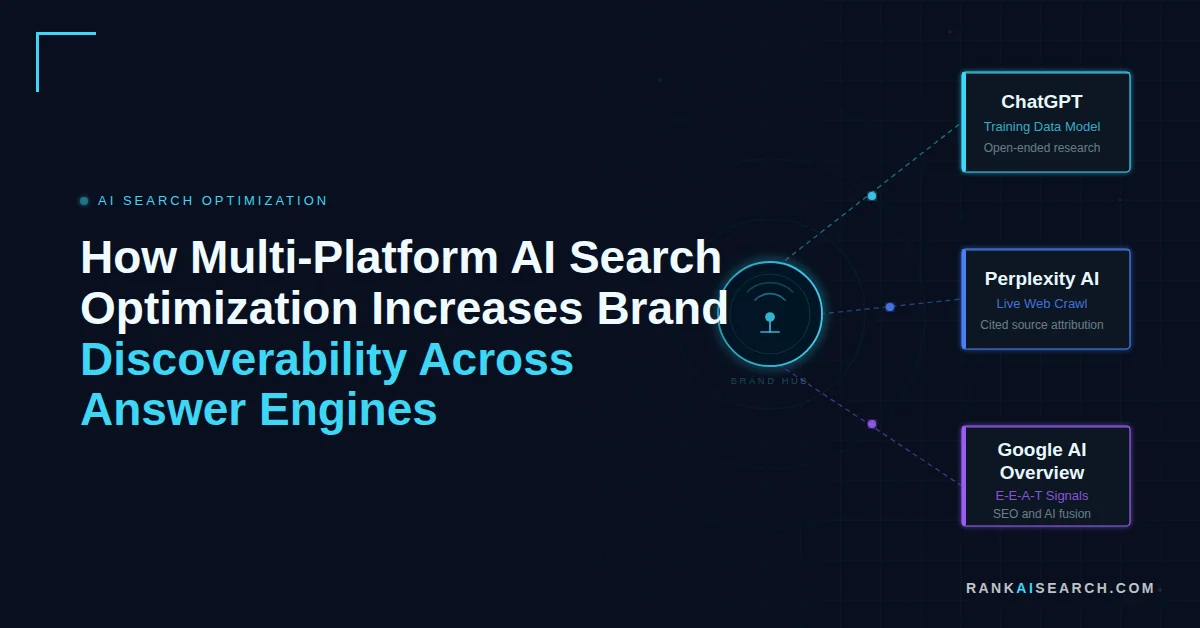
A marketing manager queries ChatGPT about the best vendors in their category and watches a competitor get recommended. They check Perplexity and find the same competitor cited with sources. They open Google AI Overview and find them featured there too. Their own brand does not appear once. That outcome is the direct result of multi-platform AI search optimization: the practice of building content and technical infrastructure that earns brand visibility across all major answer engines simultaneously.
This guide covers the core principles of cross-platform optimization, how ChatGPT, Perplexity, and Google AI Overview each evaluate and recommend brands, what technical infrastructure applies universally, and how to measure performance across all three platforms.
What Is Multi-Platform AI Search Optimization?
Multi-platform AI search optimization means creating content and technical infrastructure that earns brand visibility across ChatGPT, Perplexity, and Google AI Overview at the same time. It prioritizes universal best practices over platform-specific tactics that work on one answer engine but actively reduce visibility on others.
| Dimension | Single-Platform Optimization | Multi-Platform Optimization |
| Focus | One answer engine | All major answer engines simultaneously |
| Tactic type | Platform-specific ranking tricks | Universal quality + selective adjustments |
| Risk profile | High: one update removes all visibility | Low: diversified presence absorbs disruptions |
| Content model | Formatted for one system’s preferences | Modular and extractable by any AI system |
| Brand consistency | May vary by platform | Identical across all touchpoints |
Multi-platform AI search optimization is not about gaming algorithms. It is about building a brand presence so clear, consistent, and authoritative that every answer engine independently chooses to recommend you.
Why Does Multi-Platform Visibility Matter for Modern Brands?
Multi-platform visibility matters because buyers use multiple AI platforms during a single research journey, and a brand visible on only one is absent from the majority of that process. Each platform captures a distinct segment of buyer attention that the others do not reach.
| Platform | Primary Buyer Use Case | Content Sourcing Model |
| ChatGPT | Open-ended research, brainstorming | Training data from authoritative sources |
| Perplexity | Fact-checking, comparison research | Real-time web crawling with visible citations |
| Google AI Overview | Final decision confirmation | Indexed pages with strong E-E-A-T signals |
Gartner projects generative AI tools will reduce traditional search engine volume by 25 percent by 2026 as users shift discovery behavior toward conversational AI platforms. (Source: Gartner, “Generative AI to Reduce Search Engine Volume 25% by 2026,” 2024) That traffic migrates to the answer engines your brand may or may not currently appear in.
What Are the Core Principles of Cross-Platform AI Optimization?
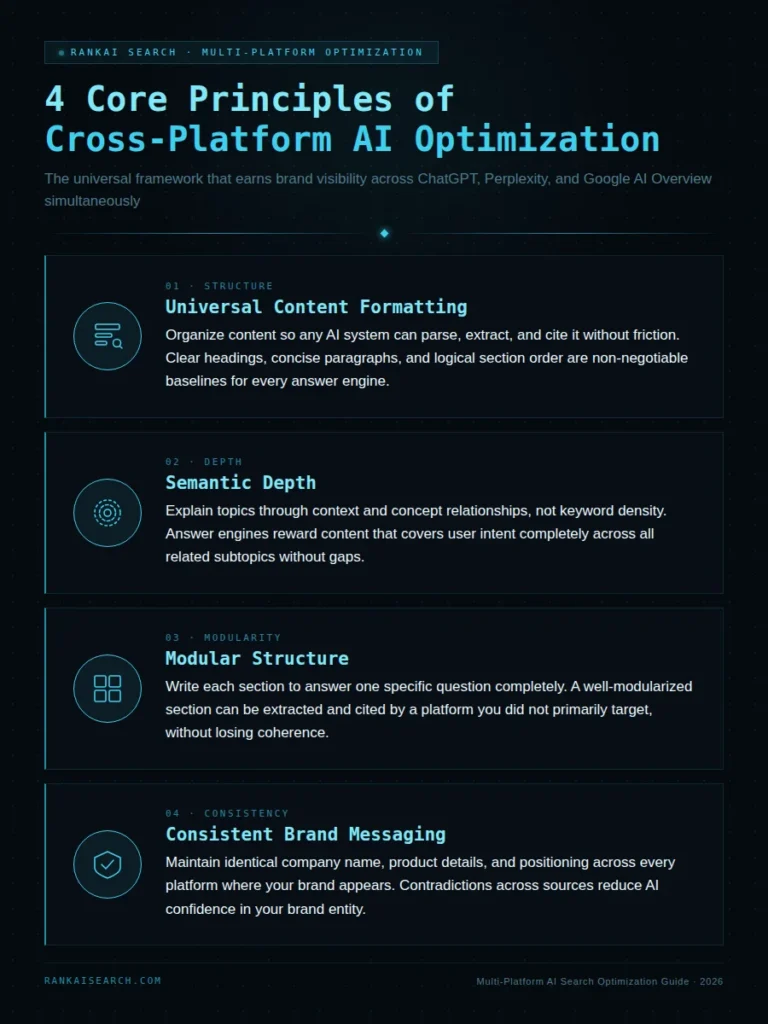
The four core principles of cross-platform AI optimization are universal content formatting, semantic depth, modular structure, and consistent brand messaging. These principles work across all major answer engines because they reflect how AI systems extract, evaluate, and attribute information regardless of platform architecture.
- Universal content formatting: Organize content so any AI system can parse, extract, and cite it without friction. Clear headings, concise paragraphs, and logical section order are non-negotiable baselines.
- Semantic depth: Explain topics through context and relationships between concepts, not keyword density. Answer engines reward content that addresses user intent completely.
- Modular structure: Write each section to answer one specific question completely. A well-modularized section can be extracted and cited by a platform you did not primarily target, without losing coherence.
- Consistent brand messaging: Maintain identical company name, product details, service descriptions, and positioning across every location where your brand appears. Contradictions across sources reduce AI confidence in your brand entity.
How Does Each Answer Engine Evaluate and Recommend Brands?
All three major answer engines reward authority, accuracy, and clarity, but they differ significantly in where they source content and how recently that content needs to have been published. Understanding each platform’s sourcing model determines where to invest optimization effort first.
The three platforms use fundamentally different sourcing mechanisms, each with distinct implications for your content and authority strategy:
- Google AI Overview draws from indexed pages with established E-E-A-T signals, integrating traditional SEO factors like backlink profile, page speed, and author credentials with AI-generated summarization.
- ChatGPT relies on training data assembled from authoritative web sources, meaning broad cross-publication presence compounds brand visibility in ways a single well-optimized page cannot replicate.
- Perplexity crawls the live web in real time for each query and displays transparent source attribution to users, giving high-authority domains with recently updated content a distinct advantage.
How Does Google AI Overview Select Brands?
Google AI Overview selects brands based on E-E-A-T signals (Experience, Expertise, Authoritativeness, and Trustworthiness) combined with traditional SEO factors including backlink profile, page speed, mobile optimization, and structured content formatting. (Source: Google Search Central, Creating Helpful, Reliable, People-First Content, 2024)
Content formatted as direct questions followed by direct answers performs best for AI Overview selection. Lists, tables, and definition-style paragraphs increase extraction probability because they reduce AI processing effort required to isolate relevant information.
How Does ChatGPT Recommend Brands?
ChatGPT recommends brands whose content appears consistently on authoritative sites, is widely cited by credible sources, and provides depth, examples, and practical application. The training process systematically underweights thin content and keyword-heavy writing.
Because ChatGPT draws from training data rather than live crawls, earning citations and mentions across respected industry publications compounds visibility over time. Individual page optimization produces less impact here than it does for the other two platforms.
How Does Perplexity AI Cite Sources?
Perplexity crawls the live web for each query, then displays source attribution alongside its answers, making the cited domain directly visible to the person asking the question. Fresh content with recent publication dates from high-authority domains is distinctly advantaged over stale material.
Perplexity’s visible citation model means a citation here signals credibility directly to human readers, not only to the algorithm. Domain reputation translates immediately into prominent, visible placement.
How Do You Build a Unified Content Foundation for All AI Platforms?
A unified content foundation starts with modular content blocks: each section answers one specific question completely so any answer engine can extract it independently of platform preferences. Comprehensive topic clusters that link related articles build the knowledge depth all three major platforms recognize and reward.
Three practices sustain this foundation over time:
- Consistent update schedules: Revise important pages at minimum every quarter. Add new data, refresh examples, and expand coverage as the topic evolves. Mark revision dates clearly; freshness is a direct visibility signal for Perplexity and an indirect one for Google AI Overview.
- Internal topic linking: Connect related articles and hub pages to build a content ecosystem. AI crawlers use internal link structure to assess topic authority alongside backlink signals.
- Human-first writing: Answer engines increasingly identify and deprioritize content written primarily for algorithms. Every sentence must serve a human reader first; AI extraction is a benefit of that, not the purpose.
What Technical Infrastructure Does Multi-Platform Visibility Require?
The essential technical requirements for multi-platform visibility are schema markup, passing Core Web Vitals, mobile-first design, clean site architecture, and HTTPS. These determine whether answer engines can access and correctly interpret your content; they are baseline requirements, not competitive differentiators.
| Technical Requirement | Why It Matters Across Platforms | Priority |
| Schema markup: Article, FAQ, HowTo, Organization | Communicates content meaning to AI systems explicitly | High |
| Core Web Vitals: LCP, CLS, INP passing | User satisfaction signal evaluated by all platforms | High |
| Mobile-first design | Required for Google indexing; affects all downstream signals | High |
| XML sitemap + clean robots.txt | Ensures all AI crawlers discover and index content | Medium |
| HTTPS + valid SSL certificate | Trust baseline evaluated by every platform | High |
Structured data for FAQ, HowTo, and Article schema types communicates your content purpose to AI systems in machine-readable format, significantly improving correct categorization and citation probability. (Source: Google Search Central, Introduction to Structured Data, 2024)
What Content Formatting Strategies Work Across All Answer Engines?
The formatting strategies that work across all answer engines are question-answer structure, list-based content, direct definitions, and descriptive headings. Each reduces extraction friction for AI systems while improving readability for human visitors.
Apply these rules consistently in every major section:
- Question-answer format: Open each section with a clear question. Answer it in the first sentence. Support with detail after the direct answer is stated.
- List-based content: Convert three or more parallel items into bullets or numbered steps. Listed information is extracted into AI-generated answers at a higher rate than equivalent dense prose.
- Definition paragraphs: Define technical terms in the first sentence of the section where they first appear. Self-contained definitions are citable out of context, which increases extraction frequency.
- Descriptive headings: Write headings that specify exactly what the section covers. AI systems use headings to interpret section content before reading the body; vague headings reduce extraction accuracy.
How Do You Prioritize Platform-Specific Optimizations?
Prioritize platform-specific optimizations based on where your actual audience searches, verified through surveys, traffic source analysis, and direct customer interviews. Audience data should drive allocation decisions, not industry assumptions about which platforms are most popular.
Translate that data into targeted investments:
- If Perplexity drives significant referral traffic, prioritize content freshness through frequent updates and domain authority building through external citation acquisition.
- If ChatGPT generates brand mentions at scale, prioritize comprehensive content published across respected third-party publications, since training data breadth outweighs on-site optimization for that platform.
Create platform-specific content variations only when data shows a material opportunity. Most brands achieve strong results with unified content plus targeted adjustments, not separate content tracks maintained in parallel.
What Authority-Building Tactics Benefit All AI Platforms?
The authority-building tactics that benefit every answer engine are external citations, entity consistency, original research, and credentialed author profiles. These signals compound over time and are significantly harder to replicate than on-page optimizations, making them the most defensible part of any long-term strategy.
Build each signal category methodically:
- External citations: Contribute to respected industry publications, participate in expert interviews, and earn mentions in authoritative research. These external signals register across all answer engine evaluation models.
- Entity consistency: Maintain identical brand descriptions, service definitions, and positioning statements everywhere your business appears online. Inconsistency reduces AI confidence in your brand entity and lowers recommendation frequency.
- Original research: Publish data analyses, proprietary studies, or unique insights not available elsewhere. Answer engines prioritize sources that introduce new knowledge over those that summarize existing content.
- Author credentials: Include detailed author bios with qualifications, work history, and links to other published work. Author authority is a quality signal that all major answer engines consider alongside domain authority.
(Source: Edelman, 2024 Trust Barometer: Brand Trust and the AI Revolution)
How Do You Monitor and Measure Multi-Platform AI Search Performance?
Measure multi-platform AI search performance by tracking brand mention frequency, referral traffic from each platform, and conversion rates from AI-sourced visitors. Establishing baseline metrics before implementing any changes is mandatory; without a baseline, you cannot isolate which optimizations are producing results.
Each platform requires its own primary metric alongside universal brand tracking:
| Platform | Primary Metric | Secondary Metric |
| Google AI Overview | Feature frequency by target query | Position within the generated overview |
| ChatGPT | Brand mention rate in responses | Context quality: positive, neutral, or negative |
| Perplexity | Citation frequency per query set | Prominence: first source or supporting citation |
Use dedicated brand monitoring tools alongside scheduled manual spot checks. Automated tools have measurement gaps, particularly for ChatGPT responses that vary by user and session. A unified reporting dashboard consolidating all platform data makes trend identification and strategic adjustment significantly more reliable.
What Are the Most Common Pitfalls in Multi-Platform AI Optimization?
The most common pitfalls are over-optimizing for one platform, maintaining inconsistent brand information, neglecting platform-specific requirements on top of the universal foundation, and ignoring emerging answer engines. Each error produces a different type of visibility loss and requires a targeted correction.
Avoid these specific mistakes:
- Over-optimization for one platform: Tactics designed exclusively for ChatGPT can actively reduce Google AI Overview selection probability. Universal best practices protect visibility across multiple evaluation models simultaneously.
- Inconsistent brand information: Contradictory product descriptions, pricing, or service definitions across sources reduce the confidence AI systems assign to your brand entity and lower recommendation frequency.
- Neglecting platform-specific requirements: Universal optimization forms the foundation, but failing to address unique platform characteristics leaves measurable visibility unrealized on each platform.
- Ignoring emerging platforms: New answer engines enter the market regularly. Early optimization establishes authority before the competitive landscape becomes crowded, an advantage that is difficult for late entrants to close.
How Do You Future-Proof Your Multi-Platform AI Search Strategy?
Future-proof your multi-platform AI strategy by building modular content systems, maintaining fundamental content quality, and preparing for multi-modal search integration. Algorithm updates across all major platforms consistently reward content that genuinely serves users over content engineered for current algorithmic preferences.
Three structural investments that compound in value over time:
- Modular content architecture: Content built in self-contained, answerable sections adapts to new platforms without requiring complete rewrites. Build for portability from the start rather than retrofitting later.
- Fundamental quality over loophole exploitation: Content that thoroughly helps users, demonstrates genuine expertise, and provides accurate information survives algorithm changes better than content optimized for current limitations.
- Multi-modal readiness: Answer engines increasingly process voice queries, image-based questions, and mixed-input searches. Optimize visual content with descriptive alt text, write in audio-friendly sentence structures, and ensure content functions across all input formats.
Frequently Asked Questions
What is the difference between single-platform and multi-platform AI search optimization?
Single-platform optimization focuses on one answer engine using tactics that may actively harm visibility on others. Multi-platform optimization builds universal content and technical infrastructure that earns brand visibility across all major answer engines simultaneously, with platform-specific adjustments added only where audience data justifies the additional effort.
How do I know which AI platforms are most important for my business?
Analyze referral traffic data, conduct customer surveys, and run direct interviews to verify which platforms your audience uses for research and purchasing decisions. Audience behavior data should drive platform prioritization, not general industry trends or assumptions about which tools professionals prefer.
Can the same content perform well on ChatGPT, Perplexity, and Google AI Overview simultaneously?
Yes. Content built on universal best practices performs across all three platforms. Comprehensive topic coverage, clear formatting, authoritative sourcing, and genuine helpfulness are rewarded everywhere. Platform-specific preferences are real but secondary to underlying content quality and structure.
How often should I update content to maintain multi-platform visibility?
Update important content at minimum every quarter, or immediately when significant industry changes occur. Perplexity rewards content updated within the past few months; ChatGPT values broad web presence more than recency; Google AI Overview rewards both established authority signals and content freshness.
What technical requirements are essential for appearing across multiple answer engines?
The non-negotiable requirements are proper schema markup, passing Core Web Vitals scores, mobile-first design, clean crawlable site architecture, and HTTPS. Structured data for Article, FAQ, HowTo, and Organization entity types are the highest-priority schema implementations for most brands.
How do I measure ROI from multi-platform AI optimization?
Track brand mention frequency across platforms, referral traffic volume from each answer engine, and conversion rates for AI-sourced visitors. Monitor brand search volume growth over time and measure customer acquisition cost for AI-influenced conversions. Together, these metrics show both visibility impact and business impact.
Should I create separate content for each AI platform or use a unified approach?
Start with a unified approach built on universal best practices. Add platform-specific content variations only when traffic data or mention frequency monitoring reveals a specific opportunity that justifies the additional production investment. Most brands achieve strong results with unified content plus minor targeted adjustments.
How long does it take to see results from multi-platform AI optimization?
Perplexity results typically appear within 4 to 8 weeks due to real-time web crawling. Google AI Overview and ChatGPT generally require 3 to 6 months as updated content is incorporated into their systems. Consistent optimization produces compounding visibility gains over 6 to 12 months.