


AI Search Optimization for Small Businesses: Why It’s Essential
Being the most experienced local provider does not guarantee that AI tools will mention your business. Your knowledge must exist online in a format that search and AI systems can retrieve, interpret, and verify. Small businesses need AI search optimization because offline expertise alone cannot influence generated answers.
This creates an opportunity for companies that understand a narrow service or customer problem better than broad competitors. A focused business can answer detailed questions that larger websites leave incomplete. This guide explains how small businesses can build AI visibility without competing on size or content volume.
Do Small Businesses Need AI Search Optimization?
Yes, small businesses need AI search optimization just as much as large brands, often more. AI tools cite specific, well-answered questions rather than brand size, so a small business with focused, authoritative content on its niche can get cited ahead of a much larger competitor that has not optimized for AI search at all.
AI search optimization is the process of making business information easier for AI systems to discover, understand, verify, and use in generated answers. It combines useful content, technical accessibility, consistent company details, firsthand evidence, and credible third-party references.
The need extends beyond technology companies. Customers now ask AI tools to compare local services, explain costs, recommend providers, diagnose problems, and narrow purchase options. Pew Research Center reported that 44% of U.S. adults used ChatGPT in 2026, up from 34% in 2025. (Source: Pew Research Center, 2026).
A small company can therefore lose visibility before a customer reaches a conventional search results page. The customer may form a shortlist, reject an option, or choose a provider based on information summarized inside an AI answer.
RankAISearch principle: A small business does not need the largest website. It needs the clearest evidence for the questions it is qualified to answer.
| Business Signal | Direct Citation Requirement? | Practical Effect |
|---|---|---|
| Company size | No published requirement | Does not guarantee inclusion |
| Brand recognition | No published requirement | Can make the company easier to identify |
| Website age | No published requirement | May provide a longer history of public information |
| Specialized expertise | Strong practical advantage | Supports precise answers to narrow questions |
| Firsthand evidence | Strong credibility signal | Adds information competitors cannot copy |
| Clear explanations | Strong extraction signal | Helps AI isolate a usable answer |
| Consistent business details | Strong entity signal | Reduces uncertainty about the company |
| Public accessibility | Basic discovery requirement | Allows search and AI crawlers to retrieve pages |
AI optimization does not guarantee a citation. It improves whether a business supplies the kind of source material an AI system can confidently retrieve and reference.
Why Can Small Businesses Compete With Larger Brands in AI Search?
Small businesses can compete because AI search systems retrieve sources that fit the user’s question. A specialized page from a small company can provide a more useful answer than a broad page from a recognized corporation.
Traditional brand advantages still matter. Large companies often have more links, mentions, content, reviews, and historical visibility. Those signals become less decisive when the question contains details the larger company has not addressed.
A customer may not ask for the biggest provider. The customer may ask for a provider that serves a particular location, works with a specific property type, supports a certain product, or offers a solution under defined conditions.
Google explains that AI Overviews and AI Mode can use query fan-out. The system issues several related searches across subtopics and data sources, which allows it to identify a wider and more diverse set of supporting pages than one conventional query may produce. (Source: Google Search Central, 2026).
| Competitive Factor | Small Business Advantage | Large-Brand Limitation |
|---|---|---|
| Topic specialization | Can focus deeply on a limited service range | Broad sites divide attention across many categories |
| Customer proximity | Hears real concerns during calls and consultations | Centralized content teams may lack frontline detail |
| Publishing speed | Can update information quickly | Multiple approvals can delay corrections |
| Local familiarity | Understands area-specific conditions | National pages often remain geographically general |
| Owner expertise | Can connect advice directly to qualified experience | Expertise may be separated from published content |
| Project evidence | Can document actual work and results | Case examples may be generalized |
| Service detail | Can explain exact steps and limitations | Corporate pages may prioritize uniform descriptions |
| Niche vocabulary | Can use the terms customers use | Broad pages may rely on standardized language |
Where Do Smaller Companies Have the Strongest Advantage?
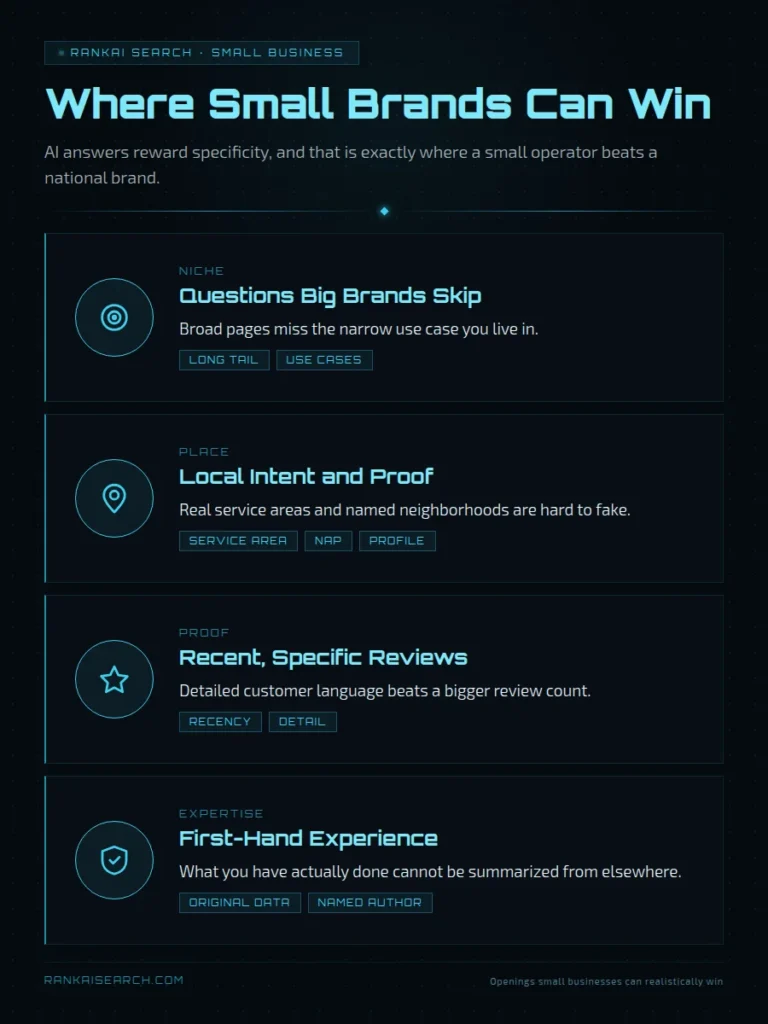
Smaller companies have the strongest advantage in narrow subjects, specialized services, local questions, and situations requiring firsthand experience. These areas reward precision and practical knowledge more than publishing scale.
A small business usually works within a limited set of services, customer types, or locations. That apparent limitation can become an AI search advantage because the company repeatedly encounters similar problems and develops knowledge that broad sources lack.
Google’s people-first content guidance recommends original information, clear sourcing, and evidence of firsthand expertise. It also asks whether content provides enough detail to help a reader achieve a meaningful goal. (Source: Google Search Central, 2025).
| Opportunity Quality | What It Means |
|---|---|
| Narrow scope | The question concerns a specific service, condition, or customer |
| Commercial relevance | The answer helps someone choose, book, buy, or solve a problem |
| Experience requirement | A useful answer depends on actual work or observation |
| Weak existing coverage | Current sources are broad, outdated, or incomplete |
Narrow Topics and Specialized Expertise
Narrow topics allow a small business to provide details that a general provider cannot address convincingly. The business can explain the exact conditions under which an answer applies.
A national supplier may publish a general guide to commercial flooring. A regional installer can explain which materials withstand humidity in local buildings, how subfloor conditions affect the choice, and what changes the installation schedule.
Specialized expertise becomes more useful when it is translated into observable information. The business should state what it inspected, what method it used, what affected the decision, and what outcome followed.
| Expertise Element | Useful Information |
|---|---|
| Customer type | Identifies who the service is designed for |
| Problem | Defines the exact issue being solved |
| Conditions | Explains when the recommendation applies |
| Method | Describes how the work is performed |
| Equipment or material | Removes ambiguity about the solution |
| Timeframe | States the normal stages and duration |
| Cost variable | Identifies what changes the final price |
| Limitation | Explains when another option is necessary |
| Outcome | Shows what the customer should expect |
A narrow page should not become thin simply because the subject is specific. It should answer the main question and cover the conditions a customer needs to interpret the answer correctly.
Local Knowledge and Firsthand Experience
Local knowledge adds information that cannot be produced through general research alone. Regulations, climate, property types, availability, service boundaries, and customer expectations can change the correct recommendation.
A national article can explain how drainage systems work. A local contractor can explain which soil conditions create recurring drainage problems in a particular area and which solutions comply with local requirements.
Firsthand experience strengthens that explanation because it connects the recommendation to actual work. Original photographs, project notes, measurements, customer outcomes, and qualified observations show that the business has encountered the situation directly.
| Local Evidence | What It Demonstrates |
|---|---|
| Service-area page | Confirms geographic coverage |
| Local project example | Shows work completed under relevant conditions |
| Original photograph | Verifies direct involvement |
| Permit explanation | Clarifies regional requirements |
| Seasonal guidance | Reflects local weather patterns |
| Neighborhood detail | Shows practical area familiarity |
| Regional price factor | Explains location-specific costs |
| Local terminology | Matches how nearby customers describe the issue |
Local details must change or improve the answer. Repeating a city name across a generic page does not demonstrate knowledge of the area.
Which AI Search Opportunities Should a Small Business Prioritize?
A small business should prioritize AI prompts connected to an active customer decision. Questions about cost, suitability, comparisons, problems, and local availability usually deserve attention before broad educational subjects.
An AI search opportunity is a recurring question for which a business can provide a more specific and credible answer than the sources currently being surfaced. The opportunity is stronger when the answer naturally leads to a purchase, booking, consultation, or qualified inquiry.
Search volume alone is a weak priority signal for a small company. A broad question may attract many people who will never become customers, while a narrow prompt may come from someone who needs a provider immediately.
| Priority | Prompt Type | Example | Business Value |
|---|---|---|---|
| Highest | Service and location | Who repairs slate roofs in Richmond? | Connects an immediate need with an available provider |
| Highest | Cost question | How much does rewiring a 1950s home cost? | Supports budgeting and inquiry decisions |
| Highest | Problem diagnosis | Why does my air conditioner stop cooling every afternoon? | Reaches customers with an active issue |
| High | Suitability question | Is a heat pump suitable for an older home? | Helps a buyer evaluate fit |
| High | Direct comparison | Heat pump versus gas furnace | Supports option selection |
| High | Process question | What happens during a commercial pest inspection? | Reduces uncertainty before booking |
| Medium | Service definition | What is trenchless pipe repair? | Builds early awareness |
| Low | Broad industry question | What is changing in the home service industry? | Has a weak connection to customer action |
How Can Limited Resources Be Used More Effectively?
Limited resources should be concentrated on one commercially important topic cluster at a time. Completing a connected group of useful pages creates more value than publishing unrelated articles across the entire industry.
A topic cluster is a group of pages centered on one service, product, problem, or area of expertise. The main page explains the broad subject, while supporting pages answer distinct questions about costs, comparisons, processes, suitability, and common problems.
This structure helps readers move from a general need to a specific decision. It also makes the website’s subject relationships more explicit.
A disciplined topic clustering strategy prevents a small team from spreading its attention across disconnected subjects. The business can finish one body of useful information before investing in the next.
| Step | Action | Required Output |
|---|---|---|
| 1 | Collect questions from calls, emails, and consultations | A list using the customer’s wording |
| 2 | Group questions by service or problem | One defined topic cluster |
| 3 | Select the page closest to revenue | A priority service or product page |
| 4 | Identify missing explanations | A content gap list |
| 5 | Add direct answers and evidence | A complete primary resource |
| 6 | Create necessary supporting pages | FAQs, comparisons, costs, or case studies |
| 7 | Connect the pages contextually | A clear internal-link structure |
| 8 | Test related AI prompts | A baseline visibility record |
| 9 | Correct weak or inaccurate sections | A documented update |
| 10 | Expand after completion | The next priority cluster |
What Content Should a Small Business Create First?
A small business should first create content that answers recurring customer questions and supports real purchase decisions. The best starting subjects already appear during calls, estimates, demonstrations, appointments, and support conversations.
This content is valuable because it reflects actual uncertainty. A page that answers a question customers repeatedly ask can reduce confusion, shorten the decision process, and provide AI systems with information grounded in real demand.
The first content set should explain the company’s main services before expanding into general industry education. Customers need to know what the business does, who the offer suits, what the process involves, and which variables affect the outcome.
| Content Type | Main Purpose |
|---|---|
| Core service page | Defines the offer and customer fit |
| Direct FAQ | Resolves one recurring question |
| Cost guide | Explains pricing variables |
| Comparison page | Clarifies trade-offs between options |
| Process guide | Shows what happens at each stage |
| Suitability guide | Identifies who should choose the solution |
| Case study | Documents firsthand experience |
| Troubleshooting page | Connects a problem with causes and next steps |
| Service-area page | Confirms local relevance |
| Policy page | Explains warranties, returns, or service limits |
Customer Questions and Service Explanations
Customer-question content converts operating knowledge into direct answers that customers and AI systems can understand. The strongest topics come from repeated confusion rather than invented keyword variations.
A useful answer begins with the conclusion. Background should follow only when it helps the reader understand conditions, exceptions, evidence, or next steps.
For example, a customer asking whether a repair can be completed in one day needs more than a statement that timelines vary. The page should give a normal range and identify the factors that extend the work.
| Answer Element | Recommended Approach |
|---|---|
| Opening | Give the direct answer |
| Service scope | State what is included |
| Customer fit | Explain who needs the service |
| Process | Describe the main stages |
| Preparation | State what the customer must do |
| Timing | Give a realistic range and variables |
| Cost | Explain what changes the total |
| Limitation | Identify when another solution is better |
| Next step | State the appropriate customer action |
A complete service answer can follow this sequence:
- State what the service does.
- Identify who needs it.
- Explain the main process.
- Describe what changes the time or price.
- State an important limitation.
- Explain the next appropriate step.
The page should use the terms customers recognize. Technical language is appropriate when it improves accuracy, but every important term should be explained in plain language.
Comparisons, Costs, and Decision Guides
Comparisons, costs, and decision guides help customers choose between options instead of only learning what those options are. They give AI systems the criteria needed to match a recommendation to a specific situation.
A useful comparison does not announce one universal winner. It explains which option performs better under each relevant condition.
A cost guide should follow the same standard. One unsupported price tells the reader little, while a realistic range with clear variables teaches the reader how the total is calculated.
| Decision Element | Useful Detail |
|---|---|
| Starting price | Provides a realistic entry point |
| Typical range | Establishes normal expectations |
| Cost variable | Explains why totals change |
| Best use case | Identifies the suitable customer |
| Main benefit | Shows the strongest advantage |
| Main limitation | Prevents an unsuitable choice |
| Timeline | Clarifies speed and disruption |
| Maintenance | Explains future obligations |
| Alternative | Shows when another option is stronger |
How Can a Small Business Prove Its Experience and Credibility?
A small business can prove credibility by connecting its claims to qualifications, firsthand examples, original evidence, transparent authorship, and reliable sources. A general claim about experience is weaker than evidence showing how that experience informed the answer.
Experience becomes visible when a page identifies the situation, method, observation, and outcome. A statement such as “we have extensive experience” gives no information about what the company has actually handled.
Authorship also matters. Readers should be able to identify who wrote or reviewed important guidance and why that person is qualified to discuss the subject.
Google added experience to its E-E-A-T framework to distinguish firsthand knowledge from information that only repeats other sources. Google also identifies trust as the central consideration across experience, expertise, authoritativeness, and trustworthiness. (Source: Google Search Central, 2022).
Clear content quality and authority signals make a page easier to assess. Accurate sourcing, focused coverage, named contributors, and transparent limitations reduce uncertainty around the information.
| Credibility Signal | Where to Show It | Example |
|---|---|---|
| Named author | Article header | Written by a licensed electrician |
| Qualified reviewer | Header or footer | Reviewed by a certified accountant |
| Relevant credentials | Author profile | License, certification, or association |
| Firsthand process | Main content | Steps used during an actual inspection |
| Original media | Service or case-study page | Project photographs or demonstration video |
| Specific example | Supporting paragraph | Conditions and result from a completed job |
| External source | Beside the factual claim | Government guidance or original research |
| Update date | Near the title | Reviewed after a policy change |
| Business policy | Dedicated page | Warranty or service guarantee |
| Limitation | Main recommendation | Situations requiring another solution |
Why Do Local and Niche Prompts Offer Faster Opportunities?
Local and niche prompts offer faster opportunities because fewer sources satisfy every condition inside the question. A page matching the service, location, customer type, and constraint can be more relevant than a broad national resource.
A general prompt such as “How do I repair a leaking roof?” creates extensive competition. A prompt about repairing a particular roof material in a defined location during a specific season requires a smaller and more specialized set of sources.
Local prompts are also closely connected to action. Customers asking for nearby services, current availability, regional prices, or local requirements are often evaluating providers rather than conducting general research.
Accurate local business citations reinforce the relationship between a company, its services, and its geographic coverage. The business name, address, phone number, category, hours, and service areas should remain consistent wherever they appear.
| Prompt Component | Example | Information the Page Must Confirm |
|---|---|---|
| Service | Emergency boiler repair | Exact service availability |
| Location | In North Leeds | Physical location or service coverage |
| Customer type | For landlords | Relevant process and experience |
| Constraint | Available on weekends | Current operating hours |
| Property type | For Victorian terraces | Specialized knowledge |
| Budget | Under a fixed amount | Pricing conditions and limits |
| Timeframe | Needed this week | Scheduling capability |
| Requirement | Licensed and insured | Verifiable qualifications |
How Can Reviews and Customer Evidence Support AI Recommendations?
Reviews and customer evidence support AI recommendations by providing independent accounts of service quality, customer outcomes, and recurring strengths. They also reveal how real customers describe their needs and experiences.
A company controls the claims on its own website. Reviews add an external perspective by showing whether customers consistently experienced the qualities the company promotes.
BrightLocal found that 40% of consumers trust AI platforms to provide business recommendations. The same survey reported that 82% read AI-generated review summaries, while 23% were willing to rely on those summaries alone when making a decision. (Source: BrightLocal, 2026).
A detailed review contributes more evidence than a generic statement such as “great service.” It can identify the problem, service, location, team member, process, and outcome.
| Review Element | What It Can Confirm |
|---|---|
| Service named | What the company delivered |
| Problem described | Which customer need was solved |
| Location mentioned | Geographic relevance |
| Outcome explained | What changed after the service |
| Team member named | Human accountability |
| Timeframe included | Recent business activity |
| Repeated theme | A consistent customer experience |
| Business response | Engagement and issue handling |
What Technical Foundations Does a Small Website Need?
A small website needs crawlable pages, indexable content, visible text, clear internal navigation, and consistent business information. Advanced optimization cannot compensate for pages that AI and search systems cannot access.
Crawling is the process by which an automated system discovers and retrieves a page. Indexing is the process of analyzing that page and making it eligible to appear in search results or retrieval systems.
Google Search Essentials explains that technical requirements, crawlable links, and indexable content form the basic foundation for search eligibility. Meeting those requirements does not guarantee visibility, but failing them can prevent a useful page from being considered. (Source: Google Search Central, 2025).
AI search platforms may use their own crawlers. OpenAI states that OAI-SearchBot is used to surface websites in ChatGPT search results and that sites blocking the crawler will not appear as sources in ChatGPT search answers. (Source: OpenAI, 2026).
| Technical Foundation | Minimum Action | Why It Matters |
|---|---|---|
| Robots.txt | Allow relevant search crawlers | Blocked systems cannot retrieve pages |
| Indexability | Remove accidental noindex directives | Excluded pages cannot become search sources |
| Internal links | Connect services and supporting pages | Shows relationships between topics |
| XML sitemap | Include canonical public URLs | Supports page discovery |
| Visible text | Put essential facts in readable HTML | Important information should not exist only in images |
| Canonical URLs | Select one main version of each page | Reduces duplicate signals |
| Mobile usability | Keep pages functional on small screens | Supports users and crawler rendering |
| Page speed | Remove unnecessary scripts and large files | Improves access and usability |
| Structured data | Match markup to visible information | Clarifies recognized page attributes |
| HTTPS | Maintain secure page delivery | Protects users and site integrity |
| Business details | Keep names, locations, and hours accurate | Supports entity verification |
How Can a Small Business Track Progress Without Expensive Tools?
A small business can track AI search progress with a fixed prompt set, Search Console, website analytics, referral records, and a simple spreadsheet. Consistent measurement matters more than owning a large collection of tools.
AI visibility is not identical to a conventional ranking position. Generated answers can change across platforms, prompt wording, user context, location, and repeated tests.
A business should therefore track patterns instead of treating one response as final proof. The same prompt should be checked several times and compared over a meaningful period.
Google introduced dedicated Search Console reporting for visibility inside generative AI features in June 2026. The report provides separate views for impressions from features such as AI Overviews and AI Mode while retaining those impressions in the broader performance report. (Source: Google Search Central, 2026).
A practical framework to measure AI search performance should record mentions, citations, accuracy, competitors, referrals, and customer outcomes.
| Metric | Simple Collection Method | What It Shows |
|---|---|---|
| Citation presence | Run a fixed prompt and record linked sources | Whether the site is used as evidence |
| Mention presence | Record whether the company appears without a link | Whether the brand is recognized |
| Citation accuracy | Compare the generated claim with the source page | Whether the business is represented correctly |
| Competitor frequency | Count companies appearing across repeated tests | Which businesses own the prompt set |
| Prompt coverage | Test several questions in one topic cluster | Breadth of topic visibility |
| Search impressions | Review queries and pages in Search Console | Conventional and AI search exposure |
| AI referral traffic | Review analytics referral and campaign data | Visits sent by AI platforms |
| Branded searches | Monitor queries containing the company name | Changes in direct interest |
| Qualified inquiries | Ask customers how they found the business | Commercial influence |
| Conversion quality | Compare inquiries by source | Whether visibility creates useful leads |
Which AI Search Tactics Are Not Worth the Time or Budget?
Tactics based on mass production, fabricated authority, and unsupported technical shortcuts are not worth a small business’s time or budget. They create more pages and signals without improving the information customers or AI systems need.
The most common mistake is treating AI optimization as a collection of tricks. Useful optimization improves access, clarity, evidence, subject coverage, and factual consistency.
Google states that generative search visibility does not require special AI text files, forced content chunking, or a separate writing style. Its guidance directs site owners back to accessible pages, helpful content, internal links, good page experience, and accurate structured data. (Source: Google Search Central, 2026).
| Low-Value Tactic | Why It Fails | Better Use of Resources |
|---|---|---|
| Publishing hundreds of thin pages | Adds volume without expertise | Improve priority service pages |
| Creating one page per wording variation | Produces overlapping content | Consolidate shared intent |
| Copying AI-generated summaries | Adds no original evidence | Include firsthand examples |
| Keyword stuffing | Reduces clarity | Use natural customer language |
| Buying fabricated mentions | Creates unreliable signals | Earn legitimate coverage |
| Adding unsupported schema | Cannot validate false claims | Match markup to visible content |
| Rewriting every page for AI | Uses time without improving value | Fix incomplete explanations |
| Treating llms.txt as a full strategy | Does not replace crawlability | Improve technical access |
| Tracking one prompt once | Ignores answer variability | Repeat a controlled prompt set |
| Changing dates without revisions | Creates superficial freshness | Update facts and recommendations |
| Publishing unsupported statistics | Weakens credibility | Cite original sources |
| Automating generic case studies | Removes firsthand value | Document actual projects |
What Should Small Businesses Remember About AI Search Optimization?
Small businesses should remember that AI visibility is a relevance and credibility challenge, not a contest to publish the most pages. Focused expertise can outperform broader content when the answer is clear, supported, and accessible.
The strongest strategy begins with knowledge the company already uses in daily work. That knowledge should be converted into service explanations, decision guides, case evidence, accurate profiles, and direct answers to customer questions.
Growth should remain controlled. The company should complete one commercially important subject before expanding into another area where its evidence is weaker.
| Core Principle | Practical Meaning |
|---|---|
| Business size is not decisive | Large companies still need relevant answers |
| Narrow expertise creates opportunity | Specialized subjects reduce direct competition |
| Firsthand evidence adds value | Original examples cannot be copied easily |
| Local detail improves relevance | Geography can change the correct recommendation |
| Clear answers improve extraction | State the conclusion before supporting detail |
| Consistency reduces uncertainty | Align the website, listings, and profiles |
| Technical access is essential | Crawlers must be able to retrieve the page |
| Reviews support verification | Customers provide independent evidence |
| Repeated measurement is necessary | One result does not establish stable visibility |
| Expansion should follow completion | Finish one topic cluster before starting another |
Ready to Build AI Visibility Around Your Strongest Niche?
AI visibility should begin with the service, problem, audience, or location where a company’s expertise is hardest to replace. The first goal is to become a credible source for valuable customer questions, not to appear for every industry topic.
A focused project begins by comparing customer demand with available evidence. The business should identify what customers repeatedly ask, which answers influence revenue, and where its experience provides information competitors cannot easily reproduce.
RankAISearch provides AI search engine optimization that connects content, technical accessibility, entity clarity, authority signals, and performance measurement. The service is designed to improve visibility across conventional search and AI-generated answers.
Businesses that need a structured plan can get in touch with us. The starting point is identifying where the company’s knowledge can improve the answers customers already seek.
Can Small Businesses Outrank Big Brands in AI Search Results?
Can a small website really be cited ahead of a major brand?
Yes, a small website can be cited ahead of a major brand. A focused page may provide a better source when it answers a narrow question with specific evidence. Company size cannot correct vague or incomplete content. The smaller website must still be crawlable, accurate, current, and credible.
How much content does a small business need for AI search?
A small business needs enough content to answer its important customer questions completely. It does not need hundreds of articles. Start with core service pages, direct FAQs, cost guides, comparisons, and case evidence. Add a new page only when it serves a distinct customer need.
Should a small business focus on local or national prompts?
A location-dependent business should focus on local prompts first. These questions align closely with service coverage and customer action. A company that sells or serves customers remotely can pursue national prompts. It should still begin with a narrow audience, problem, product, or use case.
Is AI search optimization expensive to implement?
AI search optimization does not require an enterprise software budget. Many foundational improvements involve existing pages, customer questions, business profiles, analytics, and technical cleanup. Costs increase when the website needs substantial development, original research, extensive content production, or continuous multi-platform monitoring.
Can customer reviews help a small business appear in AI answers?
Yes, customer reviews can strengthen the evidence surrounding a business. They confirm real activity, customer language, service outcomes, and recurring strengths. Reviews work best when they are authentic and consistent with information on the company’s website and public profiles.
Which pages should a small business optimize first?
A small business should optimize the pages closest to customer decisions first. These normally include core service pages, product pages, cost guides, comparison pages, and high-intent FAQs. An existing page with impressions, inquiries, links, or external references is often a stronger starting point than a new page with no established signals.
How soon can a small business start appearing in AI-generated answers?
A small business can appear after its relevant information becomes publicly accessible and retrievable for matching questions. No AI platform guarantees a fixed citation timeline. Progress should be evaluated through repeated checks across several weeks or months. One appearance proves that inclusion is possible, but it does not establish consistent visibility.
Does a small business need separate SEO and AI search strategies?
No, a small business needs one connected search strategy. Helpful content, crawlability, internal links, business consistency, and authority support both conventional and AI-powered discovery. AI-specific work adds prompt research, citation monitoring, answer accuracy checks, and cross-platform testing. It should extend the existing search foundation rather than replace it.