


How to Optimize Local Business Citations for AI Search Engines
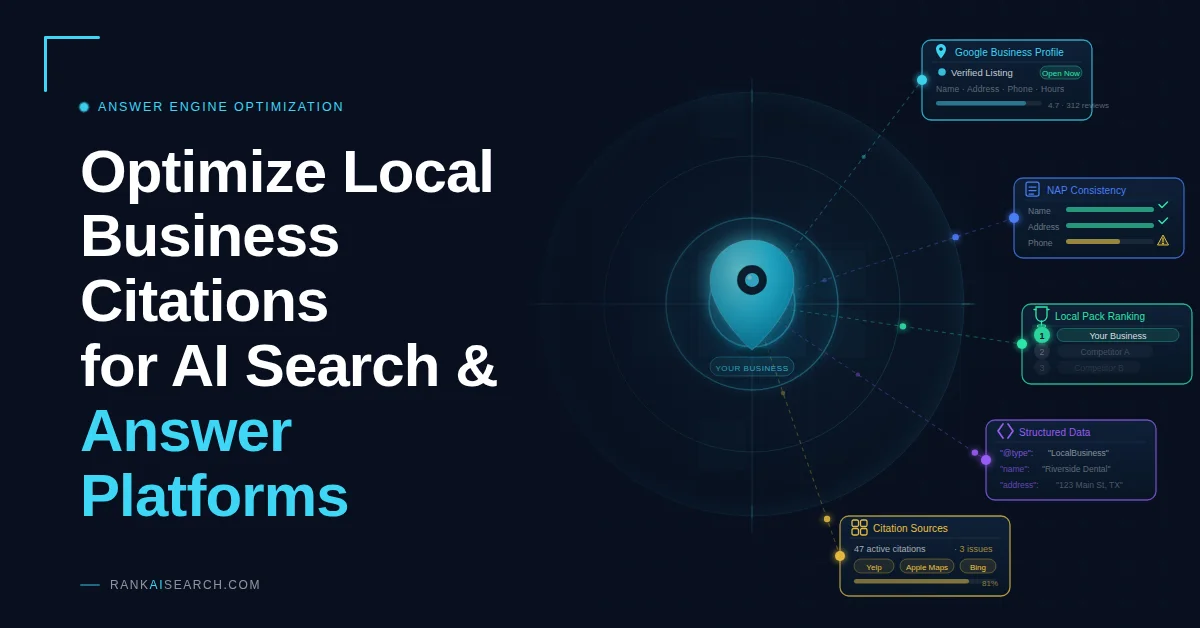
You claimed your Google Business Profile, added your address and phone number, and moved on. But AI search engines do not stop there. Platforms like ChatGPT, Perplexity, and Google AI Overview verify your business by cross-referencing your name, address, and phone number (NAP) across dozens of citation sources simultaneously. The moment they find a mismatch, your business stops being a safe recommendation.
Citations have always mattered for local SEO. In the era of AI answer engines, they matter more because AI systems need certainty before recommending any business to a user. This guide covers which citation platforms carry the most AI weight, how to structure and clean your listings, and how to build a citation strategy that AI systems trust enough to surface consistently.
What Are Local Business Citations in the Context of AI Search?
Local business citations are structured mentions of your NAP across directories, review platforms, and aggregators. AI systems treat them as verified data sources to cross-reference when formulating answers to user queries, not as passive directory listings.
Answer engines like Google AI Overview and Perplexity analyze patterns across multiple citation sources to assess accuracy and trustworthiness. When AI platforms find consistent NAP information across authoritative directories, they gain confidence in recommending your business. When they find conflicting data, they may omit your business rather than risk surfacing incorrect details.
NAP consistency requirements for AI platforms are stricter than for traditional search because these systems compare data points across dozens or hundreds of sources at once. A variation as minor as “St.” versus “Street” or a disconnected phone number is enough to trigger doubt in AI entity-matching algorithms.
| Element | What AI Systems Check |
| Business name | Exact match across all citation sources |
| Address | Full address using postal standards, suite included consistently |
| Phone number | Consistent format, active and reachable |
| Categories | Alignment between platforms |
| Hours | Current, including holiday and temporary closures |
Why Do AI Answer Engines Rely on Citation Data?
AI platforms rely on citations because they need verified, structured data sources to generate accurate local recommendations. Unstructured web content introduces too much uncertainty for systems that must confidently surface specific businesses to users.
Citation signals build brand authority for large language models by demonstrating recognition across multiple authoritative platforms. The more authoritative sources that agree on your business information, the higher your trust score in AI recommendation algorithms. According to BrightLocal’s 2024 Local Consumer Review Survey, 81% of consumers used Google to evaluate local businesses in the past year, which means the citation data feeding into Google’s AI systems affects the vast majority of local discovery decisions.
AI platforms cross-reference multiple citation sources before featuring a business in an answer. If 20 citations display identical NAP data, AI engines assign high confidence to that information. If 15 citations state one thing and 5 state another, AI platforms may exclude the business entirely rather than surface uncertain data to users.
Which Citation Platforms Matter Most for AI Search Visibility?
The highest-impact citation platforms are the ones AI systems actively query when generating answers. General directories, industry-specific sources, and data aggregators each serve a distinct role in the AI recommendation ecosystem.
General Directories
Top-tier general directories supply the foundational business data that AI systems query first when evaluating local recommendations.
| Platform | AI Relevance | Priority Action |
| Google Business Profile | Feeds directly into Google AI Overview | Complete all fields; verify through Google’s process |
| Bing Places | Influences Copilot and ChatGPT via Microsoft’s OpenAI partnership | Mirror your Google Business Profile for completeness |
| Apple Maps | Powers Siri and iOS voice assistant recommendations | Submit through Apple Business Connect |
Industry-Specific Citation Sources
Niche directories carry more weight than generic listings for specialized queries because AI platforms recognize authoritative sector validators. A law firm appearing on Avvo and FindLaw sends stronger authority signals for legal queries than a generic business directory listing would.
Examples by sector:
- Legal: Avvo, FindLaw, Justia
- Medical: Healthgrades, Zocdoc, WebMD
- Restaurants: OpenTable, Yelp, TripAdvisor
- Home services: Angi, HomeAdvisor, Houzz
Professional association directories and Chamber of Commerce memberships add an additional credibility layer. AI platforms interpret these listings as confirmation that a business operates legitimately within a recognized industry structure. Review platforms like Trustpilot and G2 contribute both structured citation data and sentiment signals that AI recommendation systems factor in.
Data Aggregators
Data aggregators distribute business information to hundreds of downstream platforms, including AI search engines that consume their data feeds. Correcting your information at the aggregator level causes changes to propagate automatically across the broader ecosystem.
| Aggregator | What They Feed |
| Neustar Localeze | Google, Bing, and hundreds of downstream directories |
| Acxiom | Broad syndication network including Apple Maps data contributors |
| Factual (now Foursquare) | Location data for apps, maps, and AI platforms |
Many citation inconsistencies persist because outdated aggregator data was never corrected at the source level. Fixing it once at the aggregator removes the error across every downstream platform simultaneously.
How Should You Structure Citations for Maximum AI Readability?
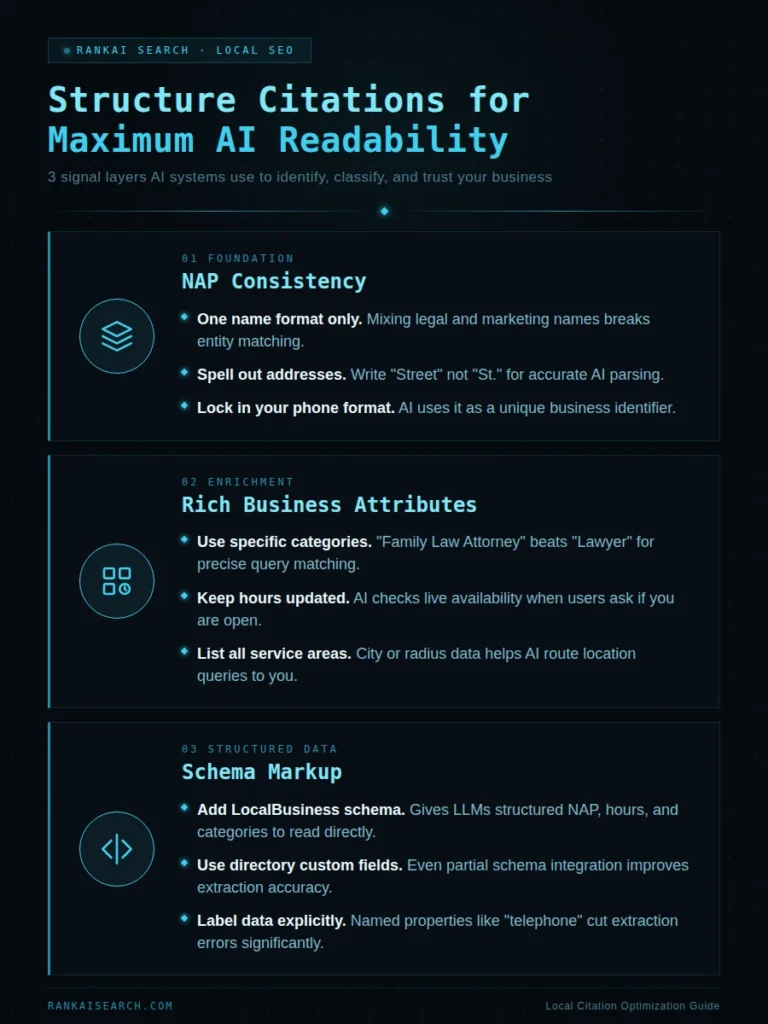
Citations structured for AI readability follow consistent formatting standards, include rich business attributes, and incorporate schema markup wherever possible. All three elements increase AI confidence in your business data.
Ensuring NAP Consistency Across All Platforms
Consistent NAP formatting allows AI systems to confidently match your business entity across sources without ambiguity.
- Business name: Choose one official format and use it everywhere. Do not alternate between “ABC Consulting, LLC” and “ABC Consulting.”
- Address: Use full words rather than abbreviations. Write “Street” not “St.” and “Suite” not “Ste.” Place suite numbers in a consistent position relative to the street address.
- Phone number: Use one format site-wide, either (555) 123-4567 or 555-123-4567. For international listings, use E.164 format (+1-555-123-4567). Avoid vanity numbers in citations since AI systems process numerical digits more reliably.
Adding Rich Business Attributes
Business categories, hours of operation, and service areas are the three attributes AI assistants query most frequently when answering local search requests. Choose the most specific primary category available on each platform: “Family Law Attorney” generates more targeted AI matches than the generic “Lawyer.”
Hours must be current across all platforms, including holiday schedules and temporary closures. For service-area businesses, specify geographic coverage explicitly rather than leaving the field blank or listing an address that does not reflect actual operations.
Incorporating Schema Markup
LocalBusiness schema markup makes citation pages directly machine-readable by providing structured data labels that AI systems extract without needing to parse unstructured text.
When a phone number is explicitly labeled as the “telephone” property in schema, AI systems read it directly rather than inferring it from surrounding text. Add LocalBusiness schema to your own website and any directory profiles that support custom markup.
What Information Should Every AI-Optimized Citation Include?
Every AI-optimized citation needs core NAP plus a set of extended attributes that allow AI engines to match your business to specific user queries. Core NAP alone is not enough for competitive AI visibility.
| Citation Element | What to Include | Why It Matters for AI |
| Business name | Exact registered name, consistent format | Enables entity matching across all platforms |
| Address | Full address, suite number, postal standards | Verifies physical location and local relevance |
| Phone number | One consistent format, no vanity numbers | Used for “call X” voice transitions and contact verification |
| Business description | Service-specific, plain conversational language | Provides context for query-to-business matching |
| Primary category | Most specific option available per platform | Powers “near me” and service-type queries |
| Payment methods | All accepted forms listed | Answers “do you accept X” queries |
| Accessibility features | Wheelchair access, hearing loop, parking | Enables accessibility-specific recommendation matching |
| Multimedia | Exterior/interior photos, virtual tour | Verifies legitimacy; strengthens recommendation confidence |
Business descriptions should read as if answering the question “What does this business do?” Avoid jargon and keyword strings. AI platforms trained on natural language penalize descriptions that read like keyword lists and treat authentic, readable copy as a stronger credibility signal.
How Do You Audit and Clean Existing Citations for AI Compatibility?
A citation audit identifies inconsistencies, duplicates, and outdated information across all platforms where your business appears. Resolving these issues before they propagate to AI knowledge bases is the single highest-impact action most businesses can take to improve AI visibility.
Identifying Citation Inconsistencies
Start by generating a complete list of platforms where your business appears. Tools like Moz Local, BrightLocal, or Semrush Listing Management scan for existing citations automatically. Supplement with manual searches using your business name plus city to catch listings these tools may miss.
Common inconsistency patterns that confuse AI entity-matching algorithms:
- Legal suffix included in some listings, excluded in others (LLC, Inc., Co.)
- Address abbreviations varying across platforms
- Suite number present in some listings and absent in others
- Phone number formatting differences between sources
Prioritize corrections on the platforms AI systems query most frequently: Google Business Profile, Bing Places, Apple Maps, and your top industry-specific directories.
Removing Duplicate and Conflicting Listings
Duplicate citations split your business presence across multiple entries, which AI systems may treat as separate businesses or flag as unreliable. Claim and merge duplicates by verifying ownership through each platform’s standard process. Google Business Profile allows you to mark duplicates directly. For platforms without a clear merge process, contact support with documentation proving business ownership.
For permanently closed locations within multi-location businesses, mark the listing as closed or remove it entirely. Leaving a closed-location listing active causes AI systems to direct users to a defunct address.
Updating Outdated Information Across Networks
Batch update tools allow simultaneous corrections across multiple platforms without manual entry on each site.
| Tool | Best For |
| Yext | Enterprise-scale real-time updates across major platforms |
| Synup | Mid-market businesses managing 10-500 locations |
| BrightLocal | Agencies and small businesses needing audit plus update in one workflow |
For platforms outside these services, apply a tiered update schedule: high-priority sources weekly, medium-priority monthly, low-priority quarterly. Set up Google Alerts for your business name plus city to catch unauthorized edits before they spread.
How Do You Build New Citations That AI Platforms Trust?
New citations built for AI visibility prioritize source authority, accurate information, and gradual acquisition over volume. Low-quality or artificially inflated citation profiles reduce AI trust rather than build it.
Follow this prioritized build sequence:
| Phase | Action | Why |
| 1. Core platforms | Claim Google Business Profile, Bing Places, Apple Maps | These feed directly into the major AI answer engines |
| 2. Top industry directories | Submit manually to your 5 most authoritative sector sources | Niche authority signals carry more weight than generic volume |
| 3. Aggregator submission | Submit to Neustar Localeze, Acxiom, Factual | Triggers downstream distribution across hundreds of platforms |
| 4. Secondary directories | Add 5-10 quality listings per month | Maintains natural velocity; avoids AI spam filters |
| 5. Association and membership directories | Add as memberships are earned | Aligns citation growth with real business milestones |
Write unique business descriptions for each platform rather than copying identical text everywhere. Providing different contextual angles gives AI answer engines multiple reference points when building local recommendations. Identical text across every listing provides no additional context and appears less natural to AI systems.
How Do Customer Reviews in Citations Impact AI Recommendations?
Customer reviews carry significant weight in AI recommendation decisions because they represent aggregated human experience at scale. AI platforms evaluate review volume, recency, ratings, and sentiment when determining which businesses to feature in answers.
Best practices for review acquisition and management:
- Send follow-up emails with direct links to your review profiles on Google, Yelp, and industry directories after each completed transaction.
- Never incentivize reviews with payment or discounts. AI systems detect unnatural acquisition patterns, and policy violations result in review removal or account suspension.
- Respond to every review with specifics: name the service praised in positive responses; describe resolution steps in negative ones.
- Implement Review and AggregateRating schema on your website so AI systems can extract ratings data directly rather than inferring it from unstructured page text.
The businesses AI recommends are not necessarily the most popular. They are the most verifiable. Consistent NAP data, authoritative citations, and authentic reviews are the signals that make a business verifiable to an AI system.
What Role Does Citation Velocity Play in AI Search Rankings?
Citation velocity is the rate at which a business acquires new citations over time. AI systems monitor it to distinguish organic growth from manipulation; unnatural spikes trigger filters that suppress visibility or flag listings for review.
| Velocity Pattern | AI System Interpretation | Risk Level |
| 5-10 new citations per month | Normal organic growth | None |
| 20-30 new citations per week | Elevated; may trigger review | Low to moderate |
| 100+ citations in a single week | Unnatural spike; manipulation signal | High suppression risk |
| Growth tied to business milestones | Credible; matches expected patterns | None |
Strategic citation acquisition aligns new listings with real business events: a location opening, a new service line, or a new professional membership. For multi-location businesses expanding into new markets, build core citations for all new locations before adding secondary sources, staggering the process over weeks rather than days.
How Should You Optimize Citations for Voice Search and AI Assistants?
Citations optimized for voice AI prioritize speakability, accurate hours, and phone number consistency. Voice assistants pull from the same citation data as text-based answer engines but deliver results as spoken output, where abbreviations and formatting inconsistencies cause audible errors.
Format business information for spoken results:
- Write “Suite 100” not “Ste 100.” Voice assistants pronounce abbreviations inconsistently.
- Spell out directional indicators: “North Main Street” not “N Main St.”
- Use a phone number format that reads naturally aloud when converted to speech.
Key citation elements voice AI queries most often:
| Query Type | Citation Element Used |
| “Find [service] near me” | Business category |
| “Is [business] open now” | Hours of operation |
| “Call [business name]” | Primary phone number |
| “Directions to [business]” | Full street address |
Test your citation presence by querying Google Assistant, Siri, and Alexa with prompts like “find plumbers near me,” “is [your business] open now,” and “call [your business name].” Note which citation sources each assistant references and prioritize those platforms first.
How Do You Measure Citation Performance in AI Search Results?
Citation performance in AI search is measured by tracking AI platform mentions, monitoring NAP consistency scores, and correlating citation improvements with changes in how frequently AI engines recommend your business.
Tracking AI Platform Mentions
Monitor AI mentions by regularly querying ChatGPT, Google AI Overview, and Perplexity with local business questions in your category and location. Document when and how each platform mentions your business, and track whether mention frequency increases after citation audits or new high-authority listing additions.
RankAISearch (rankaisearch.com) is an AI search optimization agency that provides monitoring and optimization services across answer engines, covering AEO (Answer Engine Optimization), GEO (Generative Engine Optimization), AIO (AI Overview optimization), LLMO (Large Language Model Optimization), and traditional SEO. Correlating citation health improvements with AI mention data validates where to direct citation investment.
Citation Health Metrics for AI Optimization
| Metric | Target | How to Calculate |
| NAP consistency score | 95% or higher | (Citations with exact NAP match) / (Total citations) |
| Citation authority score | Weighted average, higher is better | Sum of platform authority scores weighted by AI platform integration |
| Geographic coverage | Competitive parity or better | Citations per target market vs. top local competitors |
| Review velocity | Steady month-over-month growth | New reviews per month across citation platforms |
What Are the Most Common Citation Mistakes That Hurt AI Search Performance?
The most damaging citation mistakes create entity-matching problems, reduce AI confidence, or trigger spam filters that suppress visibility entirely. Most are fixable within a standard citation audit.
| Mistake | Why It Hurts AI Visibility | Fix |
| Inconsistent business names | AI cannot confirm two entries are the same entity | Standardize one official name format across every platform |
| Vague business descriptions | AI cannot match your business to specific queries | Replace with service-specific, location-specific language |
| Skipping industry directories | Missing the authoritative signals AI trusts most for sector queries | Add niche directories relevant to your category |
| Keyword stuffing in descriptions | Triggers AI spam filters; penalized by language models | Rewrite for human readers using natural language |
| Virtual or mailbox addresses | Contradicts location data from other sources | Use your actual operating address; use service area fields for coverage |
| Unclaimed duplicate listings | AI may treat duplicates as separate or unreliable entities | Claim, merge, or remove duplicates on each platform |
What Citation Strategies Work Best for Multi-Location Businesses?
Multi-location businesses need separate citation profiles per location, corporate-level formatting standards, and clear entity hierarchy management to maintain AI visibility across all markets simultaneously.
| Business Type | Core Strategy | Key Risk to Avoid |
| Single brand, multiple locations | Separate GBP and directory profiles per location; identical brand elements, unique local NAP | Merging location profiles or using one phone number for all |
| Franchise network | Corporate citation standards document; franchisee training and support | Individual franchisees using inconsistent name formats |
| Parent brand with subsidiaries | Distinct profiles per entity; separate NAP for each division | Using one address across all brands under the parent |
| Multi-market expansion | Build core citations for all new locations before secondary sources | Stacking new citations too fast and triggering velocity filters |
For franchise operations, establish corporate-level standards specifying required platforms, NAP format, description guidelines, and update schedules. Provide franchisees with documentation and designated support rather than leaving citation management to individual discretion. Format variations across a franchise network are among the most common sources of AI entity-matching failures at scale.
How Do You Future-Proof Your Citation Strategy for Emerging AI Platforms?
Future-proofing means building on data accuracy rather than platform-specific optimization. Consistent NAP, authoritative sources, and rich business information are baseline requirements that remain constant as individual AI platforms evolve.
Actions that keep your citation strategy ahead of platform changes:
- Monitor tech announcements from major companies including Meta, Amazon, and emerging AI startups to anticipate which business data sources new platforms will prioritize.
- Track live AI citations by querying ChatGPT, Google AI Overview, and Perplexity regularly for local searches in your category. When a previously minor platform appears as a citation source in AI-generated answers, establish your presence there before competitors do.
- Join practitioner communities where AI search developments are discussed. Early signals about new ranking factors or shifting data source preferences surface in these communities weeks or months before official announcements.
- Tie strategy updates to platform signals, not arbitrary schedules. Adjust based on what AI systems are actually citing rather than waiting for confirmation from search engine documentation.
New AI search features consistently draw from foundational sources like Google Business Profile and established aggregators before expanding to newer directories. Strong coverage at the foundation provides inherent future-proofing regardless of which new platforms emerge.
Frequently Asked Questions
How long does it take for AI search engines to recognize updated citations?
Major platforms like Google Business Profile typically reflect updated citations within 2 to 4 weeks. Changes propagate through data aggregators to downstream AI systems over 1 to 3 months, depending on how frequently each AI platform refreshes its knowledge base. High-authority platforms update in AI systems faster than smaller directories, so prioritize your top 10 citation sources for any critical updates.
Can incorrect citations prevent my business from appearing in AI answer engines?
Yes. When AI platforms encounter conflicting information across multiple sources, they often exclude the business entirely rather than risk providing users with wrong details. Inconsistent phone numbers, mismatched addresses, or varying business names create uncertainty that AI systems resolve by omitting the unreliable entry. A business can rank well in traditional search and remain invisible in AI-generated recommendations if its citation data is inconsistent.
Should I focus on quantity or quality when building citations for AI search?
Quality matters far more than quantity. Ten citations on authoritative, AI-trusted platforms outperform 100 citations on low-quality directories. AI platforms assess the authority of each citation source, not just the total count of sources. Build citations on platforms AI systems actively reference with perfect NAP consistency, then expand gradually to quality secondary platforms once high-authority coverage is established.
How often should I audit my citations for AI optimization?
Audit your top 20 citations monthly and conduct a comprehensive audit of all citations quarterly. Monthly checks on high-priority sources catch unauthorized edits before they propagate to AI systems. Quarterly full audits identify new citations that have appeared, duplicates requiring merging, and emerging platforms gaining AI prominence. After major business changes such as a move, rebrand, or service expansion, conduct an immediate audit across all sources.
Do social media profiles impact AI search visibility?
Social media profiles function as citations when they contain consistent NAP information and AI platforms can access them. Facebook business pages, LinkedIn company profiles, and Instagram business accounts provide citation signals that some AI systems reference for business verification. They carry less weight than dedicated business directories. Ensure all social profiles display NAP information matching your primary citations, but prioritize traditional directories and Google Business Profile first.
What is the minimum number of citations needed for AI answer engine recognition?
Most businesses need 15 to 30 high-quality citations for consistent AI answer engine recognition. Start with Google Business Profile, Bing Places, Apple Maps, and 3 to 5 industry-specific directories. A business with 20 perfectly consistent citations on authoritative platforms outperforms one with 100 inconsistent citations across mixed-quality sources. Focus on the right platforms with accurate information rather than chasing a specific citation count.
How do I manage citations for a business with multiple locations?
Create separate citation profiles for each physical location with location-specific NAP data while maintaining consistent brand elements across all listings. Each location needs its own Google Business Profile, Bing Places listing, and major directory citations. For service-area businesses without storefronts, specify geographic coverage areas rather than listing multiple physical addresses. Use citation management tools that support multi-location workflows to maintain accuracy across all locations without creating conflicting entries.
Can citation optimization alone improve my ranking in Google AI Overview?
Citation optimization significantly improves your chances of appearing in Google AI Overview for local queries, but it works alongside, not independently of, other signals. AI Overview also evaluates website content, review patterns, and user engagement. Citations establish that your business exists and where it operates. Website content quality and review strength determine why AI should recommend you over competitors. A combined approach consistently outperforms citation optimization in isolation.