

Does Claude Cite Sources, and How Do You Get Mentioned?
A marketer can rank in search and still be invisible inside AI answers. Claude may choose another source if that page gives a clearer answer, stronger proof, or better context. That is why brands need content built for both humans and AI systems.
Claude citations depend on access, trust, structure, and entity clarity. Your brand needs pages that answer questions directly and prove why the answer is reliable. This guide explains how Claude cites sources and how to build content it can confidently reference.
Does Claude Cite Sources When Answering Questions?
Yes, Claude cites sources when it uses web search, and it favors clear, factual, well-structured pages from credible sites. To improve your chances of being mentioned, publish authoritative content with direct answers and consistent entity information.
Claude does not cite every answer because not every answer uses live web retrieval. Anthropic says Claude can search the web for current information and provide cited sources when web search is used, which makes searchable authority important for marketers targeting Claude visibility. (Source: Anthropic Help Center, 2026)
Claude citations are not earned through one hidden tag or submission form. They come from a wider system of retrievable pages, clear passages, trusted sources, and brand facts that match the user’s prompt.
When Does Claude Include Citations?
Claude includes citations when it uses web search, research workflows, uploaded documents, or source-grounded retrieval. Claude may not cite when it answers from model knowledge, conversation context, or unsupported general reasoning.
Anthropic’s API documentation states that citations are always enabled for Claude’s web search tool and that each web search citation includes source information from retrieved results. This makes web search the main public path for marketers who want brand pages to be cited. (Source: Anthropic Docs, 2026)
Claude is more likely to need citations when the user asks about current, niche, or verifiable information. That includes pricing, product comparisons, vendor recommendations, company claims, recent research, or policy-sensitive topics.
Questions that often trigger source-backed answers include:
- What is the best agency for GEO?
- Which companies offer LLMO services?
- Compare [brand] with [competitor].
- What does [company] do?
- What are the latest AI search trends?
- Which source supports this claim?
How Does Claude Choose Which Sources to Reference?
Claude references sources that are relevant to the prompt, accessible through retrieval, and useful for grounding the answer. The strongest sources answer the question directly, show credible authorship, and support claims with evidence.
Source choice is not the same as normal organic ranking. A page can rank, but still lose a citation opportunity when another page gives Claude a cleaner passage to reference.
Claude needs two kinds of confidence before citing a page. It needs answer confidence, which comes from relevance and clarity, and source confidence, which comes from authority and trust.
Relevance and Factual Clarity
Relevance and factual clarity mean the page answers the exact user question in extractable language. A focused answer passage is stronger than a broad article that mentions the topic once.
Claude can use passages more easily when the page mirrors how users ask questions. The page should define the term, answer the prompt, and explain the evidence without forcing the model to infer missing context.
Use content elements that match natural prompts:
- Question-based headings
- Direct first-sentence answers
- Clear definitions
- Specific examples
- Short comparison tables
- Named sources
- Updated facts
Source Credibility and Authority
Source credibility means the page gives Claude enough reason to rely on its information. Anthropic advises users to review cited sources because answer quality depends on the source material and the original context behind the response. (Source: Anthropic Help Center, 2026)
Credibility must be visible on the page, not hidden inside a brand claim. Claude can reference a page with more confidence when the author, publisher, update history, and evidence are easy to verify.
How Should You Write Content Claude Can Reference?
You should write content for Claude by making every important section answer one specific question with a direct, self-contained passage. Claude can reference content more easily when the answer, entity, condition, and proof appear close together.
A strong page should not make Claude piece together meaning from scattered paragraphs. It should give Claude a complete answer unit that can stand alone in an AI-generated response.
Direct and Self-Contained Answers
A direct and self-contained answer is a short passage that answers the question without requiring the reader to scan the full article. It should include the topic, answer, condition, and reason in one compact unit.
The first sentence should carry the answer. The next sentence should define the scope or explain why the answer is true.
A useful answer passage follows this order:
- Answer the question.
- Define the condition.
- Add proof.
- Add the practical implication.
Evidence, Examples, and Supporting Context
Evidence and examples make Claude more likely to treat a passage as useful source material. A claim without support gives Claude less reason to cite the page.
Claude can reference pages that include factual support, but the support must match the claim. A statistic about AI adoption does not prove that a specific agency should be cited.
Use these proof types when they fit the section:
- Primary documentation
- Case studies
- Original research
- Screenshots
- Public benchmarks
- Named customer examples
- Expert review notes
How Can You Make Your Brand Easier for Claude to Understand?
You make your brand easier for Claude to understand by keeping your company identity, services, people, profiles, and descriptions consistent across the web. A clear brand entity helps Claude connect your business to the prompts where it belongs.
A brand entity is the structured identity of a company as AI and search systems understand it. A weak entity creates uncertainty because the model may see conflicting names, unclear service categories, or disconnected profile data.
Which Trust Signals Improve Your Chances of Being Mentioned?
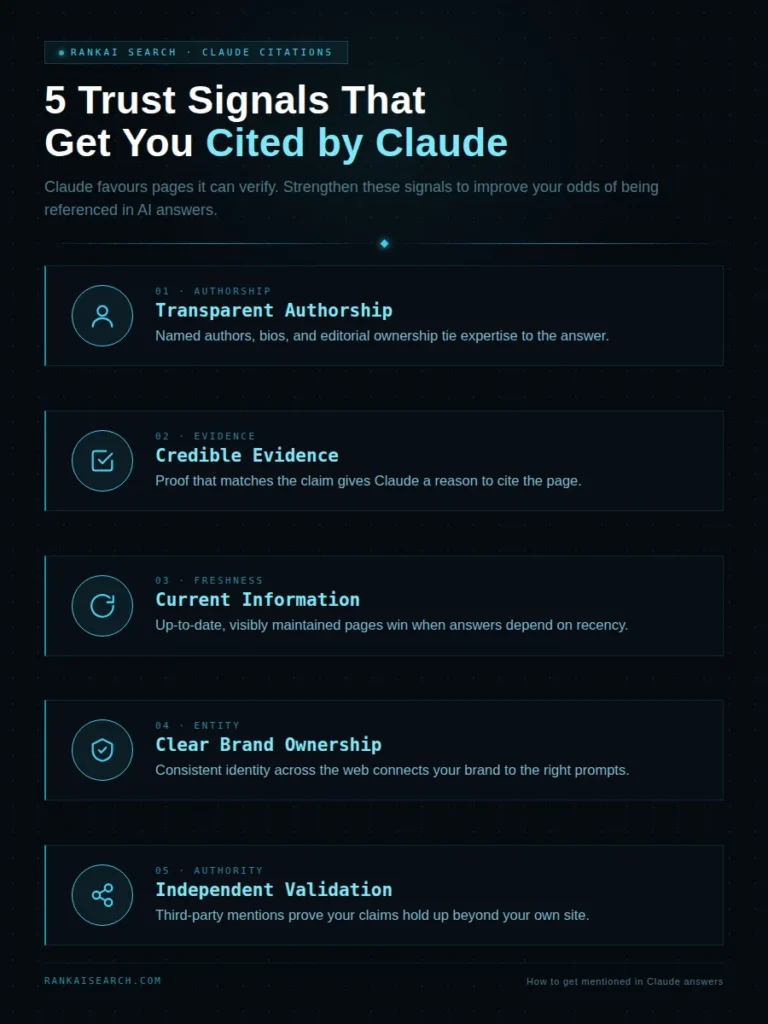
The trust signals that improve your chances of being mentioned include transparent authorship, credible evidence, current information, clear brand ownership, and independent third-party validation. These signals make your content more accountable, verifiable, and dependable for Claude and other retrieval-based AI systems.
Google’s helpful content guidance defines E-E-A-T as experience, expertise, authoritativeness, and trustworthiness, and states that trust is the central element of the framework. Claude is not Google, but public trust signals help any retrieval-based AI system evaluate source quality. (Source: Google Search Central, 2026)
Trust signals should appear at both the page level and brand level. A strong page shows who wrote it, why they can write it, and what evidence supports the claims.
Author and Publisher Transparency
Author and publisher transparency means the page clearly shows who created the content and who is responsible for it. This matters because AI-cited content should be traceable to a real person, brand, or editorial process.
Anonymous content can still be indexed, but it gives weaker confidence signals for commercial and expert topics. A named author or reviewer helps connect expertise to the answer.
Add these trust elements:
- Author name
- Author role
- Author bio
- Reviewer name where relevant
- Published date
- Updated date
- Editorial policy
- Contact page
- Company details
Independent Mentions and Citations
Independent mentions and citations show that other sources recognize the brand or its expertise. Third-party validation helps Claude see that the brand’s claims are supported outside its own website.
Strong independent signals include:
- Industry publication mentions
- Expert interviews
- Partner pages
- Customer case studies
- Review platforms
- Conference speaker pages
- Research citations
- Podcast appearances
How Does Content Structure Affect Claude Visibility?
Content structure affects Claude visibility because structured pages make facts easier to retrieve, parse, and cite. Claude can reference a page more easily when headings, direct answers, tables, and supporting facts make the answer obvious.
Anthropic’s citations documentation says Claude can provide detailed citations that help users verify the source materials behind an answer. Citation-friendly pages make that verification easier because the claim and its support are placed close together. (Source: Anthropic Docs, 2026)
Good structure also helps human readers. A buyer scanning an AI optimization article should find the answer without reading every paragraph.
Use structured formats when they improve extraction:
- Tables for comparisons
- Bullets for simple lists
- Numbered steps for processes
- Short definitions for technical terms
- FAQ sections for exact buyer questions
How Do Freshness and Accuracy Influence Source Selection?
Freshness and accuracy influence source selection when the answer depends on current facts, policies, products, pricing, or research. Claude has more reason to cite a page when the information is current, supported, and visibly maintained.
Accuracy depends on whether the claim can be checked. A page should use primary sources for technical, legal, policy, product, or pricing claims whenever possible.
Refresh priority pages when one of these changes occurs:
- Platform documentation changes
- Pricing changes
- Product features change
- Industry reports update
- Search or AI behavior changes
- Brand positioning changes
- Competitors publish stronger evidence
How Can You Increase Mentions Beyond Your Own Website?
You can increase Claude mentions beyond your own website by earning credible third-party references that explain your brand clearly. Claude may cite external pages about your brand when those pages support the answer better than your owned content.
A 2026 Ahrefs study of Google AI Overview citations found that 38% of cited pages ranked in Google’s top 10 organic results. It shows that AI citation visibility and traditional search visibility overlap but are not identical. (Source: Ahrefs, 2026)
Off-site authority gives Claude more source options. If your brand only appears on your own website, Claude has fewer independent signals to validate the brand’s relevance.
Focus on sources buyers would trust, and work with a specialist to earn them. Weak directory spam does not create the same value as a relevant publication, partner page, or documented case study.
How Can You Check Whether Claude Mentions Your Brand?
You can check Claude mentions by testing a fixed prompt set and recording whether Claude names your brand, cites your website, or cites third-party sources about you. Prompt tracking must be repeated because AI answers can change as sources, models, and retrieval behavior change.
Track mentions, citations, and accuracy separately. A brand mention shows visibility, a citation shows source attribution, and an accurate description shows entity quality.
| Signal | What it shows |
| Brand mention | Visibility — Claude names your brand |
| Citation | Source attribution — Claude links or references your page |
| Accuracy | Entity quality — Claude describes your brand correctly |
Use prompt categories that match buyer intent:
- Best [service] agency for [industry]
- Who helps with [specific problem]?
- Compare [brand] vs [competitor].
- What companies offer [service]?
- How do I choose a [category] provider?
What Can Stop Your Content From Being Cited?
Content can fail to get cited when Claude cannot access it, trust it, extract it, or connect it to the user’s question. Most citation failures come from unclear content, weak authority, outdated evidence, inconsistent brand facts, or technical access problems.
Research on generative search citations found evidence that AI-generated sources appeared in citations across four generative search engines in an audit of 712 real-world queries. This finding shows why brands need stronger authorship, proof, and quality controls than generic AI-written content provides. (Source: Allaham and Diakopoulos, 2026)
Citation blockers usually compound each other. A page with vague headings, no author, no sources, and inconsistent brand language gives Claude little reason to use it.
Avoid these content mistakes:
- Rewriting competitor pages without original insight
- Publishing many thin pages for prompt variations
- Making claims without evidence
- Hiding key content behind scripts or login walls
- Letting author pages remain empty
- Ignoring outdated statistics
- Using schema that does not match visible content
What Should You Remember About Claude Citations?
You should remember that Claude citations depend on retrieval, clarity, credibility, freshness, and entity consistency. A brand needs public evidence that is easy to find, easy to understand, and easy to verify.
Claude visibility should be treated as part of search strategy, not as a separate tactic. The same assets that help buyers trust your brand also help AI systems mention and cite your brand.
A useful Claude citation strategy starts with commercial prompts. These prompts influence discovery, comparison, trust, and purchase decisions.
Marketers should prioritize pages that influence buying decisions:
- Service pages
- Comparison guides
- Category pages
- Original research
- Case studies
- FAQ resources
- Expert explainers
Ready to Improve Your Chances of Being Mentioned by Claude?
Claude is more likely to mention brands with clear answers, visible expertise, reliable evidence, and consistent information across the web. Strengthening these signals gives your content a better chance of being retrieved and trusted.
RankAISearch can help you build a stronger Claude visibility strategy around the prompts that matter most to your customers. See how focused content, entity optimization, and authority building can make your brand easier to reference.
Frequently Asked Questions About Claude Citations
Does Claude cite sources in every response?
No, Claude does not cite sources in every response. Citations usually appear when Claude uses web search, Research, uploaded documents, or another source-grounded workflow.
A response based on general model knowledge may not show citations. Use web search or Research when citation behavior matters.
Does Claude use live web search to find sources?
Yes, Claude can use live web search when the feature is available and relevant to the question. Web search helps Claude answer questions that need current or external information.
Claude may not search for every prompt. Prompts about recent products, companies, statistics, or policies are more likely to need web retrieval.
Can Claude mention a website without linking to it?
Yes, Claude can mention a website or brand without linking to it. A mention is not the same as a citation. Track mentions and citations separately. A brand mention shows visibility, while a citation shows source attribution.
What types of websites does Claude prefer to cite?
Claude is more likely to cite websites that are relevant, credible, accessible, and clear. Strong sources include official documentation, expert articles, research reports, reputable publications, and detailed brand pages.
Commercial pages can be cited when they provide factual value. Pages that only use sales language have weaker citation value.
Does structured data help Claude understand a page?
Yes, structured data can help AI and search systems understand entities, page types, and relationships. Schema is a support signal, not a citation guarantee.
Use Organization, Article, FAQPage, Product, Service, BreadcrumbList, and Person schema where they match visible content. Incorrect schema can create confusion.
Can small or new websites be mentioned by Claude?
Yes, small or new websites can be mentioned by Claude when they provide clear and specific evidence for a prompt. New websites usually need more precise content because they have fewer external authority signals.
Small brands should target narrow prompts first. Original examples, expert authorship, and third-party mentions can help them compete.
How can you tell whether Claude has cited your content?
You can tell whether Claude has cited your content by running target prompts and checking whether your URL appears as a source. Record the prompt, answer, cited URL, model, web search status, and date.
Repeat the same test monthly. AI answers can shift as Claude changes source selection or new pages enter the web.
How long does it take for new content to appear in Claude answers?
New content usually takes weeks to months to appear consistently in Claude answers. The timeline depends on crawlability, source authority, content quality, and prompt competitiveness.
A high-authority site with a clear answer may appear faster. A new site without external validation usually needs more time and supporting mentions.