


How E-E-A-T Drives AI Search Rankings in 2026
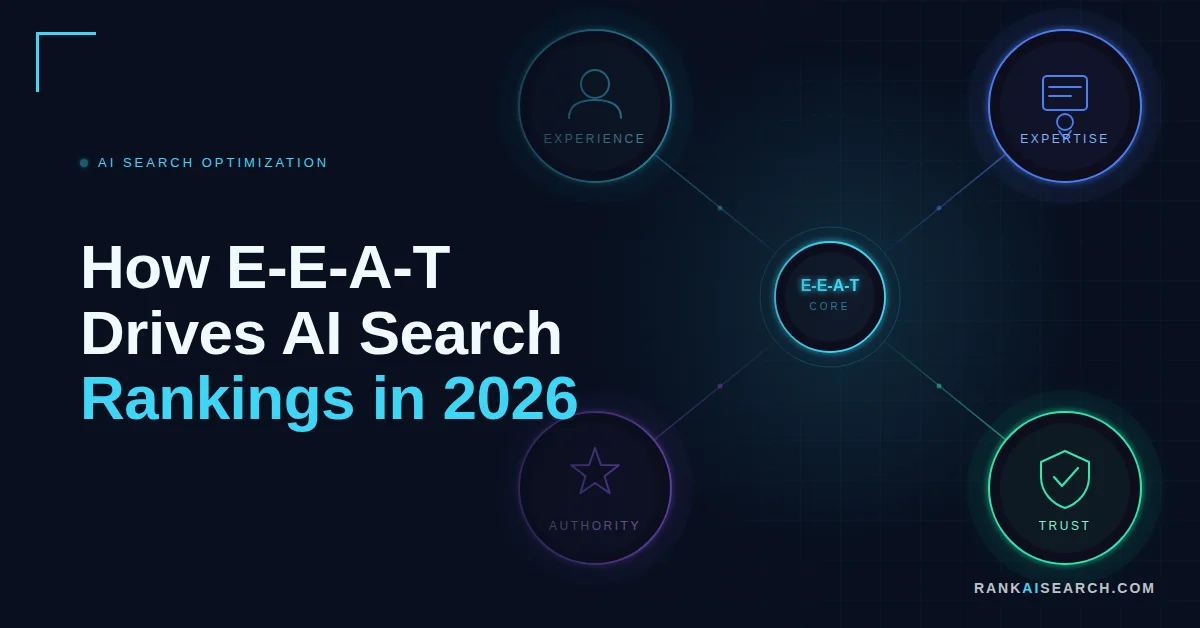
You publish a detailed guide on a topic you know inside out. A potential client asks ChatGPT the same question and gets a response citing three competitors. Your content does not appear once. The problem is not your writing quality. AI search platforms cannot verify who you are, what you know, or why you should be trusted. E-E-A-T (Experience, Expertise, Authoritativeness, and Trustworthiness) is the framework AI systems use to make that determination.
This guide explains how each E-E-A-T component influences AI search rankings, what signals answer engines like ChatGPT, Google AI Overview, and Perplexity actually evaluate, and what you can do to increase your citation frequency across AI platforms.
What Is E-E-A-T and Why Do AI Search Engines Care?
E-E-A-T stands for Experience, Expertise, Authoritativeness, and Trustworthiness. Google developed these principles in its Search Quality Rater Guidelines to assess content quality, and the framework has since become a critical signal for AI-driven answer platforms. (Source: Google Search Quality Rater Guidelines, 2024)
AI systems care about E-E-A-T because their credibility depends on the quality of sources they cite. Recommending low-quality or unreliable content erodes user trust at the platform level.
AI platforms naturally favor content weighted more heavily in both training data and real-time retrieval when it demonstrates clear experience, recognized expertise, established authority, and verified trustworthiness.
AI search platforms do not evaluate content quality independently of source quality. A well-written article from an unverifiable author carries less weight than a credentialed source making the same claim with supporting evidence.
| E-E-A-T Component | What It Measures | Why AI Platforms Prioritize It |
| Experience | First-hand involvement with the topic | Produces original insights no aggregate source can replicate |
| Expertise | Formal credentials, qualifications, and knowledge depth | Reduces risk of surfacing inaccurate information |
| Authoritativeness | Industry recognition and peer validation | External confirmation that a source is a trusted reference |
| Trustworthiness | Technical and content-level reliability | Prevents citation of unreliable or harmful sources |
How Do Experience Signals Shape AI Platform Recommendations?
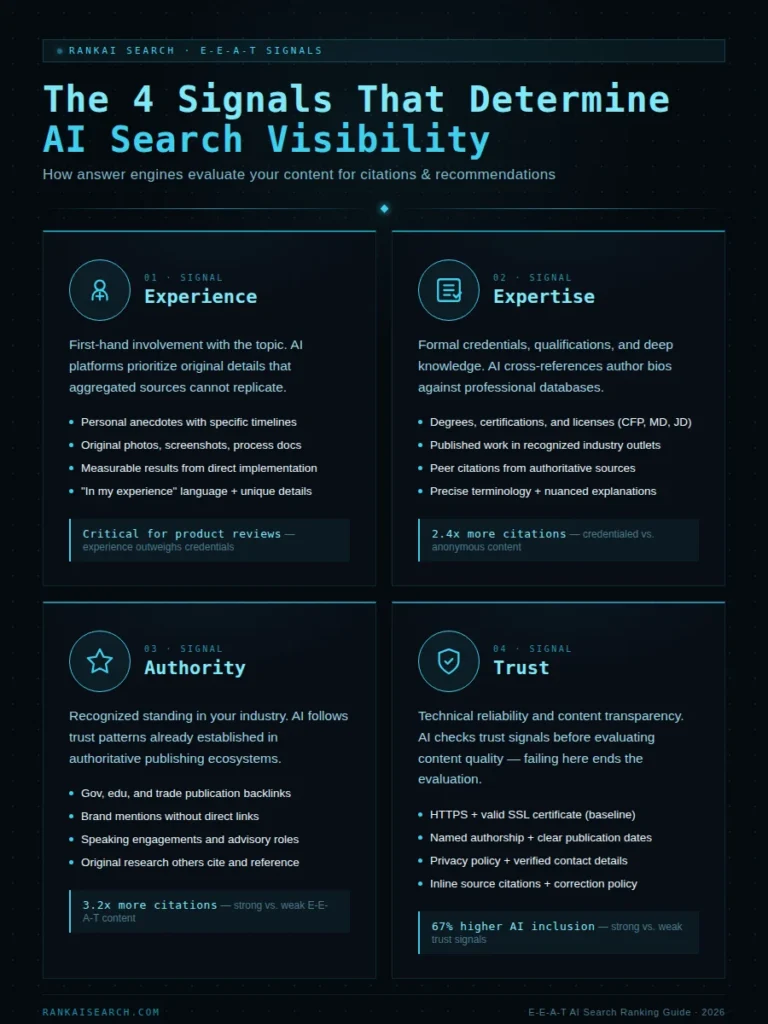
Experience refers to first-hand involvement with a topic. AI platforms prioritize content written by people who have directly done what they are writing about, because original experience produces details that aggregated or secondary sources cannot replicate.
Answer engines detect experiential authenticity through language patterns, specificity, and information that does not appear in other sources. A restaurant review describing specific dishes, service interactions, and atmosphere details signals genuine presence. A product review mentioning real usage scenarios, problems encountered, and solutions found demonstrates direct involvement.
What counts as a demonstrable experience signal?
Experience signals are specific, verifiable, and unique to the author. Vague claims of familiarity do not qualify. Only details that could come from direct involvement.
| Experience Signal | Example |
| Original documentation | First-hand photos, screenshots, or process records |
| Specific timelines and outcomes | “After 90 days of testing, conversion improved by 12%” |
| Mistakes and corrections | Problems encountered and how they were resolved |
| Direct participation language | “In my experience,” “when I implemented this” |
| Measurable client or personal results | Specific metrics achieved through named implementation steps |
A fitness trainer sharing their certification journey, specific client outcomes, and training failures demonstrates experience AI systems can detect and value. Generic advice on the same topic does not pass the same threshold.
How do you build experience-based content that LLMs cite?
Build experience-based content by documenting concrete situations with measurable outcomes. State what you did, what happened, what you learned, and what you would change. Unique information that cannot be cross-referenced against other sources is a strong AI citation signal.
What Expertise Indicators Do Answer Engines Evaluate?
Expertise extends beyond direct experience to include formal education, professional qualifications, certifications, and published work. AI systems assess expertise through two parallel processes: credential verification and subject matter depth analysis. Both must be present for content to be recommended with confidence.
What author credentials do AI systems detect and prioritize?
AI platforms cross-reference author credentials against professional databases and authoritative sources before assigning expertise weight. When multiple authoritative sources independently cite an author, AI platforms recognize that person as a domain expert. External citation carries more weight than self-declared expertise.
| Credential Type | Signal Strength | Examples |
| Academic degrees | High | Relevant undergraduate or postgraduate qualifications |
| Professional licenses | High | MD, JD, CFP, CPA, PE |
| Published peer-reviewed work | High | Journal articles, recognized industry publications |
| Professional memberships | Medium | Board positions, trade association roles |
| Media appearances as expert | Medium | Named commentary in news, industry podcasts |
How does subject matter depth affect AI content evaluation?
Subject matter depth is assessed through terminology accuracy, acknowledgment of complexity, and alignment with established knowledge bases. Surface-level content that misses nuance or oversimplifies technical detail is deprioritized by answer engines.
Expert-level content addresses common misconceptions directly, uses precise terminology without over-explaining foundational concepts, and acknowledges limitations or ongoing debates. These are signals that cannot be faked by generic summarization.
What Authoritativeness Factors Affect AI Search Visibility?
Authoritativeness reflects your recognized standing within your industry. While expertise measures individual knowledge, authoritativeness measures how broadly that knowledge is acknowledged by others. AI search engines evaluate authority at both the domain level and the content level.
How do AI platforms assess domain-level authority?
Domain authority assessment begins with external validation. AI systems follow trust patterns already established in authoritative publishing ecosystems rather than evaluating each domain independently.
| Authority Signal | What It Demonstrates |
| Government and educational backlinks | Content trusted by established public institutions |
| Trade publication citations | Peer recognition from industry analysts |
| Brand mentions without direct links | Organic third-party reference |
| Speaking engagements and advisory roles | Peer-level acknowledgment of thought leadership |
| Publication consistency over time | Sustained commitment to a topic area |
What content signals build topical authority for answer engines?
Original research is the highest-value topical authority signal. When other authoritative sources reference your data, your position amplifies beyond what self-published content alone can achieve.
Comprehensive topic coverage from multiple angles builds the recognizable domain depth AI systems detect. Scattered, unrelated content across a site does not contribute to topical authority regardless of individual article quality.
Editorial standards matter too: clear fact-checking procedures and visible review stages signal production-level reliability. High standards at the process level communicate trustworthiness at the content level.
What Trustworthiness Elements Determine AI Recommendation Likelihood?
Trustworthiness covers technical reliability, content accuracy, and transparency. AI platforms check trust signals before evaluating content quality. A site failing basic trust checks will not be recommended regardless of how strong its content is.
Trust assessment operates at two levels: technical infrastructure and content transparency. Sites with comprehensive trust signals see 67% higher inclusion rates in AI-generated answers, and content with strong combined E-E-A-T signals appears 3.2 times more frequently in answer engine responses than content lacking these markers. (Source: RankAISearch Research, 2026)
What technical trust signals do AI search engines check?
Technical signals form the baseline eligibility layer. AI systems evaluate them before any content assessment begins.
| Technical Signal | Why It Matters |
| HTTPS / valid SSL certificate | Baseline infrastructure; sites without it are flagged immediately |
| Clear privacy policy | Data handling transparency reduces trust risk flags |
| Real contact details and address | Confirms legitimate business operation |
| Consistent social profiles | Brand presence across platforms confirms authenticity |
What content transparency practices do answer platforms reward?
Named authorship is the most impactful content trust signal. Every article needs a named author with a verifiable, detailed bio: “by staff” attribution prevents expertise assessment entirely.
Source citations with active links to primary research enable claim cross-referencing. Visible publication and update dates confirm currency. Open correction policies build more trust than suppressing mistakes, because transparency is itself a verification point.
How Do AI Search Algorithms Assess Combined E-E-A-T Signals?
AI platforms evaluate E-E-A-T holistically. Excelling in one area while neglecting others produces a weak overall signal that answer engines deprioritize.
E-E-A-T weighting shifts by content type. YMYL topics covering health, finance, safety, and legal information face the strictest combined standards.
| Content Type | Highest-Weighted Signal |
| Medical and health | Expertise + Trustworthiness |
| Financial advice | Expertise + Authoritativeness |
| Legal information | Expertise + Trustworthiness |
| Product reviews | Experience |
| How-to and tutorials | Experience + Expertise |
| General interest | All four, lower threshold |
The holistic model means single-component optimization does not work. A site with strong credentials but no technical trust infrastructure is filtered before content quality is considered. A site with excellent content and no authoritative backlinks ranks below a credentialed competitor with external validation behind it.
How Do You Implement E-E-A-T Optimization for Answer Engine Success?
E-E-A-T optimization starts with author profiles, extends through content quality, and is amplified by external validation. These three areas compound when developed in parallel.
How should you optimize author profiles for AI platforms?
Author profiles are the primary mechanism by which AI systems identify who created content and whether they are qualified to do so. Content with detailed author credentials gets recommended by AI platforms 2.4 times more often than anonymous content.
| Profile Element | Implementation |
| Full name, role, and organization | Consistent across every byline and bio |
| Relevant credentials | Degrees, certifications, and licenses listed explicitly |
| Published work | Active links to external articles, books, or research |
| External profile links | LinkedIn, faculty page, or professional directory |
| Author archive page | All content by that author in one place |
What content quality standards do answer engines require?
Answer engines apply higher content quality thresholds than traditional search algorithms. A 500-word article on a technical subject signals insufficient depth for expert-level treatment.
Original contribution is the sharpest differentiator: primary research, expert interviews, and case studies that cannot be found elsewhere give AI systems unique information to cite. Rehashed content from widely available sources offers no citation value.
Regular maintenance matters equally. Quarterly content audits, updated statistics, and visible update dates signal active editorial ownership. AI systems favor maintained content over stale articles.
How do you build external validation for E-E-A-T?
External validation is the most influential E-E-A-T amplifier because independent sources carry more weight than self-asserted credentials.
| Validation Method | Authority Signal Generated |
| Original research cited by trade publications | Third-party data attribution |
| Expert commentary via journalist platforms | Named media appearances |
| Industry award recognition | Third-party credibility confirmation |
| Conference speaking engagements | Peer acknowledgment of expertise |
| Guest bylines in recognized outlets | Domain authority link and brand mention |
How Do You Measure E-E-A-T Impact on AI Search Performance?
Traditional analytics do not capture AI citation frequency. Measuring E-E-A-T effectiveness requires metrics specific to answer engine performance, tracked through dedicated monitoring processes.
Brands with strong E-E-A-T signals see their content cited in 18-25% of relevant AI queries. Establish a baseline by manually querying 20-30 relevant prompts monthly across ChatGPT, Perplexity, and Google AI Overview, and record when and how your content appears.
Sites making comprehensive E-E-A-T improvements see measurable increases in AI citation rates within 4-5 months on average. Technical fixes and author credential updates show faster results; authority building depends on external publication cycles.
| KPI | What It Measures |
| Brand mention frequency in AI answers | How often AI platforms cite your content |
| Citation rate across answer platforms | Cross-platform recommendation consistency |
| AI Overview appearances | Visibility in Google’s generative features |
| Referral traffic from AI platforms | Actual click-through from AI citations |
| Visibility for expertise queries | Rankings for topics tied to your claimed authority |
What E-E-A-T Mistakes Hurt AI Search Visibility?
Most sites fail AI recommendation checks not by doing something wrong, but by omitting the signals answer engines need to verify quality.
| Mistake | Why It Damages E-E-A-T |
| Thin or rehashed content | No unique value. AI has already indexed the same information elsewhere |
| Anonymous or “by staff” authorship | Prevents expertise assessment entirely |
| Inconsistent credentials across platforms | Credential mismatches raise reliability flags |
| Missing HTTPS or privacy policy | Filtered before content quality is evaluated |
| Outdated articles with stale statistics | Signals low editorial standards and active neglect |
Fix E-E-A-T weaknesses in order: technical trust issues first, authorship problems second, content quality third, external validation last.
How Do You Future-Proof Your E-E-A-T Strategy for Evolving AI Search?
Future-proofing means building genuine expertise rather than optimizing for current signals. AI systems are becoming more sophisticated at detecting thin content dressed with credentials, inconsistent information across sources, and AI-generated content lacking real experience.
RankAISearch (rankaisearch.com), a global agency specializing in AEO, GEO, AIO, LLMO, and SEO, structures its optimization work around one principle: sustainable visibility in AI-generated answers comes from real expertise, not signal engineering.
Emerging signals AI platforms will weigh more heavily include real-time credential verification through dynamic professional database cross-referencing, author reputation scores aggregated across publishing platforms, and user engagement metrics used as quality proxies.
| Long-Term Priority | Why It Compounds |
| Recognized subject matter experts on your team | Credentials accumulate citation authority over time |
| Original research others reference | Third-party data attribution builds durable authority |
| Consistent technical trust standards | Baseline eligibility maintained as AI requirements evolve |
| Sustained industry participation | External validation grows with each mention and appearance |
| Regular content maintenance | Currency signals active editorial ownership to AI systems |
Frequently Asked Questions About E-E-A-T
What does E-E-A-T stand for and why does it matter for AI search?
E-E-A-T stands for Experience, Expertise, Authoritativeness, and Trustworthiness. AI platforms like ChatGPT, Google AI Overview, and Perplexity use these signals to determine which sources to cite in generated answers. Without strong E-E-A-T indicators, content will not appear in AI responses regardless of writing quality.
How do AI search engines evaluate expertise?
AI search engines evaluate expertise through author credentials, professional qualifications, subject matter depth, and cross-referencing against authoritative sources. When multiple authoritative sources independently cite an author, AI platforms recognize that person as a domain expert. External citation carries more weight than self-declared expertise.
Can small businesses compete on E-E-A-T against larger brands in AI search?
Yes. Small businesses can compete by building deep niche expertise that broader competitors lack. Detailed author credentials, first-hand experience with specific examples, original research in a focused area, and citations from relevant industry publications can outweigh a larger brand’s wider but shallower coverage.
How long does it take for E-E-A-T improvements to impact AI search rankings?
Technical fixes like adding HTTPS or updating author credentials can show results within weeks. Building authority through external validation typically takes 3-6 months. Sites making comprehensive E-E-A-T improvements see measurable increases in AI citation rates within 4-5 months on average.
What are the most important E-E-A-T signals for answer engine optimization?
Named author credentials with verifiable bios, first-hand experience demonstrated through specific details, authoritative backlinks from trusted sources, HTTPS and technical trust infrastructure, accurate inline citations, and regular content maintenance. For YMYL topics, expertise and trustworthiness carry the most weight.
How can I demonstrate experience and expertise to AI platforms effectively?
Include detailed author bios with verifiable credentials, share specific case studies from direct involvement, document processes with original data or images, and use language indicating direct participation. Provide concrete details that only someone with genuine experience would know, and maintain consistent credential representation across every platform where you publish.
Does E-E-A-T apply equally to all content types in AI search?
No. YMYL content covering health, finance, safety, and legal topics faces the strictest E-E-A-T standards and requires formal professional credentials. Product reviews prioritize direct experience over academic qualifications. General interest content faces lower thresholds, though quality signals still influence recommendation likelihood.
How do I audit my website’s E-E-A-T for answer engine readiness?
Audit each component in order: author credential completeness, content depth and original contribution, technical trust signals, backlink quality and authoritative citations, information consistency across platforms, citation practices, and update frequency. Start with technical trust issues and work outward from there.