

Does FAQ Schema Help Content Get Cited by AI?
A page can answer buyer questions and still be hard for machines to parse. The answer may sit inside a dense paragraph, below several subheads, or between unrelated details. FAQ schema helps content get cited by AI by turning those answers into clear question-and-answer pairs.
The schema alone does not create authority. It only helps AI systems understand content that already deserves attention. This guide explains how FAQ schema supports AI citations and how to use it without relying on markup alone.
Does FAQ Schema Help With AI Citations?
Yes. FAQ schema structures content as explicit question-and-answer pairs, which mirrors how people prompt AI and makes the answers easy for engines to extract and cite. Well-written FAQ entries are some of the most citable content on a page.
FAQ schema is structured data that labels a page’s visible questions and answers using the FAQPage, Question, and Answer types. Google says structured data helps search engines understand page content and gather information about the web, including entities and their relationships. (Source: Google Search Central, 2026)
FAQ schema helps because AI prompts often arrive as questions. A page that pairs the exact question with a direct answer gives AI systems a cleaner unit of information to retrieve, summarize, and cite.
FAQ schema should be treated as a clarity layer, not a citation guarantee. It supports strong answers, but it cannot make vague, unsupported, or low-value content worth citing.
| FAQ Schema Benefit | What It Clarifies | Why It Helps AI |
|---|---|---|
| Question intent | The exact question being answered | Matches conversational prompts |
| Answer boundary | Where the answer starts and ends | Supports extraction |
| Page structure | The page contains Q&A content | Helps classify the content block |
| Entity context | The answer belongs to a specific page or brand | Reduces ambiguity |
| Content consistency | Visible answer matches structured markup | Supports trust |
| Internal usefulness | Answers objections and buyer concerns | Improves user value |
How Does FAQ Schema Help AI Interpret Questions and Answers?
FAQ schema helps AI interpret questions and answers by making the Q&A relationship explicit. It tells machines which text is the question, which text is the answer, and which page owns that answer.
This matters because AI systems must identify answer boundaries before they can summarize or cite a passage. A question in a heading and a direct answer below it is easier to extract than an answer hidden inside a long paragraph.
FAQ schema also helps separate official answers from surrounding content. A page may include pricing, definitions, examples, comparisons, and disclaimers, but the FAQ markup identifies the specific Q&A units.
| FAQ Schema Part | What It Means | AI Interpretation Value |
|---|---|---|
| FAQPage | The page contains FAQ content | Defines the content type |
| mainEntity | The listed questions on the page | Identifies each Q&A item |
| Question | The user-facing question | Matches natural prompts |
| name | The exact question text | Gives the query form |
| acceptedAnswer | The official answer | Defines the answer source |
| Answer | The response content | Supports extraction |
| text | The answer text | Gives the machine-readable answer |
FAQ schema is strongest when the visible page already has clean headings and direct answers. Markup should reinforce the page structure, not hide a weak answer behind structured data.
What Makes an FAQ Answer Worth Citing?
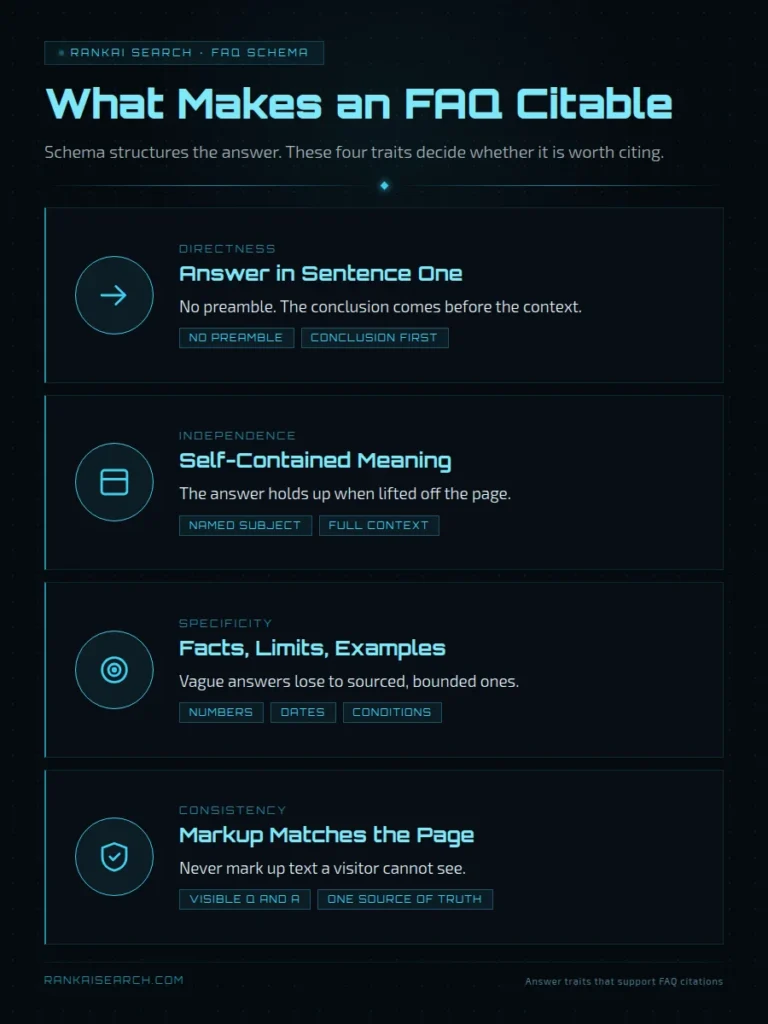
An FAQ answer is worth citing when it is direct, self-contained, specific, accurate, and supported by the page around it. AI systems need answers that can stand alone without losing meaning.
A citable answer should answer the question in the first sentence. Extra context can follow, but the core answer should not require the AI system to infer the conclusion.
The best FAQ answers sound like something a user could quote. They define the term, answer the question, and include a concrete detail that improves confidence.
| Citation-Worthy Trait | What It Looks Like |
|---|---|
| Direct answer | First sentence answers the question |
| Self-contained meaning | The answer makes sense alone |
| Specific detail | Includes numbers, criteria, examples, or limits |
| Clear subject | Names the brand, product, process, or concept |
| Visible support | Page content backs the answer |
| No filler | Removes setup and repetition |
| Current information | Dates and facts are maintained |
Direct and Self-Contained Responses
Direct and self-contained responses answer the full question without forcing the reader or AI system to search the page for missing context. The answer should name the subject, action, and condition clearly.
A weak FAQ answer says, “It depends on your setup.” A stronger answer says, “FAQ schema is useful when the page contains visible questions and answers that match real user intent.”
| Weak Answer | Strong Answer |
|---|---|
| “Yes, it can help.” | “Yes, FAQ schema can help AI interpret visible Q&A content more clearly.” |
| “It depends.” | “FAQ schema is useful when the answers are accurate, visible, and page-specific.” |
| “Use it carefully.” | “Use FAQ schema only for questions and answers that appear on the page.” |
Specific Facts and Supporting Context
Specific facts and supporting context make an FAQ answer more useful for citation. AI systems are less likely to cite vague answers that lack proof, limits, or examples.
A strong answer may include a date, threshold, named source, product condition, policy rule, or example. The added detail should improve understanding without making the answer too long.
| Context Type | Example |
|---|---|
| Date | “Google removed FAQ rich result documentation in June 2026.” |
| Rule | “The FAQ content must be visible to users.” |
| Condition | “Use FAQ schema when the page contains official site-authored answers.” |
| Example | “A service page can answer pricing, timing, eligibility, and warranty questions.” |
| Limitation | “FAQ schema does not guarantee AI citations.” |
Which Pages Benefit Most From FAQ Schema?
Pages that benefit most from FAQ schema are pages with real buyer questions, clear answers, and visible Q&A sections. These often include service pages, product pages, comparison pages, pricing pages, support pages, local pages, and long-form guides.
FAQ schema is not useful just because a page has headings. It is useful when the page answers recurring questions that users, buyers, customers, or AI prompts actually ask.
The best FAQ sections remove friction. They answer objections, clarify scope, explain terms, and help the user make a decision.
| Page Type | FAQ Topics That Help |
|---|---|
| Service page | Pricing, process, timeline, eligibility, guarantees |
| Product page | Fit, specs, compatibility, delivery, returns |
| Local page | Service area, hours, availability, parking, emergency support |
| Pricing page | Plans, billing, cancellation, limits |
| Comparison page | Differences, best fit, tradeoffs |
| Support page | Setup, troubleshooting, account issues |
| Long-form guide | Definitions, steps, mistakes, next actions |
| About page | Credentials, location, team, trust details |
FAQ schema should be page-specific. Repeating the same generic questions across many pages can dilute value and create unnecessary duplication.
How Should You Choose Questions for an FAQ Section?
You should choose FAQ questions from real user intent, buyer objections, sales conversations, support tickets, reviews, search queries, and AI prompts. The best questions reflect what people ask before they trust, buy, book, or cite a brand.
Questions should be specific enough to answer clearly. A broad question like “What should I know?” is weaker than “How long does implementation take?” or “Does this product work with Shopify?”
FAQ retrieval research has treated question similarity and answer relevance as separate signals. This supports writing questions that match real user wording and answers that directly resolve the need. (Source: Sakata et al., 2019)
Each question should earn its place on the page. A question should reduce confusion, support conversion, or clarify a topic that the main content does not fully answer.
| Question Source | Example Question |
|---|---|
| Sales calls | “How long does onboarding take?” |
| Support tickets | “How do I reset my account?” |
| Reviews | “Is this good for beginners?” |
| Search queries | “Does FAQ schema help AI citations?” |
| Product objections | “What happens if it does not fit?” |
| Local intent | “Do you serve this area?” |
| Comparison intent | “How is this different from the cheaper plan?” |
| AI prompts | “What is the best option for small teams?” |
Strong FAQ questions usually cover:
- Definitions
- Eligibility
- Pricing
- Process
- Timing
- Compatibility
- Limitations
- Proof
- Alternatives
- Next steps
How Do You Write FAQ Answers That AI Can Extract Easily?
You write FAQ answers that AI can extract easily by answering first, using plain language, keeping the answer self-contained, and adding only the context needed to verify the claim. The first sentence should be the answer, not an introduction.
AI systems can extract concise answers more reliably when the answer has a clear subject and predicate. A sentence like “FAQ schema helps AI interpret visible question-and-answer content” is easier to process than a long paragraph that circles the point.
FAQ answers should avoid marketing claims that cannot stand alone. “We are the best choice” is weaker than “This plan is best for teams that need weekly reporting and up to five user seats.”
| Writing Rule | Better FAQ Answer |
|---|---|
| Answer first | “Yes, FAQ schema can help AI interpret Q&A content.” |
| Name the subject | “FAQ schema labels each question and accepted answer.” |
| Keep it short | “Use one direct answer, then add support.” |
| Add context | “It works best when the FAQ appears visibly on the page.” |
| Avoid fluff | Remove “Many people wonder” and similar phrases |
| Avoid vague claims | Replace “high quality” with specific proof |
| Include limits | “It does not guarantee citations.” |
Use this answer structure:
- Direct answer
- One supporting fact
- One condition or limitation
- One next step where useful
How Do You Add FAQ Schema to a Webpage?
You add FAQ schema by placing valid structured data on a page that already contains visible FAQ content. The safest default format for most websites is JSON-LD added through a CMS, plugin, template, or manual code block.
JSON-LD means JavaScript Object Notation for Linked Data. The W3C published JSON-LD 1.1 as a formal recommendation, which makes it a mature format for expressing linked data on the web. (Source: W3C, 2020)
The implementation method depends on the site’s technical setup. A WordPress site may use a plugin, while a custom ecommerce or SaaS site may need template-level JSON-LD.
Clean implementation matters more than the tool. The FAQ content, markup, page type, and visible answer should all match.
| Implementation Method | Best Fit | Main Risk |
|---|---|---|
| CMS plugin | WordPress and common CMS pages | Generic or duplicate markup |
| SEO platform | Sites with managed SEO workflows | Limited customization |
| Theme template | Repeated page layouts | Incorrect fields across templates |
| Manual JSON-LD | Custom pages and advanced control | Requires QA and maintenance |
| Tag manager | Limited code access | Rendering and governance issues |
CMS and Plugin Implementation
CMS and plugin implementation uses a website tool to generate FAQ schema from visible FAQ fields or blocks. This is usually the fastest option for marketers without developer access.
Plugins work best when the FAQ content is simple and the page template is stable. They still need validation because plugins can create duplicate, outdated, or incomplete structured data.
| Plugin Check | What To Confirm |
|---|---|
| Visible FAQ content | Markup matches what users see |
| Correct page | FAQ schema appears only where needed |
| No duplication | Theme and plugin do not both output FAQ schema |
| Clean JSON-LD | Code is valid and readable |
| Updates | Edits to FAQ content update the schema |
Manual JSON-LD Implementation
Manual JSON-LD implementation gives developers control over the exact FAQ markup. It is useful when the site has custom templates, dynamic content, or strict schema governance.
Manual code should be generated from the same source as visible content when possible. Hard-coded FAQ schema can become inaccurate when page copy changes.
{ “@context”: “https://schema.org”, “@type”: “FAQPage”, “mainEntity”: [ { “@type”: “Question”, “name”: “Does FAQ schema help content get cited by AI?”, “acceptedAnswer”: { “@type”: “Answer”, “text”: “Yes. FAQ schema structures content as explicit question-and-answer pairs, which makes answers easier for AI systems to interpret and extract.” } } ] }
Manual JSON-LD should be reviewed after every content update. A valid code block can still be wrong if it no longer matches the page.
How Do You Keep FAQ Markup Consistent With Visible Content?
You keep FAQ markup consistent with visible content by marking up only the questions and answers users can see on the page. FAQ schema should never include hidden, altered, or expanded answers that do not appear in the visible content.
Consistency protects trust because structured data is a machine-readable version of the visible page. If the markup says one thing and the page says another, the content sends conflicting signals.
FAQ consistency is also a maintenance issue. A team may edit the visible FAQ answer, but the JSON-LD can remain unchanged if it is hard-coded separately.
| Consistency Check | What To Review |
|---|---|
| Question text | Same wording in visible content and schema |
| Answer text | Same meaning in visible content and schema |
| Page relevance | FAQ belongs on that page |
| Hidden content | No marked-up answers hidden from users |
| Duplicate markup | No conflicting FAQ schema blocks |
| Freshness | Dates, policies, and facts stay current |
| Entity match | Answer refers to the correct product, service, or brand |
Use one source of truth when possible. The CMS field that displays the FAQ should also populate the schema output.
Does FAQ Schema Still Matter Without a Search Rich Result?
Yes, FAQ schema can still matter without a search rich result because its value is structured interpretation, not only visual enhancement in traditional search results. It can still help organize page meaning for systems that read structured data or extract Q&A content.
This change means FAQ schema should not be sold as a rich-result tactic for most sites. Its role is now better understood as content clarity, not search-result decoration.
FAQ sections still help users even when no rich result appears. They answer objections, reduce friction, support internal links, and create concise answer passages.
| Old FAQ Schema Goal | Better Current Goal |
|---|---|
| Earn expandable FAQ snippets | Clarify visible Q&A content |
| Increase SERP real estate | Improve answer extraction |
| Add more markup everywhere | Mark up useful page-specific answers |
| Chase a rich result report | Validate content consistency |
| Treat schema as a trick | Treat schema as a clarity layer |
FAQ schema should stay only when it accurately describes useful visible content. Removing valid FAQ schema just because one Google search feature changed can remove a useful machine-readable signal.
What Are the Limitations of FAQ Schema for AI Citations?
FAQ schema cannot guarantee AI citations, rankings, traffic, or brand mentions. It helps structure the answer, but AI systems still weigh relevance, authority, freshness, source trust, content quality, and competing pages.
A page can have perfect FAQ schema and still fail to earn citations. If the answer is generic, unsupported, outdated, or weaker than another source, the markup alone will not fix the problem.
The right expectation is practical. FAQ schema can make strong answers easier to interpret, but it cannot make weak answers authoritative.
| Limitation | What To Do Instead |
|---|---|
| No citation guarantee | Improve answer quality and authority |
| No trust replacement | Add sources, proof, and expertise |
| No content rescue | Rewrite thin answers |
| No freshness fix | Update outdated facts |
| No ranking shortcut | Improve the whole page |
| No platform control | Track AI answers across tools |
| No substitute for visibility | Build entity and source authority |
FAQ schema should be part of a broader AI search workflow. It is a support signal, not a standalone growth engine.
Which FAQ Schema Mistakes Should You Avoid?
You should avoid FAQ schema mistakes that create hidden content, duplicate questions, wrong answers, unsupported claims, outdated facts, or page-level mismatch. These mistakes reduce trust and make the page harder for machines to interpret.
The most common mistake is marking up FAQ content that users cannot see. Another common mistake is copying the same FAQ block across many pages, even when the questions do not belong there.
FAQ mistakes often happen during scaling. Templates, plugins, migrations, and content refreshes can leave outdated schema behind.
| FAQ Schema Mistake | Why It Hurts |
|---|---|
| Hidden FAQ content | Creates mismatch with visible page |
| Same FAQs everywhere | Creates duplication and weak relevance |
| Overlong answers | Reduces extractability |
| Vague answers | Gives AI little usable information |
| Keyword-stuffed questions | Looks manipulative |
| Outdated policy answers | Creates factual risk |
| Marking up reviews as FAQs | Uses the wrong content type |
| Multiple conflicting FAQ blocks | Creates interpretation issues |
Avoid FAQ markup when the content is not truly an FAQ. A paragraph with a question-like heading is not always a valid Q&A section.
How Can You Test Whether Your FAQ Markup Is Valid?
You can test FAQ markup with Schema Markup Validator, rendered HTML review, crawl tools, code review, and structured data checks. Testing confirms whether the code is valid, visible, accurate, and page-specific.
FAQ validation should not only check syntax. A technically valid FAQ block can still be misleading if it marks up hidden answers or copies questions from another page.
Schema.org’s Schema Markup Validator checks structured data against Schema.org vocabulary and can validate JSON-LD, Microdata, and RDFa. (Source: Schema.org Validator, 2026)
| Testing Step | What To Check |
|---|---|
| Schema validation | Syntax and vocabulary |
| Rendered HTML | Whether schema appears after rendering |
| Visible content review | Whether users can see the Q&A content |
| Page relevance | Whether questions belong on that page |
| Duplicate check | Whether another tool outputs the same schema |
| Crawl check | Whether markup appears sitewide correctly |
| Content QA | Whether answers are accurate and current |
Testing should happen before publishing and after major edits. FAQ markup can break during CMS updates, theme changes, plugin changes, or content migrations.
What Should You Remember About FAQ Schema for AI Citations?
You should remember that FAQ schema helps AI systems interpret clear question-and-answer content, but it does not guarantee citations. Its strongest value is making useful answers easier to identify, extract, and connect to the page.
FAQ schema works best when the answer is already strong. The page still needs accuracy, authority, freshness, internal context, and visible usefulness.
| Principle | Practical Action |
|---|---|
| Write for questions | Match real user prompts |
| Answer first | Put the direct answer in sentence one |
| Mark up visible content | Keep schema aligned with the page |
| Stay specific | Add facts, limits, and examples |
| Avoid duplication | Use page-specific FAQs |
| Test markup | Validate code and visible content |
| Track performance | Monitor AI mentions and cited sources |
FAQ schema should be reviewed as part of content maintenance. Questions, answers, policies, product details, and citations can all become outdated.
Are You Ready to Make Your Answers Easier for AI to Reference?
FAQ schema works best when it supports direct, accurate, and self-contained answers. Clear question-and-answer pairs make it easier for AI systems to identify useful passages without sorting through vague introductions, unrelated details, or inconsistent page structure.
RankAISearch can help review your FAQ content, identify schema issues, and strengthen the connection between your visible answers and structured markup. This creates a clearer framework for users while giving AI tools more reliable information to interpret and reference.
Book a consultation with RankAISearch to uncover weak FAQ sections, correct implementation problems, and improve your content’s citation readiness.
Frequently Asked Questions About FAQ Schema and AI Citations
Does FAQ schema guarantee that AI will cite a page?
No, FAQ schema does not guarantee that AI will cite a page. It helps AI systems interpret Q&A content, but citation depends on relevance, authority, clarity, freshness, and competing sources. FAQ schema should support strong answers. It cannot make a weak or unsupported answer citation-worthy.
Can FAQ schema be added to any type of webpage?
FAQ schema can be added to a webpage only when the page contains visible questions and answers. The markup should describe real FAQ content on that page. It works best on pages where users have clear follow-up questions. Service, product, support, pricing, local, and guide pages are common fits.
Should FAQ answers be short or detailed?
FAQ answers should be short enough to extract and detailed enough to be useful. The first sentence should answer the question directly. A good answer often uses one short paragraph for the answer and one short paragraph for context. Add detail only when it improves accuracy or decision-making.
Does the FAQ content need to be visible to users?
Yes, FAQ content should be visible to users. Marking up hidden questions and answers creates a mismatch between structured data and the visible page. Visible FAQ content builds trust for both users and machines. The schema should mirror the answer people can read.
Can the same FAQ questions appear on multiple pages?
The same FAQ questions should not appear on many pages unless they are genuinely relevant to each page. Repeated generic FAQs can create duplication and weaken page specificity. A better approach is to tailor questions to the page’s topic. Product, service, location, and comparison pages should answer different questions.
Is FAQ schema useful even when Google does not show a rich result?
Yes, FAQ schema can be useful even when Google does not show a rich result. Its value is structured interpretation, not only search-result display. FAQ schema can help label useful Q&A content. It can also support AI extraction when the answers are visible, specific, and page-relevant.
How many questions should an FAQ section contain?
An FAQ section should contain only the questions that help users understand the page. Most pages do not need a fixed number. A short, specific FAQ section can outperform a long generic one. Quality and relevance matter more than volume.
Can incorrect FAQ markup reduce a page’s credibility?
Yes, incorrect FAQ markup can reduce a page’s credibility by creating conflicting or misleading signals. Problems include hidden answers, outdated facts, duplicate schema, and questions that do not match the page. The fix is to validate markup and compare it with the visible page. FAQ schema should describe the real content accurately.