

Does Ranking #1 Still Matter When AI Overviews Skip the Blue Links?
The old SEO goal was simple: reach the top result and win the click. AI Overviews have made that path less direct because users may get the answer before scrolling. Ranking #1 still matters, but its value now depends on whether the page also earns citations, trust, and follow-up action.
This does not make top rankings useless. It makes them part of a wider visibility system that includes AI answers, organic clicks, brand mentions, and conversions. This guide explains when ranking first still pays off and when being cited matters more.
Does Ranking Position Still Matter in AI Search?
Yes, ranking position still matters, but its value has shifted. A top-10 Google ranking still signals trust and relevance, and many AI Overviews and chatbot answers draw their sources from that same top tier. The difference is that position #1 no longer guarantees a click; it increasingly earns a citation instead.
Ranking position still helps because organic visibility reflects relevance, authority, and page quality. Those same signals can influence whether a page becomes eligible for AI selection.
Ahrefs found that 38% of Google AI Overview citations came from pages ranking in the top 10 organic results. That means top rankings still matter, but citation selection is not limited to page-one results. (Source: Ahrefs, 2026)
You should treat ranking as one visibility input. The new goal is to rank, get cited, attract qualified clicks, and influence the buyer before the click.
| Search Metric | Old Value | AI Search Value |
|---|---|---|
| Position #1 | Highest organic click opportunity | Strong visibility and citation potential |
| Top-10 ranking | Page-one exposure | Source eligibility for AI answers |
| Featured placement | Click and attention capture | Answer extraction opportunity |
| AI citation | Not tracked in classic SEO | Source influence inside generated answers |
| Brand mention | Secondary brand signal | Recommendation and trust signal |
| Organic click | Main SEO outcome | One of several outcomes |
| Conversion | Website-based action | Website action plus AI-assisted demand |
How Do AI Overviews Change the Value of a Top Ranking?
AI Overviews change the value of a top ranking by placing an answer layer above or near traditional results. A top-ranking page can still matter, but the user may read the AI answer before deciding whether to click.
The number-one result used to be the clearest winner for many queries. AI Overviews can weaken that advantage when the answer satisfies the user on the results page.
Pew Research Center found that Google users clicked a traditional search result in 8% of visits when an AI summary appeared, compared with 15% when no AI summary appeared. (Source: Pew Research Center, 2025)
The top ranking now has two jobs. It must still win the organic click, and it must provide source material that AI systems can cite.
| Top Ranking Value | What Changed With AI Overviews |
|---|---|
| Visibility | Still visible, but often below the AI answer |
| Trust signal | Still important for source selection |
| Click capture | Weaker on some informational queries |
| Citation opportunity | Stronger when the page has extractable answers |
| Brand exposure | Can happen without a click |
| Measurement | Must include CTR, citations, and conversions |
AI Overviews make search position more conditional. Ranking #1 matters most when the user still needs depth, proof, product detail, contact, or action.
Why Can Lower-Ranking Pages Still Earn AI Citations?
Lower-ranking pages can earn AI citations when they provide clearer, more specific, or more useful source material than the top organic result. AI citation systems can select sources differently from the classic ranking system.
This happens because an AI answer needs passages that support a specific claim. The page that ranks first may be authoritative overall, but another page may answer the prompt more directly.
Lower-ranking pages usually win citations when they give AI systems a cleaner answer unit. That means direct definitions, clear tables, sourced statistics, comparisons, and procedural steps.
| Why a Lower-Ranking Page Gets Cited | What It Usually Has |
|---|---|
| Better passage match | A direct answer to the prompt |
| Clearer evidence | Named sources, dates, and statistics |
| Stronger structure | Tables, lists, and question headings |
| More specific context | Use case, audience, or category fit |
| Better freshness | Updated facts or recent examples |
| Less ambiguity | Clear subject and scope |
| Unique value | Original data, tool, framework, or example |
A page does not need to outrank every competitor to influence an AI answer. It needs to be retrievable, useful, trusted, and easy to quote.
Which Search Queries Still Reward the Number-One Position?
The number-one position still matters most for branded, navigational, transactional, local, product, support, and high-intent commercial searches. These searches often require a website visit because the user needs to act, verify, compare, buy, book, or contact.
AI summaries are less likely to replace the click when the user has a clear action goal. A user searching for a login page, pricing page, store location, product detail, or checkout path still needs the destination site.
Backlinko’s analysis of 4 million Google results found that the number-one organic result had an average CTR of 27.6%. This shows why top placement still matters when the query produces traditional organic clicks. (Source: Backlinko, 2025)
The top ranking is most valuable when the page controls the next step. Examples include demo requests, ecommerce purchases, bookings, downloads, account access, and quote forms.
| Query Type | Why Position #1 Still Matters |
|---|---|
| Branded | User wants the official source |
| Navigational | User wants a specific page |
| Transactional | User needs to buy, book, or sign up |
| Local | User needs directions, hours, or contact |
| Product | User needs specs, reviews, or pricing |
| Support | User needs instructions or troubleshooting |
| Commercial comparison | User needs proof before deciding |
| High-risk topic | User needs source verification |
AI can influence these searches, but the website still closes the loop. The click remains important when the user cannot complete the task inside the AI answer.
When Does an AI Overview Reduce Organic Clicks?
An AI Overview reduces organic clicks most often when it satisfies simple informational intent directly on the search results page. The click loss is strongest when the user needs a definition, fact, list, short explanation, or basic how-to answer.
The user does not need to visit a page when the AI answer already resolves the question. This makes commodity informational content more exposed than product, service, local, or transaction pages.
Click loss is not uniform. A page can lose clicks on simple queries but still gain visibility through citations or branded follow-up searches.
| Query Pattern | Click Risk | Reason |
|---|---|---|
| Definition query | High | AI can answer in one paragraph |
| Simple fact | High | User needs one data point |
| Basic how-to | Medium to high | AI can summarize steps |
| Broad informational guide | Medium | User may stop at summary |
| Comparison query | Medium | User may still need proof |
| Product query | Lower | User needs details or action |
| Branded query | Lower | User wants official source |
| Transactional query | Lower | User must complete an action |
Pages exposed to AI Overview click loss should not only chase traffic. They should also be structured to earn citations and push users toward deeper value.
What Is More Valuable: Ranking First or Being Cited?
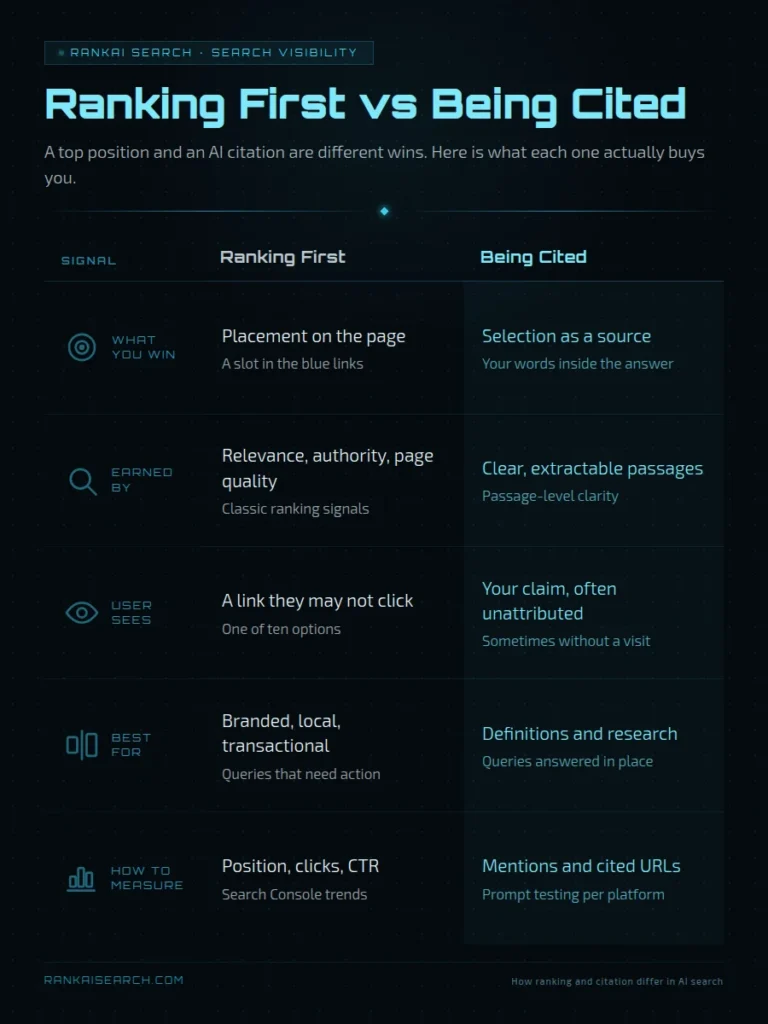
Ranking first is more valuable when the query produces high-intent clicks, while being cited is more valuable when the AI answer satisfies much of the user’s need. The best outcome is to rank strongly and be cited in the AI answer.
A ranking creates placement. A citation creates source influence. Both can support trust, but they affect the user in different ways.
You should value rankings by query intent. A cited answer can be useful for awareness, but a number-one ranking on a demo, pricing, or local service query can still produce more direct revenue.
| Scenario | More Valuable Outcome | Why |
|---|---|---|
| Basic definition | AI citation | User may not click |
| Product pricing | Ranking and click | User needs details |
| Local service | Ranking and map visibility | User needs contact or booking |
| Complex comparison | Both | User needs summary and proof |
| Thought leadership | Citation | Brand authority matters |
| Branded query | Ranking #1 | User wants official source |
| Support query | Ranking and cited answer | User needs exact steps |
| Research report | Citation and link | Source authority matters |
Ranking and citation should not be treated as rivals. They are connected outcomes in a broader search visibility system.
How Should You Optimize for Both Rankings and AI Citations?
You optimize for both rankings and AI citations by combining classic SEO fundamentals with passage-level citability. The page must be crawlable, relevant, authoritative, useful, and structured with clear answers AI systems can extract.
A strong page should satisfy the user even if the AI answer never appears. It should also give the AI system clean source material if the answer does appear.
The optimization model has three layers. The first layer earns ranking eligibility, the second earns citation eligibility, and the third earns the user’s click.
| Optimization Layer | Goal | Main Work |
|---|---|---|
| Search relevance | Rank for the query | Intent match, content depth, page quality |
| Page authority | Compete with trusted sources | Links, mentions, citations, proof |
| Passage citability | Earn AI source selection | Direct answers, evidence, clear structure |
| Click value | Encourage website visits | Unique assets, tools, examples, next steps |
| Conversion path | Turn visits into outcomes | CTAs, forms, demos, contact paths |
Search Result Relevance and Page Authority
Search result relevance and page authority help a page become eligible for organic visibility and AI source consideration. A page should answer the query better than competing pages and show why the source deserves trust.
Authority can come from backlinks, expert authorship, brand recognition, original data, reviews, citations, and third-party mentions. AI systems need signals that reduce uncertainty about the source.
| Authority Signal | Why It Supports Ranking and Citations |
|---|---|
| Backlinks | Show external recognition |
| Expert authorship | Connects content to qualified people |
| Original data | Creates unique evidence |
| Reviews | Supports brand trust |
| Digital PR | Builds third-party validation |
| Updated sources | Improves freshness |
| Internal links | Connects related topics |
| Clear entity facts | Helps systems identify the brand |
Extractable Answers and Supporting Evidence
Extractable answers and supporting evidence make a page easier for AI systems to cite. A passage should answer one question with a clear subject, direct claim, and proof.
| Citability Element | What To Add |
|---|---|
| Direct answer | First sentence answers the question |
| Question heading | H2 or H3 mirrors the prompt |
| Concrete fact | Number, date, condition, or example |
| Source attribution | Named source near the claim |
| Table | Structured comparison or criteria |
| Definition | Self-contained meaning |
| Limitation | Clear scope and exceptions |
Unique Value That Encourages the Click
Unique value that encourages the click gives users a reason to visit after reading an AI answer. The page should contain something the AI summary cannot fully replace.
This can include calculators, tools, templates, visuals, original data, downloadable resources, interactive demos, expert analysis, comparison filters, or product-specific proof.
| Click-Worthy Asset | Why Users Still Visit |
|---|---|
| Calculator | User needs a personalized output |
| Original research | User wants full data and method |
| Template | User wants a usable asset |
| Product demo | User needs to evaluate the tool |
| Case study | User wants proof and context |
| Comparison table | User needs detailed trade-offs |
| Pricing page | User needs current cost |
| Visual guide | User needs screenshots or examples |
How Can a Top-Ranking Page Remain Click-Worthy?
A top-ranking page remains click-worthy by offering depth, tools, examples, current proof, visuals, templates, product details, and next steps that AI summaries cannot fully satisfy. The click needs a reason beyond “read more.”
The page should confirm the AI answer quickly and then offer additional value. A user who clicks from an AI Overview expects the page to support the answer, not restart the explanation.
A click-worthy page should make the user’s next step obvious. That next step can be buying, booking, comparing, downloading, calculating, checking compatibility, or contacting the brand.
| Click-Worthy Page Element | Why It Works |
|---|---|
| Fast answer block | Confirms relevance immediately |
| Original examples | Adds value beyond the AI summary |
| Interactive tool | Requires the page experience |
| Current data | Gives deeper proof |
| Product detail | Supports buying decisions |
| Comparison chart | Helps users evaluate options |
| Visuals or screenshots | Shows what the answer means |
| Clear CTA | Turns interest into action |
A page that only repeats generic facts is easier for AI to replace. A page with unique value earns both citations and clicks.
How Should You Measure Search Performance Beyond Position?
You should measure search performance beyond position by tracking impressions, clicks, CTR, conversions, AI citations, AI mentions, AI referrals, source freshness, and assisted revenue. Average position alone cannot show how AI features affect visibility or business value.
A ranking report can say a page is winning while clicks fall. It can also miss AI citations that influence users without sending traffic.
Google Search Console explains that the Performance report shows clicks, impressions, CTR, and average position. Google recommends focusing more on trends in impressions and clicks than on position alone. (Source: Google Search Console Help, 2026)
A modern report should separate classic SEO performance from AI answer influence. This helps teams identify whether a page is losing demand, losing clicks, or gaining no-click visibility.
| Metric | What It Shows | Why It Matters |
|---|---|---|
| Average position | Organic placement | Shows ranking movement |
| Impressions | Search exposure | Shows visibility |
| CTR | Click efficiency | Shows SERP impact |
| Organic clicks | Search traffic | Shows visits |
| Conversions | Business outcomes | Shows value |
| AI citations | Source use in AI answers | Shows answer influence |
| AI mentions | Brand visibility | Shows awareness |
| AI referrals | Visits from AI tools | Shows traffic from answer engines |
| Assisted revenue | Indirect impact | Shows commercial influence |
Citations, Mentions, and AI Visibility
Citations, mentions, and AI visibility show whether answer engines use or recommend the brand. These metrics capture search influence that ranking reports miss.
Track target prompts across Google AI Overviews, AI Mode, ChatGPT, Perplexity, Gemini, Claude, and Copilot. Record whether the brand appears, which source is cited, and whether the answer is accurate.
| AI Visibility Metric | What To Record |
|---|---|
| Brand mention | Whether the brand appears |
| Citation URL | Which source is used |
| Competitor mention | Which brands appear instead |
| Answer sentiment | Whether the description is accurate |
| Source freshness | Whether the citation is current |
| Prompt class | Informational, commercial, local, or support |
| Position overlap | Whether cited pages also rank organically |
Clicks, Conversions, and Assisted Revenue
Clicks, conversions, and assisted revenue show whether search visibility produces business impact. A page can lose some clicks and still produce better leads if AI search prequalifies users.
Measure traffic quality by landing page, query class, source, conversion rate, lead quality, and revenue. Do not judge AI-era search only by total organic sessions.
| Business Metric | Why It Matters |
|---|---|
| Organic conversions | Shows direct SEO value |
| AI referral conversions | Shows answer-engine traffic value |
| Branded search lift | Shows delayed demand |
| Demo or form submissions | Shows sales intent |
| Ecommerce revenue | Shows purchase value |
| Pipeline influence | Shows B2B impact |
| Assisted conversions | Shows non-linear journeys |
Why Is Topical Coverage More Important Than One Number-One Ranking?
Topical coverage is more important than one number-one ranking because AI systems and search engines need evidence that a brand understands the whole topic, not one isolated query. A single ranking can win one search, but topical authority can influence many prompts.
AI search often breaks a query into related sub-questions. A brand with strong coverage across definitions, comparisons, use cases, examples, data, and FAQs gives retrieval systems more useful source material.
Topical coverage also protects against volatile rankings. If one page loses position, related pages can still earn visibility, citations, and referrals.
| Topical Coverage Asset | Why It Helps |
|---|---|
| Definition page | Establishes core meaning |
| How-to guide | Answers procedural prompts |
| Comparison page | Supports evaluation queries |
| Use-case page | Matches specific audiences |
| Data report | Creates citable evidence |
| FAQ section | Answers follow-up questions |
| Product or service page | Supports commercial intent |
| Case study | Provides proof |
A topical cluster should connect pages with internal links. The site should make it clear which page is the main authority and which pages support specific subtopics.
Which Ranking Strategies Are Losing Value in AI Search?
Ranking strategies losing value include thin keyword pages, answer-burying intros, generic content, weak listicles, unsupported claims, clickbait titles, and pages built only to match one keyword variation. AI search reduces the value of content that can be summarized without needing the source.
Old SEO tactics often aimed to win the result page. AI-era SEO needs the page to support answer extraction, source trust, and user action.
Ranking strategies lose value when they create pages that look useful to algorithms but feel interchangeable to users. AI systems can easily replace content that adds no original evidence or perspective.
| Losing Strategy | Better Strategy |
|---|---|
| Thin keyword variation pages | Build one stronger intent-matched page |
| Long setup before answer | Answer in the first sentence |
| Generic listicles | Add criteria, proof, and examples |
| Unsupported claims | Cite sources and show evidence |
| Keyword stuffing | Use natural language and entity clarity |
| Link-only authority building | Earn mentions, reviews, and expert proof |
| Static content | Refresh facts and examples |
| Ranking-only reporting | Track citations and conversions |
The strongest pages still follow SEO fundamentals. They also give AI systems better passages to cite and users better reasons to click.
What Should You Remember About Ranking Position in the AI Search Era?
You should remember that ranking position still matters, but it is no longer the only measure of search success. The best search strategy tracks rankings, citations, mentions, clicks, referrals, conversions, and revenue.
| Key Point | Practical Action |
|---|---|
| Ranking still matters | Keep tracking average position and top-10 visibility |
| Clicks are less guaranteed | Watch CTR by query type |
| Citations matter more | Build extractable answer passages |
| Authority still matters | Earn links, mentions, and trusted references |
| Lower pages can be cited | Optimize passages, not only positions |
| Topical coverage matters | Build clusters around buyer questions |
| Business value matters | Connect search visibility to revenue |
Ranking #1 is still worth pursuing when the query has business value. It should be part of a broader plan that also earns citations and qualified visits.
Are You Ready to Turn Search Rankings Into Citations and Customers?
A strong organic position creates more value when the page can also earn AI citations, attract qualified clicks, and guide visitors toward a meaningful action. Direct answers, reliable evidence, topical authority, and unique on-page value help your content perform beyond its numerical ranking.
RankAISearch can evaluate where your highest-ranking pages are losing citation, click, or conversion opportunities. This creates a clearer strategy for strengthening passage-level citability, protecting high-intent traffic, and measuring the business impact of your visibility across traditional and AI search.
Request an AI visibility review from RankAISearch to identify which ranked pages need stronger citation signals, click-worthy value, and conversion paths.
Frequently Asked Questions About Search Rankings and AI Overviews
Do AI overviews only cite pages ranking in the top 10?
No, AI Overviews do not only cite pages ranking in the top 10. Top-10 pages often appear as citations, but AI systems can cite pages outside the first organic page. This means ranking helps but does not guarantee citation. Passage clarity, evidence, relevance, and source trust also matter.
Can a page rank first without appearing in an AI overview?
Yes, a page can rank first without appearing in an AI Overview. The AI Overview may cite another source that better supports the generated answer. This can happen when the top page is broad, unclear, outdated, or less extractable. A strong ranking does not automatically make a page the best citation source.
Can a lower-ranking website be cited above the top result?
Yes, a lower-ranking website can be cited above the top result inside an AI Overview. AI systems can select sources based on answer support, not only organic position. Lower-ranking pages can win citations when they provide direct answers, structured evidence, original data, or clearer explanations. This is why passage-level optimization matters.
Which query types are most affected by AI overviews?
Informational queries, definition queries, simple facts, broad research questions, and basic how-to searches are often most affected. These queries can be answered directly inside the AI Overview. Commercial, local, branded, and transactional queries are less replaceable. Users still need websites to buy, book, compare, verify, or contact.
Does an AI citation improve a page’s organic ranking?
An AI citation does not have a confirmed direct ranking benefit. A citation shows that an AI system selected the page as a useful source for that answer. The indirect value can still be meaningful. Citations can increase brand exposure, trust, referral traffic, and follow-up branded searches.
Should you still track average ranking position?
Yes, you should still track average ranking position. It remains useful for understanding organic visibility and competitive movement. Average position should be paired with impressions, CTR, clicks, conversions, AI citations, and AI mentions. A ranking without clicks or citations may have less business value than it once did.
How can you tell whether rankings are driving AI visibility?
You can tell whether rankings are driving AI visibility by comparing ranked pages with AI-cited pages for the same prompts and queries. Track whether your top-ranking pages are also cited in AI Overviews, ChatGPT, Perplexity, Gemini, Claude, and Copilot. Record the cited URL, answer wording, source freshness, and competitor presence. Repeat the same prompts over time because AI answers can change.
Is ranking first still worth the investment?
Yes, ranking first is still worth the investment when the query has commercial value, strong demand, or citation potential. The number-one position can still drive clicks, trust, and AI source eligibility. The investment should not stop at ranking. The page should also be optimized for citations, user value, conversion, and brand authority.