

Does Schema Markup Help Your Content Get Cited by AI?
Think of schema markup as a label system for your website. It tells machines whether a page is an article, product, service page, FAQ, author profile, or organization page. That structure can help AI engines interpret your content more accurately.
Better interpretation can improve citation opportunities, but it does not guarantee them. Schema works best when the visible content is already useful, current, and authoritative. This guide explains how schema markup helps AI search and which schema types matter most.
Does Schema Markup Help With AI Search?
Yes. Schema markup helps AI engines understand your content’s structure, entities, and relationships, improving how accurately they interpret and cite you. Article, Organization, Product, and FAQ schema are the most useful types for AI.
Schema markup is structured data added to a webpage to describe meaning in a machine-readable format. Google says it uses structured data to understand page content and gather information about the web, including people, books, and companies. (Source: Google Search Central, 2026)
Schema helps because AI systems need context, not just keywords. A page may mention a brand, service, product, author, and topic in one article, and structured data helps machines separate those entities.
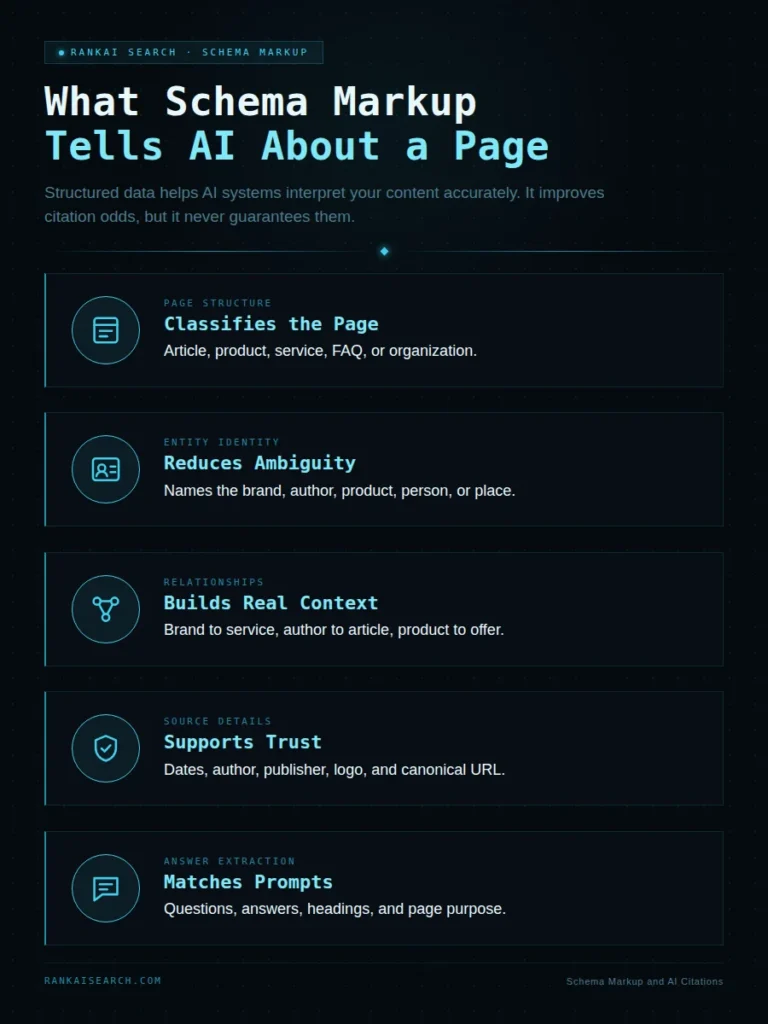
| Schema Benefit | What It Helps AI Understand | Why It Matters |
| Page structure | Article, product, service, FAQ, or organization | Helps classify the page |
| Entity identity | Brand, author, product, person, or place | Reduces ambiguity |
| Relationships | Brand to service, author to article, product to offer | Builds context |
| Source details | Dates, author, publisher, logo, URL | Supports trust signals |
| Answer extraction | Questions, answers, headings, and page purpose | Helps match prompts to content |
What Does Schema Markup Tell AI About a Page?
Schema markup tells AI systems what a page is, what entities appear on it, and how those entities relate to each other. It turns visible page meaning into structured labels that machines can process more consistently.
A page can describe a company in prose, but schema can identify that company as the publisher, provider, seller, employer, or product brand. This distinction matters because AI systems need to understand the role each entity plays.
Schema also helps separate the page topic from supporting mentions. For example, an article may mention five companies, but mainEntity can clarify the central subject of the page.
| Schema Element | What It Communicates | Example |
| @type | The type of entity | Article, Organization, Product |
| name | The entity name | Brand, product, author, or page name |
| description | A concise entity summary | Service or product description |
| author | Who created the content | Person or organization |
| publisher | Who published the page | Company or media brand |
| dateModified | When content was updated | Currentness signal |
| mainEntity | The primary subject | Product, FAQ, service, or topic |
| sameAs | Matching identity URLs | Official profiles or reference pages |
Schema is most useful when it confirms what users can already see. Hidden or unsupported facts in structured data can create trust problems instead of clarity.
Which Schema Types Matter Most for AI Visibility?
The schema types that matter most for AI visibility are Organization, Article, Product, Service, FAQPage, Person, BreadcrumbList, and WebPage schema. These types help AI systems connect the brand, page, author, content, offer, and answer structure.
The right schema type depends on the page’s job. A homepage needs brand identity markup, while a product page needs product and offer details.
Schema types work best as a connected graph. A strong article page can identify the author, publisher, topic, breadcrumbs, update date, and main entity in one structured system.
| Schema Group | Main Purpose | Best Use |
| Brand schema | Identifies the organization | Homepage, About page, sitewide graph |
| Content schema | Defines editorial material | Blog posts, guides, resources |
| Product schema | Defines product details | Product pages and ecommerce pages |
| Service schema | Defines service offers | Agency, SaaS, local, and B2B pages |
| FAQ schema | Labels questions and answers | FAQ sections with visible answers |
| Person schema | Defines authors and leaders | Author pages and expert profiles |
Brand and Publisher Schema
Brand and publisher schema identifies the organization behind the website. It helps AI systems understand which domain is official, which company published the content, and which public profiles connect to the same brand.
Organization schema can include the brand name, URL, logo, contact details, social profiles, and administrative details. Google says adding Organization structured data to a homepage can help it understand administrative details and disambiguate an organization in search results. (Source: Google Search Central, 2026)
| Schema Type | Best Page Fit | Main AI Value |
| Organization | Homepage, About page, sitewide graph | Defines the brand entity |
| LocalBusiness | Local business pages | Connects brand to location |
| Person | Author and leadership pages | Connects expertise to people |
| WebSite | Homepage or sitewide graph | Defines the website entity |
| BreadcrumbList | Most indexable pages | Clarifies site hierarchy |
Content, Product, and Service Schema
Content, product, and service schema explains whether a page is informational, commercial, transactional, or instructional. This helps AI systems understand whether the page should support an answer, describe an offer, or verify a product fact.
Product and service markup should only include facts visible on the page. Google’s Product structured data documentation says product markup can help product information appear in richer ways in Google Search, including Google Images and Google Lens. (Source: Google Search Central, 2026)
| Schema Type | Best Page Fit | Main AI Value |
| Article | Blog posts, guides, news, resources | Defines editorial content |
| Product | Product detail pages | Defines product facts |
| Service | Service pages | Defines offer and service scope |
| Review | Review content | Defines evaluation details |
| HowTo | Instructional pages where supported | Defines ordered steps |
Question-and-Answer Schema
Question-and-answer schema labels visible questions and answers in a structured format. It helps machines identify direct answers when the page contains genuine FAQ or Q&A content.
FAQ schema should be used for clarity, not as a shortcut to search enhancements. Google limited FAQ rich results in 2023 to well-known, authoritative government and health websites. This means most brands should value FAQ markup for machine understanding rather than rich-result display. (Source: Google Search Central Blog, 2023)
| Schema Type | Best Page Fit | Main AI Value |
| FAQPage | Site-authored FAQ sections | Defines official answers |
| QAPage | Community Q&A pages | Defines user questions and answers |
| Question | Individual question entity | Identifies the query |
| Answer | Accepted or official answer | Identifies the response |
How Should You Match Schema to the Page Type?
You should match schema to the primary purpose of the page. The markup should describe what the page actually is, not what the brand wants the page to rank for.
Page-type matching matters because schema sends classification signals. A service page marked only as an article may understate its commercial role, while a product page marked mainly as an FAQ may hide important offer details.
A page can have more than one schema type when the content supports it. A service page can use Service, Organization, BreadcrumbList, and FAQPage if each type reflects visible content.
| Page Type | Best Schema Match | Add When Relevant |
| Homepage | Organization, WebSite | LocalBusiness, sameAs |
| About page | Organization, Person | founder, sameAs |
| Blog post | Article, BlogPosting | Person, Organization |
| Service page | Service, Organization | FAQPage, BreadcrumbList |
| Product page | Product, Offer | AggregateRating, Review |
| FAQ page | FAQPage | WebPage, Organization |
| Author page | Person | sameAs, knowsAbout |
| Case study | Article, CreativeWork | Organization, Service |
The best schema choice follows the user’s expectation. If a user lands on a pricing page, the markup should support pricing, offers, products, or services instead of describing the page only as generic content.
How Does Schema Clarify Entities and Their Relationships?
Schema clarifies entities by assigning names, types, identifiers, and relationships to the important things on a page. This helps AI systems understand whether a name refers to a company, product, person, place, article, service, or offer.
Entity relationships matter because AI systems build answers from meaning. A clean schema graph can connect a brand to its authors, services, products, offers, profiles, and supporting pages.
The sameAs property is especially useful for identity clarity. Schema.org defines sameAs as a URL that points to a reference page that unambiguously indicates an item’s identity. (Source: Schema.org sameAs, 2026)
A brand with inconsistent entity signals is harder for AI systems to describe accurately. Schema can reduce that ambiguity when it matches visible content and official profiles.
| Relationship | Schema Property | Example |
| Brand owns website | publisher or provider | Organization publishes article |
| Person wrote article | author | Author connected to guide |
| Page focuses on entity | mainEntity | Product is main subject |
| Entity matches profile | sameAs | Brand linked to official profiles |
| Product belongs to brand | brand | Product connected to company |
| Service offered by company | provider | Agency offers GEO services |
| Page belongs in hierarchy | BreadcrumbList | Blog category and article path |
How Can You Add Schema Markup to Your Website?
You can add schema markup with a CMS plugin, SEO platform, tag manager, or manual JSON-LD code. JSON-LD is the best default for most modern websites because it can be managed without wrapping every visible HTML element.
The implementation method should match the website’s complexity. A small WordPress site may use an SEO plugin, while a large ecommerce or SaaS site may need template-level JSON-LD controlled by developers.
Clean implementation matters more than the tool. The final markup should be valid, page-specific, and consistent with the visible page.
| Implementation Method | Best Fit | Main Watchout |
| SEO plugin | WordPress and standard CMS sites | Generic or duplicate schema |
| Ecommerce app | Shopify, WooCommerce, BigCommerce | Product data must stay current |
| Tag manager | Teams without full code access | Rendering and maintenance risk |
| Manual JSON-LD | Custom websites and complex templates | Requires developer QA |
| Template-level schema | Large sites with repeatable layouts | Needs accurate data fields |
Plugin-Based Implementation
Plugin-based implementation uses SEO plugins, ecommerce apps, or schema extensions to generate structured data. This is usually the fastest option for non-technical teams.
Plugins work best when page templates are simple and the website has standard content types. They can create Organization, Article, Product, Breadcrumb, and FAQ markup with fewer manual steps.
| Plugin Benefit | Watchout |
| Fast setup | May create generic schema |
| Easy maintenance | May duplicate markup |
| CMS integration | May miss custom fields |
| Template support | May not fit complex page types |
| Lower technical barrier | Still requires validation |
Manual JSON-LD Implementation
Manual JSON-LD implementation uses custom structured data added to a page, template, or application layer. This gives developers more control over schema fields, entity relationships, and page-specific logic.
Manual schema is useful when the website has custom products, dynamic service pages, complex author data, or advanced entity relationships. It also helps large sites avoid duplicate or incomplete plugin output.
{
“@context”: “https://schema.org”,
“@type”: “Article”,
“headline”: “Does Schema Markup Help Your Content Get Cited by AI?”,
“author”: {
“@type”: “Organization”,
“name”: “RankAISearch”
},
“publisher”: {
“@type”: “Organization”,
“name”: “RankAISearch”,
“url”: “https://rankaisearch.com”
}
}
Manual JSON-LD should be generated from trusted data sources. Hard-coded schema can become inaccurate when authors, prices, services, or dates change.
How Do You Keep Schema Consistent With Visible Content?
You keep schema consistent with visible content by marking up only facts that users can verify on the page. Schema should confirm the page’s meaning, not add hidden claims for machines.
Consistency matters because schema becomes part of the evidence layer around your content. If the visible page says one thing and structured data says another, the page sends conflicting signals.
Schema should update when the page updates. Prices, product availability, dates, authors, service names, locations, and review counts can become wrong if structured data is not tied to the same source as visible content.
| Schema Field | Visible Content Check |
| headline | Matches page title or article title |
| author | Author appears on the page |
| dateModified | Update date is accurate |
| Product | Product is visible on the page |
| Offer | Price and availability match the page |
| FAQPage | Questions and answers are visible |
| Organization | Brand facts match official site content |
| Review | Review text is visible and genuine |
Use one source of truth for brand and product data. Schema should pull from the same database, CMS fields, or content model that powers the visible page.
How Can You Test and Validate Structured Data?
You can test structured data with Google’s Rich Results Test, Schema Markup Validator, Search Console reports, crawl tools, and manual code review. Validation confirms syntax, eligibility, and meaning before the markup becomes a long-term site signal.
Testing should happen before publishing and after publishing. A schema block can be valid JSON while still using the wrong type, missing important fields, or contradicting visible content.
A full validation process needs both technical review and editorial review. Developers can confirm syntax, while SEO and content teams confirm whether the markup accurately describes the page.
| Testing Tool | What It Checks | When To Use It |
| Rich Results Test | Google-supported rich result eligibility | Before and after publishing |
| Schema Markup Validator | Schema.org syntax and vocabulary | During implementation |
| Search Console | Detected structured data issues | After indexing |
| Page source review | Final rendered markup | During QA |
| Crawl tools | Sitewide schema patterns | During audits |
| Manual content review | Visible content consistency | Before deployment |
Testing should also look for duplicate graphs. Duplicate schema from plugins, themes, and manual code can make a page harder to interpret.
What Can Schema Markup Not Do for AI Search?
Schema markup cannot guarantee AI citations, rankings, traffic, or positive brand mentions. It improves machine understanding, but AI systems still evaluate relevance, authority, freshness, quality, and competing sources.
Schema is not a replacement for useful content. A weak page with perfect structured data can still lose to a stronger page with clearer evidence and stronger authority.
Ahrefs tracked 1,885 pages that added JSON-LD schema between August 2025 and March 2026 and compared them with 4,000 control pages across Google AI Overviews, AI Mode, and ChatGPT. The study found that adding schema alone barely moved AI citations. (Source: Ahrefs, 2026)
This finding does not mean schema has no value. It means schema works best as support for pages that already deserve to be retrieved, understood, trusted, and cited.
| Schema Cannot Do | What You Need Instead |
| Guarantee AI citations | Strong content and trusted sources |
| Replace authority | Third-party validation and topical depth |
| Fix wrong visible content | Updated page copy |
| Hide weak evidence | Real proof and citations |
| Override search quality | Helpful content and technical access |
| Force rich results | Eligibility and policy compliance |
| Correct brand confusion alone | Entity cleanup across the web |
Schema should be measured as part of a broader system. The right question is not whether schema alone caused citations, but whether schema helped strong pages become easier to interpret.
Which Schema Mistakes Can Reduce Content Trust?
The schema mistakes that can reduce content trust include inaccurate markup, mismatched page types, duplicate schema, hidden claims, fake reviews, outdated details, and structured data that conflicts with visible content. These errors make the page harder for search and AI systems to interpret reliably.
The most damaging problems occur when schema presents a different version of the page than users can see. Conflicting product prices, author details, service information, review data, or update dates can weaken accuracy and entity clarity.
Many schema issues come from copied templates, overlapping plugins, or fields that are not updated with the page. Structured data should always describe the real content and use the correct schema type for the page’s primary purpose.
| Mistake | Why It Hurts |
| Marking hidden content | Creates mismatch with visible page |
| Using the wrong schema type | Misclassifies the page |
| Duplicating plugin and manual schema | Sends conflicting graphs |
| Adding fake reviews | Damages trust and policy compliance |
| Using outdated prices | Creates inaccurate product data |
| Omitting author or publisher | Weakens source clarity |
| Ignoring dateModified | Makes freshness unclear |
| Copying schema from another page | Creates inaccurate entities |
Avoid schema shortcuts. Structured data should describe the real page, not create a machine-only version of the page.
How Should Schema Fit Into a Broader AI Search Strategy?
Schema should fit into a broader AI search strategy by clarifying entities, reinforcing content structure, and connecting pages to trusted brand facts. It should work beside strong content, technical accessibility, internal links, third-party authority, and AI visibility tracking.
Schema helps machines interpret the page, but broader AI visibility depends on the evidence around the page. AI systems need clear answers, trusted sources, current facts, crawlable content, and consistent entity signals.
Schema should be built into content workflows instead of added only during audits. Every new page should have a page-type schema plan before publishing.
| AI Search Layer | Role of Schema |
| Content quality | Labels the content but does not replace it |
| Entity optimization | Defines brand, author, product, and service relationships |
| Technical SEO | Works with crawlability and indexability |
| Internal linking | Reinforces page hierarchy and topic clusters |
| Third-party authority | Supports facts that outside sources validate |
| AI tracking | Helps connect cited pages to structured entities |
| Conversion strategy | Clarifies offers users reach after AI discovery |
Schema is most powerful when it connects content to an entity strategy. A page should not only be marked up correctly, but also fit into a clear topic, brand, and authority system.
What Should You Remember About Schema Markup and AI Citations?
You should remember that schema markup helps AI systems interpret content, but it does not guarantee citation. Its main value is making page meaning, entities, and relationships easier to verify.
Schema works best when the visible content is useful, accurate, current, and authoritative. The markup should clarify facts that are already strong enough to support an AI answer.
Schema also needs maintenance. Product prices, author names, service details, review counts, and update dates can become wrong if the markup does not update with the page.
| Key Takeaway | Practical Action |
| Schema supports understanding | Mark up the real page purpose |
| Schema is not a ranking shortcut | Improve content and authority |
| Entity clarity matters | Use Organization, Person, and sameAs carefully |
| Page type matters | Match schema to the page |
| Accuracy matters | Keep markup aligned with visible copy |
| Testing matters | Validate before and after publishing |
| Maintenance matters | Review after every major content update |
Schema should be viewed as AI-readable documentation for your website. It tells machines what the page means in a format they can process more consistently.
Are You Ready to Make Your Content Easier for AI to Interpret?
Schema gives AI systems clearer context about your pages, entities, authors, products, and services. When the markup matches visible content, it can reduce ambiguity and support more accurate interpretation.
RankAISearch can help align your schema, content structure, and entity signals across key pages. Strengthen the machine-readable foundation that supports your broader AI search visibility.
Frequently Asked Questions About Schema Markup for AI Search
Does schema markup guarantee that AI will cite a page?
No, schema markup does not guarantee that AI will cite a page. It helps machines understand the page, but citation depends on relevance, authority, freshness, clarity, and competing sources. Schema should be treated as support, not a promise. The page still needs useful content and credible evidence.
Which schema type should a business website add first?
A business website should usually add Organization schema first. It defines the brand entity and connects the website to official business facts. After that, add page-specific schema. Service pages, articles, products, FAQs, and author pages should use markup that matches their purpose.
Is JSON-LD better than microdata for AI search?
JSON-LD is the best default format for most websites. It is easier to maintain because it can sit in a script block without wrapping every visible HTML element. Microdata can still work when implemented correctly. The stronger choice depends on technical setup, but JSON-LD is usually cleaner for modern SEO workflows.
Can incorrect schema harm AI visibility?
Yes, incorrect schema can harm AI visibility by creating conflicting or misleading machine-readable signals. It can also reduce trust when structured data does not match visible content. The fix is to validate markup and review it against the live page. Schema should describe only what users can verify on the page.
Does FAQ schema still help if search engines do not show rich results?
Yes, FAQ schema can still help clarify question-and-answer content even when it does not create a visible rich result. Its value is machine understanding, not only a search-result enhancement. FAQ markup should only be used when the page contains visible questions and answers. Do not add FAQ schema to content that is not formatted as an FAQ.
Should every page on a website contain structured data?
Every important indexable page should contain relevant structured data, but not every page needs the same schema type. The markup should match the page’s purpose. A contact page, article, product page, and service page should not share identical schema. Each page should describe its own primary entity and function.
How often should schema markup be reviewed or updated?
Schema markup should be reviewed after major content, product, service, pricing, author, or template changes. It should also be checked during quarterly technical SEO audits. Dynamic websites need stronger maintenance. Product availability, ratings, dates, and author details can become inaccurate if schema is not tied to current data.
Can AI understand content that does not use schema markup?
Yes, AI can understand content that does not use schema markup. AI systems can read visible text, headings, links, citations, and page context. Schema makes understanding easier and more explicit. It reduces ambiguity when several entities, products, authors, or services appear on the same page.