


How Do Citation Signals Impact AI Search Recommendations and Brand Authority?
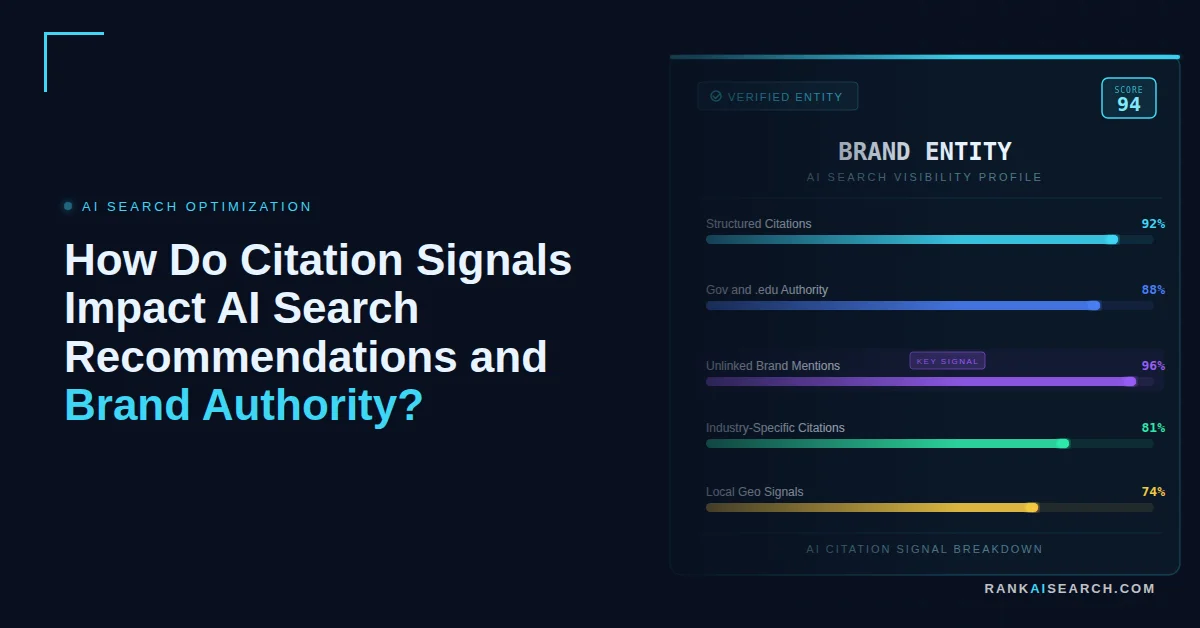
When a potential customer asks ChatGPT to recommend an estate planning attorney, three firms appear in the response. Yours doesn’t. For most businesses, that missing recommendation comes down to citation signals: the consistent, cross-referenced evidence AI systems need to trust your brand enough to surface it.
This guide explains how citation signals work across AI search platforms, how to build and maintain them, and how they connect with the broader answer engine and generative engine optimization strategies practiced by RankAISearch, a global agency specializing in GEO, AEO, AIO, LLMO, and SEO for brands competing in AI-driven search ecosystems.
What Are Citation Signals in AI Search Optimization?
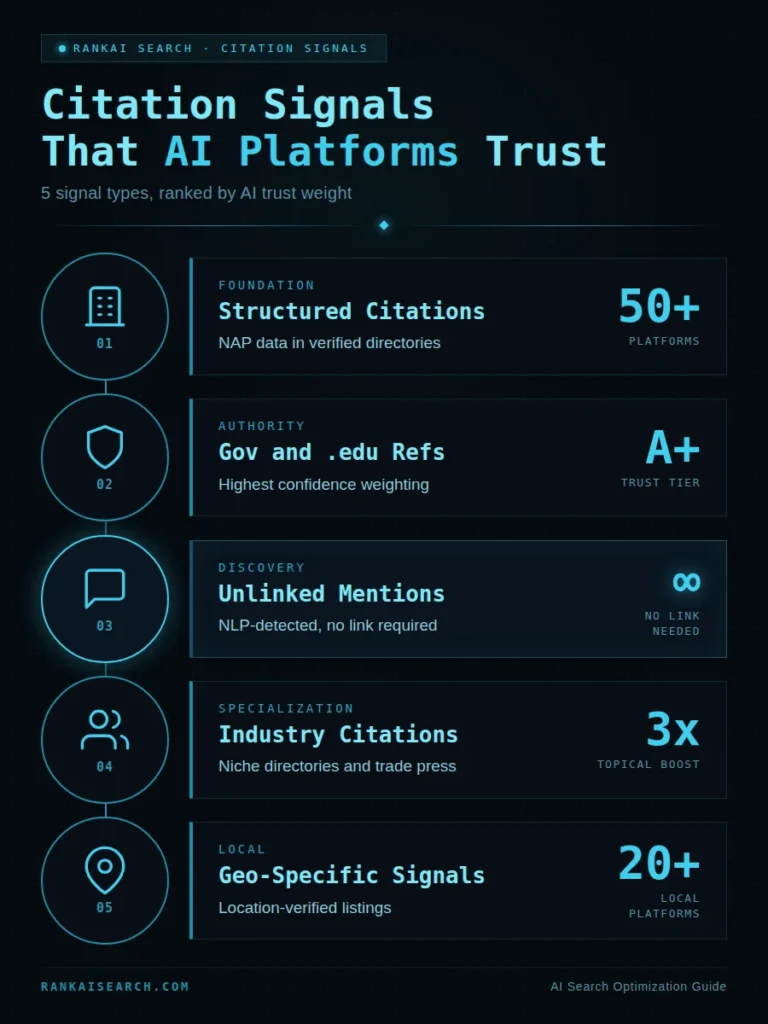
Citation signals are digital references to your brand, business information, or content that AI platforms use to verify credibility and build entity understanding. They include structured business listings, unlinked brand mentions, references in authoritative publications, and consistent Name, Address, and Phone (NAP) data across directories.
Answer engines treat citations as verification data, not ranking levers. Where Google historically evaluated link authority and anchor text, platforms like ChatGPT, Perplexity, and Google AI Overview analyze citation patterns to verify entity identity. They assign confidence scores based on source consistency and authority.
AI platforms recognize four primary citation types, each serving a different function in the verification process:
| Citation Type | Description | Example Sources |
| Digital mentions | Brand name references, with or without hyperlinks | News articles, blog posts, forums |
| Structured citations | NAP data in standardized directory formats | Google Business Profile, Yelp, Yellow Pages |
| Authoritative references | Brand mentions in high-trust publications | Trade journals, government sites, .edu domains |
| Academic and government sources | Citations used for factual verification | .gov databases, peer-reviewed publications |
Why Do AI Search Engines Value Citation Signals?
AI search engines value citation signals because they provide independently verifiable proof that your brand exists, operates legitimately, and is recognized by trusted sources. Without cross-referenced citation data, AI systems cannot assign high confidence scores and will omit a brand from recommendations even when its content is strong.
Large language models learn about businesses directly from citation patterns in their training data. The more frequently a brand appears in quality, consistent content, the more accurately AI systems represent it when users ask relevant questions.
AI recommendation algorithms weight citations across three measurable dimensions, with source quality mattering most:
| Factor | What AI Measures | Why It Matters |
| Frequency | How often your brand is cited across verified sources | Establishes baseline presence in AI knowledge bases |
| Recency | Whether citations are current and growing over time | Signals active, legitimate business operation |
| Source quality | Domain authority and editorial standards of citing platforms | Determines confidence score applied to each signal |
Co-citation patterns shape AI rankings even without direct brand mentions. When your brand is referenced alongside established industry authorities in the same content, AI systems infer credibility through association. This relationship-mapping technique is increasingly central to how answer engines determine which brands deserve recommendation.
Citation authority is not built in a campaign. It accumulates through consistent, cross-referenced presence that AI systems can independently verify across every platform where customers search.
How Does Citation Quality Affect AI Platform Rankings?
Citation quality determines how much authority each signal contributes to your brand’s AI visibility. AI platforms evaluate every citation across three dimensions: domain authority, editorial standards, and topical relevance. Each dimension receives a separate weight in the confidence scoring process:
| Quality Dimension | What AI Evaluates | Impact on Confidence Score |
| Domain authority | Trust level assigned to the citing website | Higher authority = higher weight per citation |
| Editorial standards | Fact-checking processes and review requirements | Vetted sources receive pre-assigned trust |
| Topical relevance | Alignment between source topic and your business category | Off-topic citations contribute minimal authority |
A citation from the American Bar Association matters far more to a law firm’s AI visibility than 20 listings on low-scrutiny general directories. AI platforms apply this weighting automatically, making source selection more important than citation volume.
What Makes a Citation Source Authoritative?
Authoritative citation sources are platforms AI systems already treat as reliable data inputs, meaning any mention carries pre-established trust. Government websites, educational institutions, established news organizations, and recognized industry associations rank at the top of this hierarchy. AI platforms have learned to recognize their editorial review and fact-checking processes as markers of reliable content.
Each industry has its own trusted citation ecosystem, and citations outside your vertical carry less topical authority even when the source domain is strong:
- Healthcare: medical associations, Healthgrades, physician licensing databases
- Legal: state bar associations, Martindale-Hubbell, FindLaw
- Finance: regulatory body databases, financial industry publications
- Technology: developer communities, IEEE, recognized tech publications
To identify high-value citation opportunities, analyze where your top-performing competitors appear consistently. Prioritize platforms with strict listing standards and editorial review processes.
How Does Citation Consistency Across Platforms Affect AI Trust?
Inconsistent citations fragment your entity signals and force AI systems to treat variations of your business as separate, lower-confidence entities. A listing showing “ABC Company” on one platform and “ABC Co.” on another splits your authority between two unresolved entity records.
The difference in AI treatment between consistent and inconsistent citations is direct and measurable:
| NAP State | AI Entity Treatment | Recommendation Likelihood |
| Identical across all platforms | Single high-confidence entity record | High |
| Minor variations (St. vs Street) | Partially unified, lower confidence | Reduced |
| Significant inconsistencies | Multiple competing entity records | Low |
Fixing inconsistency starts with a master citation format documenting the exact version of your business name, address, phone number, and website URL. Audit all existing listings against that format and correct discrepancies starting with the highest-authority platforms. Tools like BrightLocal, Moz Local, and Yext automate this monitoring and flag new discrepancies quarterly. (Source: BrightLocal, Local Consumer Review Survey, 2024)
How Do You Build a Citation Strategy for Answer Engine Optimization?
Answer engine optimization (AEO) is the practice of structuring brand information so AI systems can readily surface it in generated answers. An effective citation strategy for AEO follows a tiered hierarchy that prioritizes authority over volume: start with foundational directories, expand to industry-specific platforms, then add local and regional listings.
Each tier serves a distinct function in how AI platforms verify and categorize your brand:
| Tier | Platform Type | Examples |
| 1: Foundation | Major business directories, universal platforms | Google Business Profile, Bing Places, Apple Maps |
| 2: Industry | Vertical-specific directories, professional associations | State licensing boards, trade association databases |
| 3: Local/Regional | Geographic listings, municipal databases, chambers of commerce | City business directories, local chamber websites |
Two principles govern effective citation management at every tier:
- Monitor quarterly: Maintain a tracking document logging every platform, submission dates, and login credentials. AI platforms recrawl sources continuously, so corrections need to happen promptly.
- Quality over quantity: Fifty citations from trusted, relevant sources generate more AI visibility than 500 listings from low-authority directories. Avoid automated submission services, which scatter brand information across questionable sites and introduce inconsistencies that reduce confidence scores.
How Do Local Citations Influence AI Search Recommendations?
Local citations are the primary data source AI platforms use to match businesses to geographically relevant queries. When a user asks an AI system for a local service provider, the answer depends on which businesses have the strongest, most consistent citation presence in that area.
Google AI Overview cross-references Google Business Profile data with local directories, map services, and location-specific websites to verify which businesses genuinely operate in a given area. Businesses with complete, consistent local citation profiles appear significantly more often in AI Overview results for queries with geographic terms or location-based intent. (Source: Google Search Central, 2025)
A complete local listing covers every field AI platforms use for verification:
- Business name, address, and phone in exact match to your master citation format
- Accurate business categories that reflect your services
- Business hours, service area, and accepted payment methods
- Quality photos and a detailed, keyword-relevant business description
Local chambers of commerce, city directories, regional news websites, and area-specific service directories provide geographic context that reinforces AI platforms’ understanding of your service area. Citations from locally recognized sources carry particular weight for location queries, as these function as trusted geographic validators in local AI knowledge bases.
How Do Unlinked Brand Mentions Serve as Citation Signals?
Unlinked brand mentions contribute to AI visibility by providing natural language evidence of your brand’s existence and relevance without requiring a hyperlink. AI platforms use natural language processing and entity recognition to scan content across the web, identify brand names in context, and log these mentions into their knowledge bases.
The context surrounding an unlinked mention determines its signal strength. References in authoritative content, positive sentiment, and mentions alongside relevant industry topics amplify the signal. A brand name appearing in a low-authority forum post with no topical context contributes almost nothing to AI trust scoring.
The most reliable way to generate unlinked mentions at scale is to create conditions where other publishers naturally reference your brand. Three approaches work consistently:
- Original research: Publish proprietary data and industry insights that other publications want to cite as a reference source
- Expert commentary: Respond to journalist queries via services like HARO to earn mentions in news articles and features
- Industry participation: Contribute to conferences, panels, and professional communities where your expertise is recognized by peers
Converting unlinked mentions into structured citations strengthens their verifiability. When you find an authoritative site referencing your brand without a link, contact the author and request a hyperlink for reader convenience. Most publishers add links when approached professionally, converting a passive signal into a trackable citation.
How Do You Optimize Industry-Specific Citations for AI Platforms?
Industry-specific citations are the strongest topical relevance signals AI platforms use to associate your brand with a particular area of expertise. A brand that appears consistently in niche directories and publications ranks higher for specialty queries. Topical concentration teaches AI systems exactly which queries should surface your brand.
Vertical directories and professional associations carry extra citation weight because they vet members before granting listings. This vetting gives each citation a built-in third-party validation signal. Credentials, certifications, and professional designations embedded in listings further strengthen authority signals.
Source type determines signal weight, with professional licensing boards ranking highest due to their rigorous vetting process:
| Source Type | Signal Strength | Examples |
| Professional licensing boards | Very high | State bar associations, medical licensing boards |
| Trade associations | High | Industry-specific member directories |
| Trade publications | High | Contributed articles, expert quotes, brand features |
| Niche industry blogs | Medium | Specialized sector coverage with editorial oversight |
Trade publication citations function as expert validation signals in AI training data because these sources are already treated as authoritative inputs by most major AI platforms. Contributing articles, providing expert quotes, and appearing in industry roundups delivers compounding citation authority over time.
How Does Citation Velocity Impact AI Search Algorithm Trust?
Citation velocity refers to the rate at which your brand accumulates new citations over time. AI platforms monitor this growth rate to distinguish organic authority building from artificial manipulation. Steady growth from relevant sources signals genuine business expansion; sudden spikes from low-authority sources raise algorithmic scrutiny.
Organic citation growth follows three behavioral patterns that AI platforms use to confirm legitimacy:
- Citations appear gradually across varied and relevant source types, not in bursts
- Sources are appropriate to the brand’s industry, location, and specialization
- No single event produces a disproportionate surge in citation volume
Sudden citation spikes risk suppressing visibility rather than improving it, even when the spike has a legitimate cause. If you anticipate a surge from a product launch or press announcement, document the cause and ensure citations come from contextually appropriate sources. Steady pre-existing growth is the best protection against algorithmic scrutiny. (Source: Moz, Local Search Ranking Factors, 2023)
Build sustainable citation momentum by treating acquisition as a byproduct of genuine business activity:
- Set monthly targets for new citations from authoritative, relevant sources
- Publish content that naturally attracts references from others in your industry
- Develop genuine relationships with journalists and community voices whose mentions carry real topical authority
How Do You Monitor and Measure Citation Signal Performance?
Measuring citation signal performance requires tracking citation health and AI platform visibility changes simultaneously. Neither measurement alone tells the full story: citation growth with declining AI visibility signals a quality problem, while strong visibility with stagnant citations means competitors may eventually close the gap.
Four citation metrics provide the clearest view of whether your strategy is building AI-visible authority:
| Metric | What It Measures | Why It Matters |
| Citation count | Total verified listings across platforms | Establishes baseline volume for authority building |
| Source authority distribution | Percentage from high vs. low-authority platforms | Determines the quality weighting of each signal |
| NAP consistency score | Accuracy of business information across listings | Inconsistencies reduce AI confidence scores |
| AI visibility rate | How often your brand appears in AI-generated answers | The outcome metric that validates the full strategy |
Recommended tools for each layer of citation management:
- BrightLocal / Moz Local: Local citation tracking, NAP consistency monitoring, and discrepancy alerts
- Yext: Enterprise-scale listing management across hundreds of platforms simultaneously
- Google Alerts: Free brand mention monitoring for unlinked references across the web
Build quarterly reports documenting citation changes, AI visibility shifts, and business outcomes such as lead quality, branded search growth, and traffic from AI-driven referrals. This creates the evidence base to justify continued investment and identify which platform tiers drive the best results.
What Citation Mistakes Hurt AI Search Rankings?
The most damaging citation mistakes are those that fragment your entity signals or introduce conflicting data that AI systems cannot resolve. Duplicate listings, incomplete NAP data, and platform neglect all reduce AI confidence scores. The effects compound over time as platforms continuously recrawl sources and update their knowledge bases.
The five citation errors below damage AI visibility in distinct ways, but all share the same root cause: inconsistency in how brand information is presented across platforms:
| Mistake | AI Impact | Fix |
| Duplicate listings | Fragments entity authority across competing versions | Claim and merge duplicates; request removal of inaccurate versions |
| Inconsistent NAP | Splits entity into multiple lower-confidence records | Apply master citation format across all platforms immediately |
| Incomplete listings | Reduces trust signal completeness | Complete all available fields including hours, categories, and descriptions |
| Ignoring emerging platforms | Misses visibility as new answer engines grow | Research which data sources ChatGPT, Perplexity, and Claude use |
| Neglecting maintenance | Outdated information creates ongoing inconsistency | Audit quarterly; update everywhere when any business detail changes |
Emerging AI platforms deserve early attention because citation strategies established before a platform reaches scale deliver compounding advantages. ChatGPT, Perplexity, and Claude rely on different data sources than Google. Research which directories each prioritizes and establish citations there before competitors do.
How Do Citation Signals Connect with Other AI Ranking Factors?
Citation signals do not operate in isolation. They function as one component of a broader entity-based optimization system. Citations serve as the third-party verification layer that gives AI systems confidence in what your own structured data asserts.
How citation signals feed into other AI ranking systems:
| Ranking System | How Citations Enable It | What Breaks Without Citations |
| Entity recognition | Consistent citations build your brand’s entry in AI knowledge graphs | AI systems lack sufficient data to recommend your brand confidently |
| Semantic relevance | Topic-focused citations teach AI which queries should surface your brand | Broad or unfocused citations dilute topical association |
| Knowledge graph enrichment | Citations supply facts and relationships that populate knowledge panels | Thin entity profiles produce incomplete or inaccurate AI answers |
When schema markup on your site matches citation information across third-party platforms, AI systems treat the alignment as a verified consensus signal. A discrepancy between schema and third-party citations reduces confidence in your entity data. Audit both simultaneously and treat cross-platform consistency as a core optimization principle.
What Is the Future of Citation Signals in AI Search Ecosystems?
Future AI systems will evaluate citation context more heavily than citation count. The emphasis will shift from accumulating mentions to earning them in topically precise, editorially rigorous environments.
The sentiment of the citing source, the topical authority of the publication, and the semantic richness of the surrounding content will all carry more weight as AI platforms get better at detecting manufactured presence. Emerging citation types are also expanding beyond text-based directories to audio, video, and social content. Podcast appearances, video citations, and verified social media presence with genuine engagement are becoming measurable signals.
Brands that maintain AI citation visibility through the next wave of answer engine development will share three strategic habits:
- Diversify citation formats: Build presence across text, audio, video, and structured data rather than concentrating on directory listings alone
- Prioritize context quality: Pursue mentions in expert-authored, topically specific content rather than broad-audience publications
- Stay platform-aware: Monitor which data sources new AI systems prioritize and establish citations there before competitors do
The convergence of traditional SEO and AI-focused citation practices means core principles remain stable: consistency, accuracy, and authoritative sourcing matter regardless of the search platform. What AI optimization adds is a greater requirement for structured data alignment, entity relationship clarity, and semantic context precision. All of these amplify citation signals rather than replace them.
Frequently Asked Questions (FAQs) About Citation Signals in AI Search
What are citation signals and why do AI search engines care about them?
Citation signals are references to your brand, business information, or content across the web that AI search engines use to verify credibility before surfacing you in recommendations. AI platforms need multiple independent sources to confirm information because no single source is treated as authoritative on its own. The more consistent and authoritative your citations, the higher the confidence score AI systems assign to your brand.
How do citation signals differ from traditional backlinks in AI search optimization?
Citation signals focus on information consistency and entity verification, while backlinks transfer page-level authority through hyperlinks. AI platforms also track unlinked brand mentions and structured business data that traditional search engines largely ignore.
Citations verify that your business exists and operates as a recognized entity. Backlinks signal that another page considers your content worth referencing. Both matter, but they serve different functions in how AI platforms build the entity understanding needed to recommend your brand.
What types of citations have the most impact on AI platform recommendations?
Citations from government websites, educational institutions, industry associations, and established news organizations carry the most weight. AI platforms pre-assign high trust to these source types based on their editorial standards. Professional licensing boards and industry-specific directories provide strong topical validation that teaches AI systems which queries your brand should answer.
Structured citations with complete NAP information across major business directories form the foundation of citation authority. Co-citations alongside recognized industry authorities establish the contextual relevance that helps AI platforms understand your competitive positioning.
How can I identify and fix inconsistent citations that hurt AI search visibility?
Create a master citation format documenting the exact version of your business name, address, phone number, and website URL. Use citation monitoring tools to find all existing listings and compare each against that master format in a tracking spreadsheet.
Correct discrepancies on high-authority platforms first, since those carry the most weight in AI verification. Run full audits quarterly to catch new inconsistencies before they compound.
How long does it take for citation improvements to affect AI search rankings?
Most businesses see initial improvements in AI search visibility within 4 to 12 weeks after correcting citations. Timing varies based on how quickly each AI platform recrawls its sources, with major platforms like Google reflecting changes faster than newer AI systems.
Building significant citation authority from scratch takes 6 to 12 months of consistent effort. The exact timeline depends on the severity of starting inconsistencies and the authority level of the platforms involved.
What is the difference between structured and unstructured citations for AI platforms?
Structured citations appear in business directories and databases with standardized fields for name, address, and phone number. They give AI systems machine-readable data that can be parsed, verified, and cross-referenced programmatically. Unstructured citations are brand mentions in articles and other content where no standardized format exists, but NLP technology can still extract and log the reference.
AI platforms use structured citations to verify core entity data such as location, contact information, and business category. They use unstructured citations to build contextual understanding of your expertise areas and topical associations.
How do local citations specifically influence Google AI Overview results?
Google AI Overview relies on local citation signals to verify which businesses operate in specific geographic areas and match them to location-based queries. It cross-references Google Business Profile data with local directories, map services, and location-specific websites before generating recommendations. A business with incomplete or inconsistent local citations may be skipped entirely, even when its services are directly relevant to the query.
Businesses with complete, consistent citation profiles across major local platforms appear more frequently in AI Overview results for geographic queries. The volume of consistent, cross-referenced data gives AI Overview the confidence it needs to surface a recommendation.
Can too many citations hurt my brand’s credibility with AI search engines?
Low-quality citations in large volumes harm credibility because AI platforms are designed to detect unnatural citation growth. Sudden volume spikes from irrelevant or low-authority sources are a known red flag that triggers scrutiny and can reduce visibility rather than improve it.
The correct approach is to focus on citations from trusted, relevant platforms and let volume grow as a natural byproduct of a quality-first strategy. Steady, diversified growth from appropriate sources consistently builds credibility. Shortcuts that prioritize citation count over quality create the inconsistency patterns that AI platforms penalize.