

How Does Digital PR Help With AI Search Visibility?
A journalist quotes your expert in a respected industry article. Later, an AI tool uses that article to explain a topic, compare providers, or support a recommendation. Digital PR helps AI search visibility by placing your brand inside trusted content that answer engines can use as source material.
Strong PR coverage gives AI systems context they cannot get from a homepage alone. It can show what your brand knows, who trusts it, and where it fits in the market. This guide explains how digital PR coverage supports brand authority, entity clarity, AI citations, and search visibility.
How Does Digital PR Help With AI Search Visibility?
Digital PR helps AI search visibility by earning mentions and coverage on authoritative publications that AI engines read and trust. These third-party references build the credibility and entity signals that make AI more likely to surface and cite your brand.
Digital PR is the practice of earning online media coverage, expert mentions, backlinks, data citations, podcast references, newsletter mentions, and industry visibility through newsworthy stories. In AI search, the value is not only the backlink. The surrounding text helps AI systems understand what the brand does and why it matters.
Google says its generative AI features on Search depend on Google Search systems and reward unique, valuable content that helps users. This means authority, accessibility, and usefulness still matter when content appears in AI-generated experiences. (Source: Google Search Central, 2026)
Digital PR gives AI systems more independent evidence. A brand that is mentioned by respected publications, analysts, customers, partners, and experts becomes easier to verify than a brand that only describes itself.
| Digital PR Signal | What It Creates | Why It Helps AI Visibility |
|---|---|---|
| Editorial coverage | Independent brand mention | Supports trust and recognition |
| Expert quote | Named topical authority | Connects the brand to expertise |
| Data-led story | Original evidence | Gives AI systems citable facts |
| Backlink | Source connection | Helps search discovery and authority |
| Unlinked mention | Contextual brand reference | Builds entity association |
| Podcast or webinar mention | Cross-format visibility | Expands source footprint |
| Industry report inclusion | Category validation | Supports recommendation context |
| Review or analyst mention | Third-party proof | Helps AI compare brands |
Why Do Third-Party Mentions Matter to AI Engines?
Third-party mentions matter because AI engines use outside sources to validate who a brand is, what it does, and whether other trusted sources recognize it. A brand becomes easier to surface when many credible pages describe it consistently.
AI systems do not evaluate brands only through official websites. They can retrieve media articles, review pages, partner pages, analyst reports, expert roundups, directory profiles, and social or community references.
Third-party mentions also reduce reliance on self-published claims. A media article saying a company specializes in a category can reinforce the same claim on the company’s own site.
| Third-Party Mention Type | AI Visibility Value |
|---|---|
| News article | Shows public relevance |
| Trade publication | Shows industry relevance |
| Expert roundup | Connects brand to expertise |
| Podcast show notes | Adds topical context |
| Partner page | Confirms business relationships |
| Analyst report | Supports category authority |
| Review platform | Reflects customer validation |
| Conference page | Confirms speaker or event authority |
The strongest mentions are specific. A sentence that names the brand, category, audience, product, and expertise gives AI systems more context than a vague logo placement.
Which Digital PR Results Create the Strongest AI Signals?
The strongest digital PR results for AI visibility are editorial coverage, expert quotes, original research, data-led stories, analyst mentions, partner citations, and trusted industry references. These results give AI systems clear evidence from sources beyond the brand’s website.
Digital PR results are strongest when they combine authority and relevance. A national publication can create broad awareness, while a niche trade publication can create stronger category context.
Cision’s 2026 State of the Media Report found that 66% of journalists rely on PR-provided content, including press releases, pitches, and media kits, for story ideas. This makes strong PR inputs important for earning credible coverage. (Source: Cision, 2026)
The best PR results contain language that AI systems can reuse accurately. A clear expert quote, statistic, definition, or category explanation is more useful than a generic brand mention.
| PR Result | AI Signal Strength | Why It Matters |
|---|---|---|
| Expert quote in trade media | High | Connects person, brand, and topic |
| Original research coverage | High | Creates unique citable data |
| Analyst inclusion | High | Validates category relevance |
| Product launch coverage | Medium | Signals freshness and innovation |
| Partner announcement | Medium | Confirms ecosystem relationships |
| Founder profile | Medium | Supports expertise and entity clarity |
| Generic press release pickup | Low to medium | May be duplicated or thin |
| Low-quality syndicated mention | Low | Adds little authority or context |
Strong PR outcomes should be saved, tagged, and connected to owned content. A covered research story should link back to a report, methodology page, or category resource when possible.
Editorial Coverage and Expert Quotes
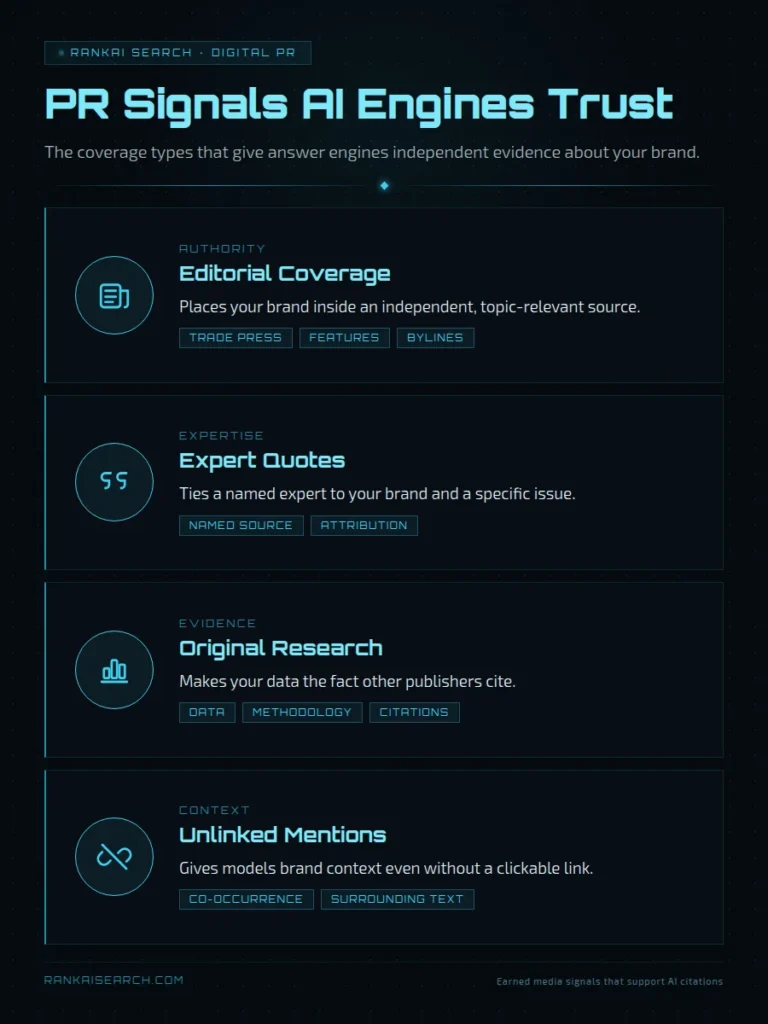
Editorial coverage and expert quotes create strong AI signals because they place the brand inside an independent, topic-relevant source. The surrounding context helps AI systems connect the brand with a problem, category, or expert viewpoint.
An expert quote is strongest when it gives a clear point of view. A quote that explains a market shift, buyer problem, or technical concept is more useful than a promotional quote.
| Expert Quote Element | Strong Version |
|---|---|
| Named expert | Full name, title, and company |
| Specific topic | Clear category or issue |
| Useful claim | Insight readers can apply |
| Source context | Publication matches the topic |
| Brand connection | Company is named naturally |
| Supporting page | Owned content expands the idea |
Original Research and Data-Led Stories
Original research and data-led stories create strong AI signals because they give media outlets and AI engines a reason to cite the brand as the source of a fact. Data can make a brand part of the evidence layer in its category.
| Research Asset | AI Visibility Value |
|---|---|
| Survey report | Creates brand-owned statistics |
| Benchmark study | Supports category comparison |
| Trend analysis | Gives media timely angles |
| Customer data study | Shows market behavior |
| Industry index | Builds recurring authority |
| Methodology page | Makes data easier to trust |
| Data visualization | Helps journalists explain findings |
Original research should include methodology. AI systems and journalists need to understand who was studied, when the data was collected, and what the results actually mean.
How Can Digital PR Strengthen Your Brand as an Entity?
Digital PR strengthens your brand as an entity by creating repeated, consistent references that connect the brand to topics, people, products, locations, industries, and expertise. AI systems need those relationships to understand what the brand represents.
An entity is a distinct person, place, organization, product, or concept that machines can identify and connect to other entities. Google introduced the Knowledge Graph as a model for understanding “things, not strings,” which reflects the importance of entities and relationships in search. (Source: Google Search Blog, 2012)
Digital PR supports entity clarity by repeating the same core facts across trusted sources. These facts include the brand name, domain, founders, category, services, products, locations, customers, and notable proof.
Entity strength improves when third-party sources say the same true thing. Conflicting descriptions across media profiles, directories, and partner pages make the brand harder to summarize accurately.
| Entity Signal | Digital PR Contribution |
|---|---|
| Brand name | Repeated exact naming |
| Domain | Official website references |
| Category | Clear market classification |
| Founders or experts | Named human associations |
| Products or services | Described offerings |
| Industry | Contextual relevance |
| Location | Geographic clarity |
| Proof | Awards, research, reviews, or coverage |
| Relationships | Partners, customers, events, or associations |
A strong PR strategy should keep entity facts consistent. Every pitch, media bio, data report, press kit, and expert profile should describe the brand the same way.
What Makes a Publication Valuable for AI Visibility?
A publication is valuable for AI visibility when it is authoritative, crawlable, topic-relevant, indexed, trusted by readers, and likely to be cited or retrieved by AI systems. Relevance matters as much as domain strength.
A large publication can help broad recognition. A niche publication can help AI systems understand category expertise more precisely.
AI value is reduced when a publication blocks crawlers, hides content, uses thin syndication, or removes article pages quickly. A strong PR target should create a durable, indexable article with useful context.
| Publication Factor | Why It Matters |
|---|---|
| Topic relevance | Connects the brand to the right category |
| Editorial standards | Supports trust |
| Crawlability | Allows retrieval systems to access the page |
| Indexability | Helps search-based AI discover the article |
| Named author | Adds accountability |
| Clear article date | Supports freshness |
| Original context | Avoids thin duplication |
| Audience fit | Reaches the right buyers or analysts |
| Citation history | Signals source usefulness |
High-value PR targets are not always the biggest outlets. The best target is the publication that AI systems and buyers can trust for that topic.
How Should You Choose Topics for an AI-Focused PR Campaign?
You should choose AI-focused PR topics by matching newsworthy angles with buyer questions, category gaps, original data, expert insight, and topics where your brand needs stronger entity association. A PR topic should help journalists write and help AI systems understand.
AI-focused PR should not chase coverage for any mention. It should earn coverage that reinforces the brand’s expertise in a specific market, problem, or buyer decision.
The best topics sit where brand expertise overlaps with public interest. A cybersecurity company should not only pitch product updates, but also explain emerging threats, buyer mistakes, compliance risks, and practical protections.
| Topic Source | PR Angle | AI Visibility Benefit |
|---|---|---|
| Customer data | Industry benchmark | Creates citable evidence |
| Expert insight | Market commentary | Builds topical authority |
| Product usage trends | Behavior shift story | Links brand to category demand |
| Regulatory change | Practical explanation | Connects brand to current guidance |
| Buyer pain point | Problem-solving article | Matches AI prompts |
| Original survey | Data-led news | Creates source authority |
| Local trend | Regional relevance | Supports local AI visibility |
| Partner data | Ecosystem story | Builds relationship signals |
How Can Expert Commentary Increase Brand Mentions?
Expert commentary increases brand mentions by placing named experts and brand viewpoints inside articles that AI systems can retrieve. A quoted expert can connect the brand to a specific topic without requiring a full feature story.
Expert commentary works because journalists need credible sources who can explain fast-moving topics. The expert’s title, company, and quote create an entity link between the person, brand, and issue.
The strongest expert commentary is direct and quotable. It states what is happening, why it matters, what mistake to avoid, and what action the reader should take.
| Expert Commentary Type | Best Use |
|---|---|
| Trend quote | Explains a market shift |
| Data interpretation | Adds meaning to a statistic |
| Warning quote | Flags a common mistake |
| Prediction | Frames a near-term change |
| Practical advice | Gives an action step |
| Technical explanation | Clarifies a complex topic |
| Local insight | Adds regional context |
| Buyer guidance | Helps decision-making |
Expert commentary should be consistent across channels. The same expert bio, company description, and category focus should appear in pitches, author pages, and owned content.
Why Are Unlinked Brand Mentions Still Valuable?
Unlinked brand mentions are valuable because they give AI systems contextual language about the brand even without a clickable backlink. The mention can still connect the brand to a topic, source, expert, product, or market category.
Traditional SEO often prioritizes links because links pass measurable authority signals. AI search adds more value to contextual co-occurrence because models and retrieval systems can use text around the brand mention.
Ahrefs reported that unlinked mentions have little impact on traditional SEO but can matter more for GEO because LLMs learn from words, co-occurrence, and context on the page. (Source: Ahrefs, 2025)
An unlinked mention is strongest when the article clearly states what the brand does. A bare mention in a list is weaker than a sentence that explains the brand’s category, audience, and proof.
| Mention Type | AI Value |
|---|---|
| Brand plus category | Helps classification |
| Brand plus expert | Connects authority to a person |
| Brand plus data point | Supports source identity |
| Brand plus customer outcome | Adds proof |
| Brand plus location | Supports local relevance |
| Brand plus product | Clarifies offering |
| Brand plus comparison | Supports evaluation prompts |
Unlinked mentions should still be tracked. They may become part of the source trail that helps AI systems describe the brand accurately.
How Can Digital PR Support Your Existing Website Content?
Digital PR supports existing website content by earning external proof that strengthens the claims, topics, and entities already covered on the site. PR coverage works best when it reinforces high-value pages instead of existing as isolated media wins.
A digital PR campaign should connect to landing pages, research reports, category guides, comparison pages, service pages, and author profiles. This helps users and AI systems move from third-party coverage to deeper owned content.
PR should make the website more credible. A report page that earns media citations becomes stronger than a report page with no external validation.
| Owned Content Asset | Digital PR Support |
|---|---|
| Research report | Earns data citations |
| Service page | Builds authority around the service |
| Category guide | Reinforces expertise |
| Comparison page | Supports third-party validation |
| Case study | Turns customer outcome into news |
| Author profile | Builds expert authority |
| Product page | Supports launch and innovation signals |
| Local page | Earns regional relevance |
Digital PR should also create internal linking opportunities. A media-covered report should be linked from related guides, landing pages, and resource hubs.
How Should PR and SEO Teams Work Together?
PR and SEO teams should work together by choosing shared topics, target publications, expert angles, landing pages, source facts, and measurement goals. Digital PR works best for AI visibility when coverage, citations, and owned content reinforce the same entity signals.
PR teams understand journalists, narratives, timing, and news value. SEO teams understand search demand, crawlability, content gaps, AI citations, and source performance.
The shared goal should be authority with retrievable evidence. A strong campaign earns coverage and strengthens the source material AI systems use.
| Team | Main Contribution | Shared Output |
|---|---|---|
| PR | Story angle and journalist relationships | Earned coverage |
| SEO | Keyword, prompt, and topic research | Search-aligned topics |
| Content | Landing pages and reports | Citable source assets |
| Analytics | Tracking and reporting | Visibility measurement |
| Leadership | Expert points of view | Credible commentary |
| Product | Feature and data accuracy | Correct claims |
| Sales | Buyer objections | Campaign relevance |
Shared Campaign Topics and Target Publications
Shared campaign topics and target publications make PR coverage more useful for AI visibility. A topic should matter to journalists, buyers, and AI prompts at the same time.
PR and SEO teams should review target publications together. A publication can be attractive for PR reach but weak for AI visibility if the article is not crawlable or does not cover the category clearly.
| Shared Planning Item | Why It Matters |
|---|---|
| Buyer prompt | Aligns campaign with AI questions |
| Search demand | Confirms audience interest |
| Publication relevance | Improves topical authority |
| Expert source | Builds human credibility |
| Landing page | Gives coverage a source hub |
| Data asset | Gives journalists a reason to cite |
| Internal links | Connects campaign to site architecture |
Consistent Facts, Messaging, and Landing Pages
Consistent facts, messaging, and landing pages keep AI systems from receiving conflicting brand signals. The brand description in a pitch should match the brand description on the website, press kit, author page, and media coverage.
A shared fact sheet helps prevent errors. It should include the brand name, domain, category, services, product descriptions, leadership names, founding facts, locations, customer proof, and approved boilerplate.
| Consistency Item | What To Standardize |
|---|---|
| Brand name | Exact spelling and capitalization |
| Domain | Official website URL |
| Category | Primary market or service area |
| Services | Clear service list |
| Expert titles | Accurate names and roles |
| Statistics | Source and date |
| Landing pages | Official supporting URLs |
| Boilerplate | Short approved brand description |
How Can You Measure the AI Visibility Earned Through Digital PR?
You can measure AI visibility earned through digital PR by tracking AI mentions, citations, source URLs, sentiment, prompt coverage, referral traffic, branded search, backlinks, unlinked mentions, and coverage quality. The goal is to see whether media coverage changes how AI systems describe and cite the brand.
Measurement should begin before the campaign. A baseline shows which AI tools already mention the brand, which competitors appear, and which sources are cited.
Digital PR performance should be measured in layers. A campaign may produce immediate coverage, later AI citations, and delayed branded demand.
| Metric | What It Measures | Why It Matters |
|---|---|---|
| Media placements | Earned coverage volume | Shows PR output |
| Publication quality | Authority and relevance | Shows signal strength |
| Backlinks | Linked references | Supports discovery and authority |
| Unlinked mentions | Contextual references | Supports entity association |
| AI mentions | Brand appearance in AI answers | Shows AI visibility |
| AI citations | Sources linked or referenced by AI | Shows source influence |
| Prompt coverage | Prompts where the brand appears | Shows topic reach |
| Sentiment accuracy | Correctness of AI description | Protects brand trust |
| Referral traffic | Visits from AI or media | Shows traffic impact |
| Branded search | Demand lift | Shows delayed influence |
Measurement should compare AI answers before and after major PR placements. The same prompts should be tested across ChatGPT, Perplexity, Gemini, Copilot, Claude, Google AI features, and other relevant tools.
Which Digital PR Tactics Are Less Likely to Help?
Digital PR tactics are less likely to help when they create low-quality syndication, irrelevant mentions, duplicated press releases, weak directories, paid placements without disclosure, or coverage that lacks topical context. AI visibility needs trustworthy signals, not just more URLs.
A mention on an irrelevant site can create noise. A quote in a trusted trade publication can create a much stronger association than dozens of low-quality reposts.
Google’s spam policies warn against tactics designed to manipulate search rankings, including generative AI responses in Google Search. This makes low-value scaled content and manipulative placement tactics risky. (Source: Google Search Central, 2026)
Press releases can still support announcements, but they are weaker when they are the only signal. A release becomes more useful when it leads to original reporting, expert inclusion, or authoritative coverage.
| Weak PR Tactic | Why It Helps Less |
|---|---|
| Mass syndicated press release | Creates duplicate low-context pages |
| Irrelevant guest post | Weak topical association |
| Paid mention without relevance | Low trust value |
| Thin award listing | Minimal context |
| Link-only campaign | Misses entity and narrative value |
| Generic quote blast | No distinct expertise |
| Outdated media kit | Spreads stale brand facts |
| Low-quality directory submission | Adds weak source clutter |
Digital PR should prioritize fewer, stronger signals. One authoritative article with a clear brand explanation can outweigh many vague mentions.
What Should You Remember About Digital PR for AI Visibility?
You should remember that digital PR improves AI visibility by creating credible third-party evidence around your brand, experts, topics, and category. AI systems need that evidence to recognize, compare, and cite the brand with confidence.
| Principle | Practical Action |
|---|---|
| Earn authority | Target trusted publications |
| Build entities | Keep brand facts consistent |
| Support owned content | Link PR to useful source pages |
| Use experts | Place named commentary in relevant outlets |
| Create data | Publish original research |
| Track mentions | Measure linked and unlinked coverage |
| Monitor AI answers | Track citations, sentiment, and competitors |
| Avoid weak tactics | Skip irrelevant or low-quality placements |
Digital PR should be part of a broader AI visibility system. The strongest results come from earned media, technical SEO, citable content, entity clarity, and ongoing AI answer monitoring.
Ready to Earn the Authority AI Engines Look For?
AI engines rely on credible third-party sources to confirm what your brand does, where it fits, and why it deserves attention. Relevant media coverage, expert commentary, original research, and consistent brand mentions create independent evidence that your website cannot establish on its own.
RankAISearch can help connect your digital PR campaigns with your content, entity signals, and AI visibility goals. This creates a stronger source trail across trusted publications while ensuring that coverage reinforces the topics and expertise you want associated with your brand.
Connect with the RankAISearch team to identify valuable PR opportunities and strengthen the external signals that support AI mentions, citations, and recommendations.
Frequently Asked Questions About Digital PR and AI Search Visibility
What is digital PR for AI visibility?
Digital PR for AI visibility is the practice of earning credible online coverage that helps AI systems understand, validate, and cite a brand. It connects the brand to trusted publications, expert commentary, original data, and category authority. The goal is not only referral traffic or backlinks. The goal is to build a source trail that AI systems can use when answering buyer questions.
Does a brand mention need a backlink to help AI visibility?
No, a brand mention does not always need a backlink to help AI visibility. Unlinked mentions can still provide contextual signals about what the brand does and which topics it is associated with. Backlinks remain valuable for discovery and authority. The strongest coverage includes both a useful mention and a relevant link.
Which publications are most valuable for AI search?
The most valuable publications are trusted, crawlable, indexed, and relevant to the brand’s category. A niche trade publication can be more useful than a broad outlet if it provides stronger topical context. Publication quality should be judged by more than domain authority. Editorial standards, audience fit, article depth, author credibility, and topic relevance all matter.
Can local or industry publications influence AI recommendations?
Yes, local and industry publications can influence AI recommendations when the user’s prompt includes geography, industry, audience, or use case. These publications help AI systems connect the brand to a specific market context. A local business needs credible local mentions. A B2B company needs credible industry mentions.
How does original research support digital PR campaigns?
Original research supports digital PR campaigns by giving journalists and AI systems unique facts to cite. A survey, benchmark, or dataset can make the brand the source of a specific claim. The research should include methodology, dates, sample details, and clear findings. Weak or unclear data is harder to trust.
Do press releases improve AI search visibility?
Press releases can support AI search visibility when they introduce accurate facts and lead to original editorial coverage. A press release alone is often weaker than a journalist-written article or trade publication feature. Use press releases for announcements that need an official record. Do not rely on syndicated release pickups as the main PR strategy.
How can you track AI mentions after earning media coverage?
You can track AI mentions by testing target prompts across AI tools and recording brand mentions, cited sources, sentiment, competitors, and source freshness. Compare results before and after major coverage. Use analytics and media monitoring together. AI visibility measurement should include mentions, citations, referral traffic, branded search, and conversion quality.
How long does digital PR take to influence AI-generated answers?
Digital PR can influence AI-generated answers over weeks or months when coverage is indexed, retrieved, and selected by AI systems. Faster movement is more common when the coverage appears on authoritative and crawlable sources. The timeline depends on source strength, topic demand, AI platform behavior, and consistency across the web. One placement can help, but repeated credible signals usually work better.