


How Does Structured Data Implementation Elevate AI Search Visibility?
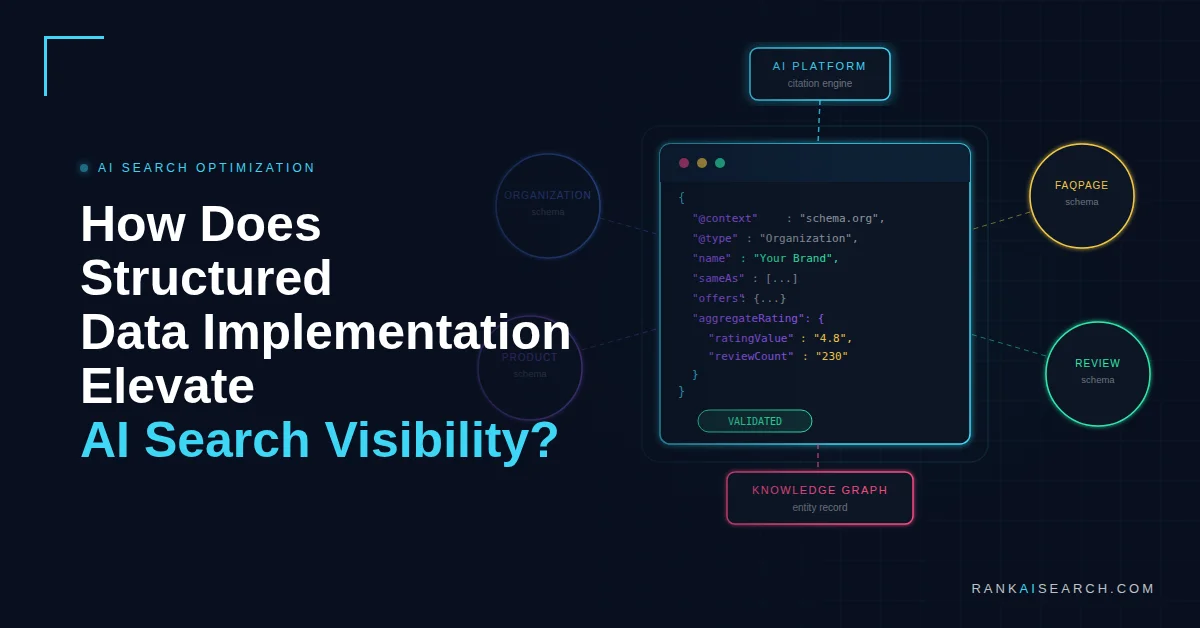
When someone types a question into ChatGPT or Google AI Overview, the answer they receive comes from sources those systems already trust. If your website lacks structured data, AI platforms have no reliable way to extract, verify, or cite your content, regardless of how well it’s written. Structured data gives answer engines the organized, machine-readable information they need to recommend your brand.
This guide covers which schema types matter most for AI search visibility, how to implement them correctly, what mistakes to avoid, and how to measure results across major answer engine platforms.
What Is Structured Data and Why Does It Matter for AI Search?
Structured data is machine-readable code that labels the content on your website so AI platforms know exactly what each element represents. Traditional search engines treat structured data as one of many ranking signals. AI answer engines treat it as a prerequisite for citation. Without it, platforms like ChatGPT and Perplexity cannot reliably verify your facts, identify your entities, or decide whether to recommend you.
The connection between schema vocabulary and AI comprehension is direct. Schema.org provides standardized definitions for entities, relationships, and attributes that large language models parse efficiently. When your markup uses recognized vocabulary types, AI platforms can confidently extract your information and include it in generated responses.
| Factor | Traditional SEO | AI Search Optimization |
| Primary use of structured data | Rich results, featured snippets | Entity verification, source credibility |
| How AI reads it | One of many signals | Core input for response generation |
| Risk of missing it | Fewer rich results | Invisible to answer engines |
| Risk of bad markup | Lower rankings | Flagged as unreliable source |
How Do AI Answer Engines Process Structured Data?
Large language models convert your JSON-LD markup into knowledge graph representations. The system extracts entities, properties, and relationships from your code, then cross-references them against its existing knowledge base. If your structured data aligns with what the AI already knows about your industry, citation likelihood increases.
Real-world results confirm this. A software company that added Organization and Product schema in early 2025 saw its brand appear in ChatGPT project management recommendations 67% more often within three months. An e-commerce retailer that implemented detailed Product schema with review markup saw a 43% increase in qualified traffic from Google AI Overview shopping recommendations. (Source: RankAISearch Case Studies, 2025)
Answer engines favor explicitly structured information because it eliminates the interpretation overhead that introduces error risk. When AI systems have high confidence in your data’s accuracy, they recommend your brand more frequently and cite your information as authoritative.
Why Is JSON-LD the Preferred Format for AI Platforms?
JSON-LD (JavaScript Object Notation for Linked Data) is the format AI platforms parse fastest and most reliably. Unlike microdata or RDFa, JSON-LD sits in a separate block of your page code, which means AI systems can extract it without processing your entire HTML structure.
Key implementation advantages include:
- Faster parsing: AI platforms validate your JSON-LD against schema.org standards in seconds
- No rendering interference: The markup sits outside the visible page, so layout is unaffected
- Multi-type support: A single page can carry Organization, Product, FAQ, and Review schema simultaneously
- Error isolation: A syntax error in one block does not corrupt the rest of your markup
Clean, validated JSON-LD increases AI citation likelihood by up to 78% compared to sites with syntax errors or missing required properties. Even a single missing comma can cause an answer engine to reject your entire markup block as if no structured data existed at all.
Which Structured Data Types Do AI Platforms Value Most?
Organization schema is the non-negotiable foundation. After that, the priority order depends on your business type, but Product, Service, FAQ, and Review schemas consistently drive the most AI citation activity.
Here is a priority roadmap by business category:
| Business Type | Priority 1 | Priority 2 | Priority 3 |
| E-commerce | Product + Offer | AggregateRating + Review | Organization |
| Service business | Organization | Service + LocalBusiness | FAQPage |
| Content publisher | Article | Organization | BreadcrumbList |
| Professional services | Organization | FAQPage | ProfessionalService |
| Local business | LocalBusiness | Service | Review |
Organization Schema: The Foundation
Organization schema tells answer engines who you are, where you operate, and how to contact you. Required properties include:
- name: must match how your brand appears across the web
- url: points to your official homepage
- logo: high-resolution image that clearly represents your brand
- description: 200–300 characters explaining what your organization does
- address, telephone, email: complete contact details
- sameAs: links to verified social profiles (Facebook, LinkedIn, Twitter, Instagram)
AI platforms use the sameAs property to cross-reference your identity across the web. Brands with complete social profile markup appear more trustworthy to answer engines evaluating source credibility.
Product and Service Schema: The Revenue Drivers
Product schema must include name, description, brand, SKU, GTIN numbers, and an offers block with price, currency, availability, and condition. Service schema requires serviceType, provider, areaServed, and a detailed description using recognized industry terminology.
For service businesses, the areaServed property is critical. It tells AI platforms which geographic regions you serve and directly determines whether you appear in location-specific queries. Add hasOfferCatalog to list multiple service offerings with individual descriptions and pricing.
Accurate, current pricing and availability data is non-negotiable. If your Product schema states a price of $99 but your page shows $129, AI platforms flag the discrepancy and may ignore your markup entirely.
FAQ Schema: Direct Citation Fuel
FAQ markup gets cited more frequently than almost any other schema type because the format directly matches how users phrase questions to AI platforms. Answer engines pull FAQ structured data to respond to conversational queries, often quoting it near-verbatim.
Write FAQ answers as self-contained, complete responses. Each answer should read as a standalone cited fact, not as a teaser that requires the reader to visit your site.
Review and Rating Schema: Trust Signals
AggregateRating markup with review count and average score gives AI platforms a fast credibility signal. A product rated 4.7 from 230 reviews gets recommended more often than an identical product without rating markup. The data must be accurate. Inflated or fabricated review markup causes answer engines to distrust all structured information on your site.
How Should You Structure Your About Page for AI Comprehension?
Organization schema on your About page builds the entity record AI platforms use whenever your brand is relevant to a query. Core required properties are name, URL, logo, description, and founding date. These anchor your organization in the knowledge graph.
Use ContactPoint to specify contact methods for different departments:
“contactPoint”: [ { “@type”: “ContactPoint”, “telephone”: “+1-800-555-0100”, “contactType”: “customer service” }, { “@type”: “ContactPoint”, “telephone”: “+1-800-555-0200”, “contactType”: “sales” } ]
For the sameAs array, include direct profile URLs only, never the platform homepage. AI platforms cross-reference these to verify your identity and assess your digital footprint. Incomplete or broken sameAs links reduce entity confidence.
How Do You Implement Structured Data Across Your Full Site?
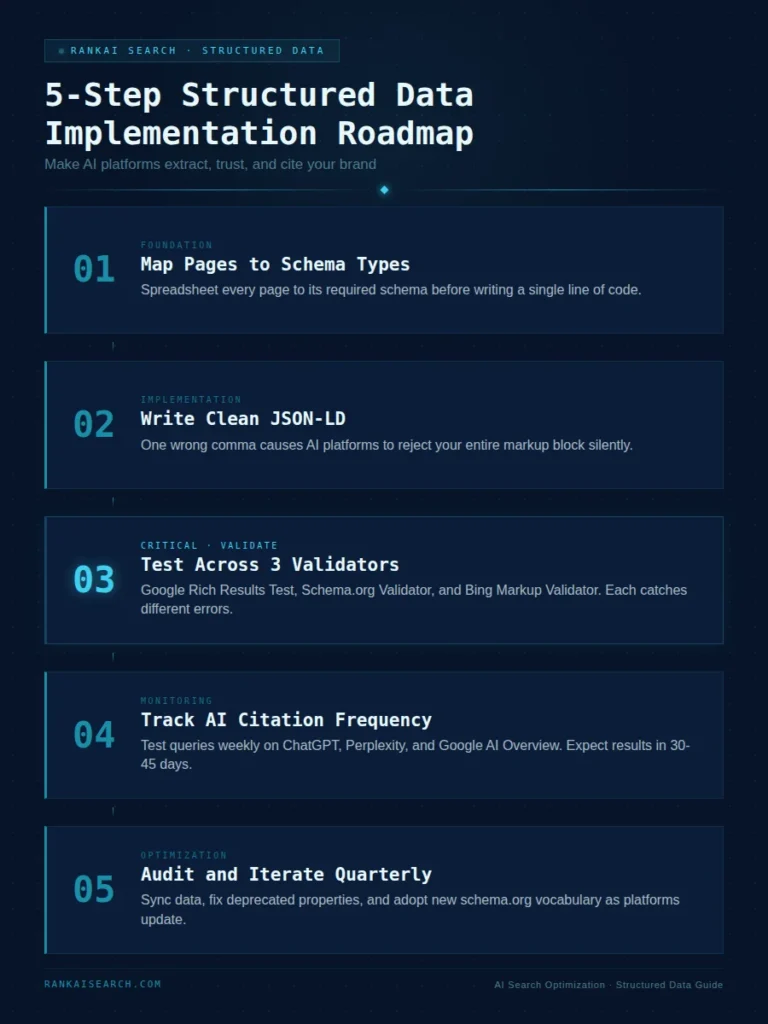
Start by mapping every important page type to its required schema. Before writing a single line of code, build a spreadsheet with this structure:
| Page Type | Required Schema | Optional Schema |
| Homepage | Organization, WebSite | BreadcrumbList |
| Product page | Product, Offer | Review, AggregateRating |
| Service page | Service | LocalBusiness, FAQPage |
| Blog post | Article | Author, BreadcrumbList |
| About page | Organization | ContactPoint |
| FAQ page | FAQPage | Organization |
Write JSON-LD in your page’s <head> tag following schema.org specifications exactly. Use proper JSON syntax: quoted property names, correct data types for each field, and valid URLs throughout. For WordPress sites, plugins like Schema Pro or Rank Math automate basic implementations. Custom-coded solutions give more control but require technical knowledge.
For large e-commerce or content-heavy sites, use dynamic implementations that pull structured data from your CMS or database automatically. This keeps markup synchronized with visible page content as prices, availability, and other details update.
What Are the Essential Technical Best Practices?
Clean JSON-LD structure prevents parsing failures before they happen. These rules are non-negotiable.
Syntax rules:
- Every opening brace must have a closing brace
- All property-value pairs must use correct punctuation
- Property names must be quoted strings
- URL values must be complete, valid URLs including the scheme (https://)
Property rules:
- Use current property names — deprecated names cause silent failures
- Price values must be numbers without currency symbols; currency goes in priceCurrency
- Required fields vary by schema type; missing name, description, or url causes complete parsing failure
- Do not repeat the same information in multiple properties; each property serves a distinct purpose
Consistency rules:
- Structured data must match visible page content exactly
- Price, availability, and rating data must stay synchronized as you update your site
- Broken sameAs URLs must be fixed immediately, they actively harm entity trust scores
How Do You Test and Validate Structured Data Before Publishing?
Run every implementation through three separate tools before going live:
| Tool | What it catches |
| Google Rich Results Test | Syntax errors, eligibility for rich results |
| Schema.org Validator | Non-standard property names, type mismatches |
| Bing Markup Validator | Platform-specific parsing issues |
Each tool catches different error types. Using only one tool leaves gaps. After validation, monitor AI platform responses over the following 30–45 days. Most answer engines begin recognizing properly implemented structured data within 2–4 weeks, but full integration into knowledge systems typically takes 30–45 days.
Set up automated testing that validates your structured data weekly to catch problems introduced by CMS updates or plugin changes before they affect AI visibility.
What Advanced Strategies Give a Competitive Advantage?
Layering multiple schema types on a single page creates comprehensive entity representation. A product page can carry Product, Review, FAQPage, and BreadcrumbList schema simultaneously. Each type provides different extractable information, and AI platforms pull whichever element best answers the user’s specific query.
Industry-specific schema types are frequently overlooked and provide significant first-mover advantage:
- Medical practices: Physician, MedicalBusiness
- Restaurants: Restaurant with Menu
- Legal professionals: Attorney with practice areas and bar admissions
- Educational organizations: EducationalOrganization, Course
- Events: Event with date, location, and performer details
Implement detailed property hierarchies now even if current AI platforms do not fully utilize them. As answer engines become more sophisticated, they will extract and apply more complex structured data relationships. Sites that implement comprehensively today will benefit immediately as AI platforms expand their utilization.
How Does Structured Data Connect to Knowledge Graph Entities?
Structured markup strengthens knowledge graph connections by providing explicit entity identifiers and relationship data. The sameAs property is the primary tool for this. Link your Organization schema to your Wikipedia page, Crunchbase profile, and industry directory listings.
For products, include manufacturer identifiers and UPC codes that AI platforms can verify against external databases. When your structured data consistently references the same entities and identifiers that appear in authoritative sources, answer engines gain confidence in your information’s accuracy.
Entity disambiguation uses @id properties to create unique URIs for entities on your site:
{
“@context”: “https://schema.org”,
“@type”: “Organization”,
“@id”: “https://yoursite.com/#organization”,
“name”: “Your Brand Name”
}
This prevents AI platforms from confusing your organization with similarly named entities, particularly important for brands with common names or names that overlap with other industries.
How Does Breadcrumb Markup Help AI Platforms Understand Your Site?
BreadcrumbList schema helps AI platforms map content relationships across your site. Each breadcrumb item shows where a page sits within your overall structure, giving answer engines the context they need to recommend your content appropriately.
A well-structured breadcrumb trail from homepage through category to specific product page allows AI platforms to:
- Identify your main content categories and priority pages
- Understand how specific content relates to broader topic areas
- Determine which level of detail is appropriate for a given user query
- Build a complete site map faster, which accelerates citation onset
Sites with clear hierarchical breadcrumb markup get recommended for a wider range of related queries because AI platforms understand the full topical scope of the site, not just individual pages.
How Do You Measure Structured Data Impact on AI Search Performance?
Track these key performance indicators monthly:
| KPI | How to measure |
| AI platform citation frequency | Manual query testing across ChatGPT, Perplexity, Google AI Overview, Bing Chat |
| Brand mention rate | Alerts for brand name in AI-generated content |
| AI-referred traffic | Referral traffic from AI platform domains in analytics |
| Schema validation score | Automated weekly testing via Rich Results Test API |
Document citation frequency across specific query types before implementing new schema. After implementation, test the same queries monthly. Correlate spikes in citation rates with specific schema additions to identify which types deliver the most value for your industry.
Use UTM parameters on URLs embedded in your structured data where possible to track clicks from AI platforms directly in analytics. Combine this with search console impressions data following structured data updates to build a complete attribution picture.
What Mistakes Actively Harm AI Search Visibility?
The most damaging errors fall into three categories.
Data accuracy failures:
- Inflated or fabricated review ratings
- Price or availability data that does not match the visible page
- Service claims that do not reflect actual offerings
AI platforms cross-reference structured data against other sources. Once an answer engine flags your markup as unreliable, it may ignore all your structured data indefinitely — not just the problematic schema type.
Overoptimization signals:
- Keyword stuffing in description properties
- Dozens of near-identical Product schemas with minor variations
- Implementing every possible schema type regardless of relevance
AI platforms penalize manipulation attempts the same way traditional search engines do. Implement only schema types that genuinely apply to your content.
Technical debt:
- Deprecated property names left in live markup
- Price or availability data out of sync after CMS updates
- Broken sameAs URLs after social profile changes
Schedule quarterly structured data audits to identify and fix accumulated issues before they degrade AI citation rates. Subscribe to schema.org announcements and review specification changes quarterly to stay current with vocabulary updates.
Frequently Asked Questions About Structured Data
What types of structured data have the biggest impact on AI search visibility?
Organization schema provides the foundation for AI platform recognition. Product and Service schemas directly influence recommendation frequency for commercial queries. FAQ markup gets cited frequently because it mirrors how users phrase questions to AI platforms. Review and rating schemas boost trust signals that affect citation likelihood across all query types.
How long does it take for AI platforms to recognize newly implemented structured data?
Most AI platforms begin recognizing properly implemented structured data within 2–4 weeks. Full integration into answer engine knowledge systems typically takes 30–45 days. Complex implementations with many interrelated schema types may take longer as AI platforms verify relationships and cross-reference information against their knowledge bases.
Can incorrect structured data implementation harm AI search performance?
Yes, bad structured data causes more damage than having no markup at all. AI platforms that detect false information, syntax errors, or contradictions between markup and visible content may flag your site as unreliable. This reduces citation frequency across all queries, not just those related to the problematic schema.
Do I need different structured data strategies for Google AI Overview versus ChatGPT?
The same quality structured data works across all major AI platforms. All answer engines rely on schema.org standards and prefer JSON-LD format. Different platforms may weight certain schema types more heavily, so test your specific queries across multiple platforms to identify platform-specific optimization opportunities.
How often should I update structured data to maintain AI search visibility?
Update structured data immediately when factual information changes — prices, availability, contact details, or service offerings. Conduct comprehensive audits quarterly to identify optimization opportunities and fix degradation. Monitor schema.org updates annually to implement new vocabulary standards as AI platforms begin supporting them.
What is the difference between structured data for traditional SEO and AI optimization?
Traditional SEO uses structured data primarily to qualify for rich results and featured snippets. AI optimization relies on structured data for core entity understanding, fact verification, and source authority assessment. AI platforms extract more information from your markup and use it more directly in response generation than any traditional search algorithm does.
How can I tell if AI platforms are successfully reading my structured data?
Validate technical correctness first using Rich Results Test and Schema.org Validator. Then test relevant queries across ChatGPT, Perplexity, Google AI Overview, and Bing Chat to see whether information from your markup appears in responses. Look for direct facts or phrases from your schema appearing in AI-generated answers. Increased brand mentions after implementing specific schema types confirms successful extraction.
Which industry-specific schema types are most commonly overlooked?
Professional service providers frequently miss Attorney, Physician, and FinancialService schemas. Restaurants underutilize Menu and MenuItem markup. Educational organizations often skip Course and EducationalOrganization schemas. Events pages frequently omit complete Event schema with performer and location details. These specialized types provide significant competitive advantage because adoption rates remain low across most industries.