

How Does Topic Clustering Strategy Enhance AI Search Visibility?
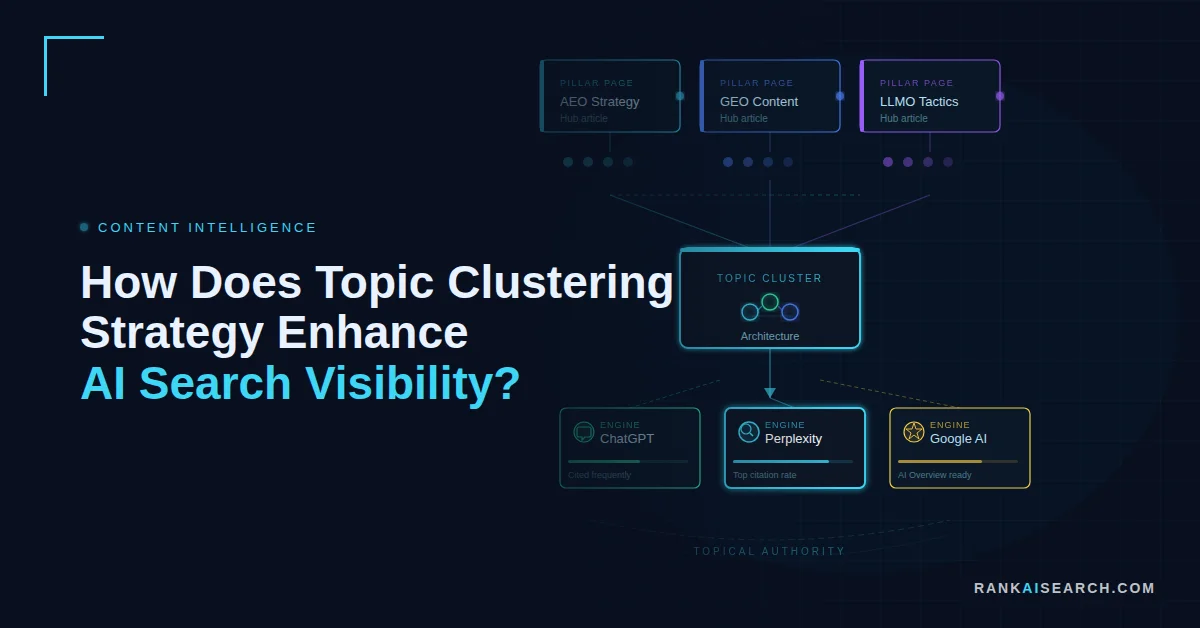
You’ve published 40 blog posts this year. Each one is well-written and keyword-targeted. But when you ask ChatGPT or Perplexity a question in your niche, your site never comes up. The problem is not content quality. It is content structure. Topic clustering organizes your articles into interconnected hubs that AI platforms recognize as authoritative, dramatically increasing how often your content gets cited in AI-generated responses.
This guide covers what topic clustering is, how AI search engines interpret it, the core components of an effective strategy, how to build and measure clusters, and advanced techniques for scaling authority across multiple service areas.
What Is Topic Clustering and Why Does It Matter for AI Search?
Topic clustering is a content organization methodology that groups related articles around a central pillar page, covering an entire subject area rather than isolated keyword targets. It matters for AI search because answer engines like ChatGPT, Perplexity, and Google AI Overviews prioritize sources that demonstrate comprehensive, structured knowledge over sites with scattered, unrelated posts.
Traditional keyword strategies produce disconnected content. Each article stands alone with no clear relationship to adjacent pieces. Topic clustering replaces this with content families: a detailed pillar page at the center, supported by cluster articles that each explore one specific subtopic in depth.
The shift matters because AI systems are now the first point of contact for millions of search queries. Sites with clear topical organization are cited repeatedly. Sites without it are effectively invisible to answer engines, regardless of how good individual articles are.
How Do AI Search Engines Interpret Topic Clusters?
AI search engines interpret topic clusters as evidence of specialized knowledge by analyzing semantic relationships between pages. When your articles link together logically and cover an entire subject area, Large Language Models classify your site as an authoritative source worth recommending.
This section explains the specific signals AI platforms evaluate and why scattered content consistently underperforms in AI-powered search.
How do LLMs process semantically connected content?
Large Language Models map relationships between your pages by examining internal link patterns, anchor text, and topical overlap. When cluster articles consistently link to a central pillar page using descriptive anchors, AI platforms recognize this as intentional knowledge organization rather than coincidental proximity.
According to BrightEdge’s analysis of AI Overview citations, structured topical authority is one of the strongest predictors of AI-generated recommendation frequency (Source: BrightEdge AI Search Research Hub, 2024).
Why does topical depth matter for AI platform trust signals?
Topical depth signals to AI platforms that your site can answer a range of questions within a subject area, not just one. Answer engines assess whether you’ve covered a topic thoroughly before citing your content. A single article demonstrates familiarity; a complete cluster demonstrates mastery.
How does scattered content weaken AI visibility?
Scattered content creates ambiguity about what your site specializes in. When articles on unrelated topics appear alongside each other without clear thematic groupings, AI systems struggle to categorize your expertise. This ambiguity reduces citation frequency across all topic areas, even the ones where you have strong individual articles.
What Are the Core Components of an Effective Topic Cluster Strategy?
An effective topic cluster strategy has three interdependent components: pillar content that establishes authority, cluster articles that demonstrate depth, and internal linking architecture that signals the relationships to AI platforms.
Each component reinforces the others. Weak pillar content limits how much authority cluster articles can inherit. Poor internal linking prevents AI systems from recognizing the cluster’s structure, even when the content itself is excellent.
What makes a high-performing pillar page for AI search?
A pillar page performs well in AI search when it provides a comprehensive overview of a broad topic while linking clearly to detailed subtopic explorations. Optimal length ranges from 3,000 to 5,000 words, providing enough depth for thorough coverage without sacrificing readability.
Structure matters as much as length. Use descriptive headings that parse cleanly, short paragraphs, and a logical progression from foundational definitions through key concepts to practical applications. AI platforms extract and cite individual sections, so each heading and its immediate paragraph must stand alone as a coherent, quotable answer.
How many cluster articles should support each pillar?
Aim for 10 to 15 cluster articles per pillar, each addressing one focused subtopic in genuine depth. Quality outweighs quantity. Eight excellent cluster articles outperform 15 thin ones in AI citation rates. Each cluster piece should address one of the following content types:
- Definitional questions (“What is X?”)
- Process questions (“How do you do X?”)
- Comparison queries (“X vs. Y”)
- Troubleshooting questions (“Why is X not working?”)
- Use case examples (“How does X apply to [industry]?”)
This variety ensures your cluster can support AI-generated responses regardless of how users phrase their questions.
What internal linking patterns signal topic relationships to AI?
Contextual internal links with descriptive anchor text signal topic relationships to AI systems more effectively than generic links. Cluster articles should link to the pillar page using anchor text that includes topic keywords. The pillar page should link to every cluster article with contextual anchors that explain what specific information the reader will find.
| Link type | Anchor text example | Effect on AI interpretation |
| Cluster → Pillar | “topic clustering strategy” | Reinforces pillar as authority hub |
| Pillar → Cluster | “how to identify content gaps in a topic cluster” | Maps cluster article scope for AI |
| Cluster → Cluster | “internal linking architecture” | Strengthens sibling relationships |
| Random → Unrelated | “click here” or “learn more” | Dilutes topical focus; avoid |
How Do You Build Topic Clusters That AI Platforms Recommend?
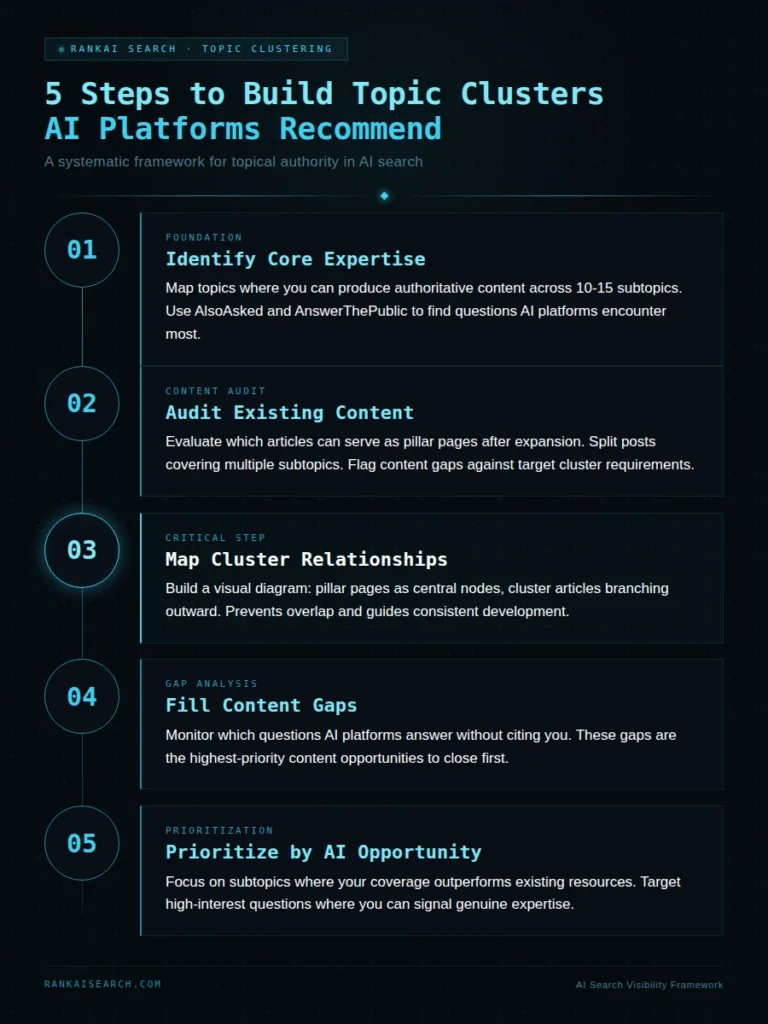
Build topic clusters through a five-step systematic process: identify core expertise areas, audit existing content, map cluster relationships visually, fill content gaps strategically, and prioritize based on AI search opportunity.
Step 1: Identify core expertise areas. Choose topics where you can produce authoritative content across at least 10 to 15 subtopics. Research the questions users ask using tools like AlsoAsked and AnswerThePublic. Align pillar topics with both audience needs and business goals.
Step 2: Audit existing content. Evaluate which articles can serve as pillar pages after expansion and which work better as cluster content. Flag pieces that cover multiple subtopics in one article; these usually need to be split.
Step 3: Map cluster relationships visually. Create a diagram or spreadsheet showing which cluster articles support which pillar. Pillar pages are central nodes; cluster articles branch outward. Use this map consistently as you develop new content to prevent overlap between different clusters.
Step 4: Identify and fill content gaps. Analyze which subtopics you’ve missed by reviewing competitor coverage and monitoring which questions AI platforms answer without citing your site. These gaps are the highest-priority content opportunities.
Step 5: Prioritize by AI search opportunity. Focus on subtopics where you can provide more comprehensive coverage than existing resources. According to Semrush’s State of Content Marketing report, pages that achieve topical authority rankings generate 3.8 times more organic traffic than isolated pages targeting the same keywords (Source: Semrush State of Content Marketing Report, 2023).
How Does Topic Clustering Compare to Traditional Content Silos?
Topic clustering outperforms content silos in AI search because it gives answer engines a clear, confident category for your expertise. Siloed content leaves AI systems uncertain about what you specialize in, reducing the frequency and confidence of recommendations.
| Dimension | Topic Clusters | Content Silos |
| AI classification | Clear expertise category | Ambiguous; hard to categorize |
| Citation frequency | High; clusters reinforce each other | Low; individual articles compete alone |
| Internal linking | Intentional, hierarchical, topical | Random or minimal |
| Content gaps | Systematic identification and filling | Unaddressed; no mapping process |
| Zero-click performance | Strong; clusters synthesized by AI | Weak; fragmented coverage |
| Migration effort | Requires restructuring and linking | None, but ongoing cost is low visibility |
Migrating from silos to clusters does not require rebuilding your site. Group existing articles by theme, identify the most comprehensive piece as a provisional pillar, expand it to cover the broader topic overview, and update internal linking to reflect the new cluster structure.
How Does Topic Clustering Improve Answer Engine Optimization?
Topic clustering improves Answer Engine Optimization (AEO), the practice of optimizing content to be cited and quoted by AI-powered answer engines, by giving those engines comprehensive, organized source material to draw from. When a user asks a question, AI platforms search for sources that thoroughly address the topic. A well-built cluster provides that coverage in a structured, accessible format.
Clusters increase featured recommendation rates because they compete as a unified body of knowledge rather than as isolated articles. When AI platforms evaluate sources, a site that has covered 12 dimensions of a topic signals far more confidence than a site with one strong article on the same subject.
Zero-click AI answers often synthesize content from authoritative clusters. Your cluster may not always generate direct traffic in these cases, but it builds your site’s reputation as a trusted reference that AI platforms return to repeatedly. Ahrefs analysis of AI-generated citations found that sites with strong internal linking structures are cited in AI answers at rates significantly higher than those with weak or no interlinking (Source: Ahrefs Blog, “How to Get Cited by AI”, 2024).
How Do You Measure Topic Cluster Performance in AI Search?
Measure topic cluster performance through three primary indicators: citation frequency in AI-generated responses, visibility in answer engine recommendations, and referral traffic originating from AI platforms. Track these systematically alongside traditional SEO metrics.
Monitoring AI citation frequency:
- Set up Google Alerts and manual query tests for your target topics across ChatGPT, Perplexity, and Google AI Overviews
- Record which cluster articles appear in responses and how often
- Note which AI platforms cite your content most frequently and analyze what format those pages use
Traffic and visibility tracking:
- Monitor referral traffic from AI platforms via Google Analytics 4 source segmentation
- Track position changes for pillar pages and cluster articles monthly
- Review zero-click search impression data in Google Search Console for featured snippet and AI Overview appearances
Adjusting based on performance data:
If certain cluster articles consistently get cited while others stay invisible, analyze the differences in structure, specificity, and depth. Expand successful content formats. Strengthen internal linking to underperforming cluster pieces. Address uncovered subtopics that AI platforms mention when not citing your site.
What Topic Clustering Mistakes Hurt AI Visibility?
The most damaging topic clustering mistakes are creating pillar topics that are too broad or too narrow, failing to maintain semantic connections between cluster pieces, and allowing cluster content to go stale.
Scope errors:
- Pillar topics like “marketing” or “technology” are too broad to demonstrate expertise. AI platforms cannot confidently categorize your authority.
- Pillar topics like “blue widget marketing in Seattle” are too narrow to support 10 or more meaningful cluster articles.
- The right scope allows at least 10 distinct, valuable subtopics that each deserve their own dedicated article.
Linking errors:
- Linking cluster articles to unrelated topics dilutes topical focus and confuses AI systems about your expertise boundaries.
- Removing cluster articles without updating the pillar page’s outbound links creates broken connections that weaken the cluster’s signal.
- Using generic anchor text (“click here”, “read more”) prevents AI systems from parsing the topical relationship between linked pages.
Freshness errors:
Outdated statistics, deprecated tools, and irrelevant recommendations signal declining expertise to AI platforms. Establish a quarterly review schedule for every pillar page and annual reviews for cluster articles. Update statistics, replace dead links, and add new subtopics as the subject evolves.
Advanced Topic Clustering Techniques for AI Search Dominance
Advanced topic clustering techniques extend basic cluster architecture into multi-layer hierarchies, cross-cluster linking, and multimedia diversification that signals comprehensive coverage to AI platforms.
Multi-layer cluster hierarchies work well for complex industries. Create primary pillar pages covering broad topics, secondary pillar pages addressing major subtopics, and cluster articles for specific aspects. A three-tier structure demonstrates specialization depth that AI platforms recognize as genuine expertise rather than surface-level coverage.
Cross-cluster linking strengthens overall site authority when your expertise spans multiple connected areas. Link between pillar pages of related clusters when contextually justified. These connections show AI systems how your topic areas relate without blurring individual cluster boundaries.
Multimedia diversification signals comprehensive coverage:
- Videos explaining processes
- Infographics summarizing frameworks or data
- Podcasts featuring expert interviews
- Interactive tools that apply concepts
Format diversity helps answer engines serve your content in response to different user preferences, including voice queries, visual searches, and text-based questions.
User-generated content integration adds social proof and fresh perspectives. Case studies, customer examples, and community questions demonstrate real-world application. AI platforms treat engagement signals as validation of content value.
How Do You Scale Topic Clustering Across Multiple Service Areas?
Scale topic clustering by fully developing clusters in core expertise areas before expanding to adjacent topics. Launching new clusters while existing ones remain underdeveloped produces partial authority across many topics rather than strong authority in any.
Reach at least 10 quality cluster articles per pillar before starting a new cluster. This discipline ensures each cluster reaches the depth threshold where AI platforms begin classifying your site as a trusted reference for that topic.
Resource allocation for sustained cluster development:
| Priority | Action | Frequency |
| 1 | Update statistics and links in pillar pages | Quarterly |
| 2 | Add new cluster articles to active pillars | Monthly |
| 3 | Audit internal linking for broken or missing connections | Quarterly |
| 4 | Initiate new clusters in adjacent topic areas | After existing cluster reaches 10+ articles |
| 5 | Review AI citation rates and adjust underperforming pieces | Monthly |
Maintain documentation standards across all clusters. Establish templates for pillar page structure, cluster article formatting, and internal linking patterns. Consistency helps AI platforms recognize your content architecture across the full site, not just within individual clusters.
Frequently Asked Questions about Topic Clustering
How many cluster articles should support each pillar page for optimal AI search performance?
Aim for 10 to 15 cluster articles per pillar page. This range provides sufficient depth to demonstrate comprehensive expertise without creating thin content that inflates the cluster without adding value. Prioritize thorough coverage of each subtopic over hitting a specific article count.
Can existing content be reorganized into topic clusters without losing search rankings?
Yes, existing content can be reorganized into topic clusters without losing rankings if you maintain URL structure wherever possible and update internal linking systematically to reflect the new cluster relationships. Expanding thin pillar candidates and filling content gaps during the reorganization typically improves rankings as AI platforms recognize the stronger topical organization.
How long does it take for AI search engines to recognize topic cluster architecture?
AI search engines typically begin recognizing topic cluster architecture within 4 to 8 weeks after implementation. Full performance improvements appear over 3 to 6 months as AI platforms accumulate more signals about your enhanced topical authority. Timeline depends on your site’s existing authority and how completely you’ve developed the cluster.
What is the ideal word count for pillar pages targeting AI answer engines?
Pillar pages targeting AI answer engines perform best at 3,000 to 5,000 words. This length supports comprehensive topic coverage while maintaining readability. Focus on completeness and clear structure rather than hitting a specific word count. AI platforms value well-organized, complete information over arbitrary length targets.
Should topic clusters focus on transactional or informational search intent for AI platforms?
Topic clusters should primarily focus on informational search intent. Answer engines most frequently cite educational content that helps users understand topics, solve problems, and make informed decisions. Include transactional content where appropriate, but establish authority through comprehensive informational coverage first.
How do topic clusters improve visibility on ChatGPT and Perplexity AI specifically?
Topic clusters improve visibility on ChatGPT and Perplexity by establishing your site as a comprehensive source these platforms can cite with confidence. When users ask questions, these AI systems search for authoritative sources that cover topics with both depth and breadth. Well-structured clusters signal that completeness, increasing citation likelihood across a wider range of query types.
Can small businesses with limited content compete using topic clustering strategies?
Small businesses can compete effectively by clustering around narrow, specific topic areas rather than broad subjects. Focused depth in a niche topic outperforms surface-level coverage of a broad one. Build complete clusters around the topics closest to your actual expertise before expanding to adjacent areas.
What tools support topic cluster visualization and planning?
Mind mapping tools, content strategy platforms like MarketMuse or Clearscope, and spreadsheet templates all support cluster visualization. The best tool is whichever lets you update relationships easily as your cluster evolves. Represent pillar pages as central nodes with cluster articles branching outward. Rebuild this map whenever you add new articles or retire old ones.