


How Knowledge Graph Optimization Powers AI Search Recommendations
A prospect asks ChatGPT for the best vendor in your category. The AI names three competitors and skips you, even though your content is stronger and your reviews are better. The problem is not your content. The AI does not recognize your brand as a verified entity it can trust, so knowledge graph optimization is what gets you named in that answer. Knowledge graph optimization is the practice of establishing your brand as a clearly defined, consistently described entity that AI platforms can recognize, verify, and recommend. This guide covers what it is, how AI engines use it, how to audit your current presence, and the strategies that strengthen your entity over time.
Understanding Knowledge Graph Optimization for AI Search
Knowledge graph optimization is the work of making your brand a recognized entity inside the structured databases that AI platforms use to verify and connect facts. A knowledge graph is a database of entities, their attributes, and the relationships between them: a connected web of facts that maps how brands, products, and concepts relate.
Traditional SEO targets keywords and rankings. Knowledge graph optimization targets identity. It ensures AI systems understand who you are, what you offer, and why you hold authority in your field, independent of any single keyword.
The shift matters because discovery now happens inside the answer, not on a results page. Zero-click searches reached 58.5% of U.S. searches in 2025, and that rate climbs to an average of 83% when an AI Overview appears (Source: Similarweb / Omnibound, 2026). When the answer is generated rather than linked, the brands named in that answer win the visibility.
Strong entity signals drive three outcomes:
- Inclusion in generated answers. Verified, consistent information lets platforms cite you with confidence.
- Higher recommendation frequency. Clear entity definitions and relationship signals make your brand appear more often in relevant queries.
- Compounding authority. Each new signal reinforces the existing ones, raising the cost for competitors to displace you.
AI systems do not recommend the best content. They recommend the brands they can verify.
How Do AI Search Engines Use Knowledge Graphs to Understand Your Brand?
AI engines build an entity profile of your brand by pulling signals from many sources at once, then use that profile to decide when to recommend you. They scan structured data, authoritative websites, business directories, social profiles, and knowledge bases to piece together what your brand represents.
Three signal types drive how well these systems understand you, and each plays a distinct role in recommendation decisions.
| Signal Type | What It Tells AI | Why It Affects Recommendations |
| Entity recognition | Your core attributes: industry, offerings, location, positioning | Determines whether AI categorizes you correctly when your name appears |
| Entity relationships | Which leaders, publications, and topics you associate with | Connections to trusted sources read as endorsement signals |
| Information consistency | Whether your details match across every platform | Conflicting data forces AI to guess or omit you entirely |
Entity recognition lets answer engines identify what kind of business you are. When someone mentions your company name, the platform needs to know whether you are a software provider, a consulting firm, or a manufacturer, plus your industry focus and geographic presence.
Relationship signals influence trust. When your brand consistently appears alongside industry leaders and respected organizations, AI platforms interpret those connections as proof of standing. HubSpot illustrates the pattern: its verified business data, extensive structured data, and clear associations with marketing automation topics make it a default recommendation when users ask AI platforms about marketing tools.
What Are the Key Components of Knowledge Graph Optimization?
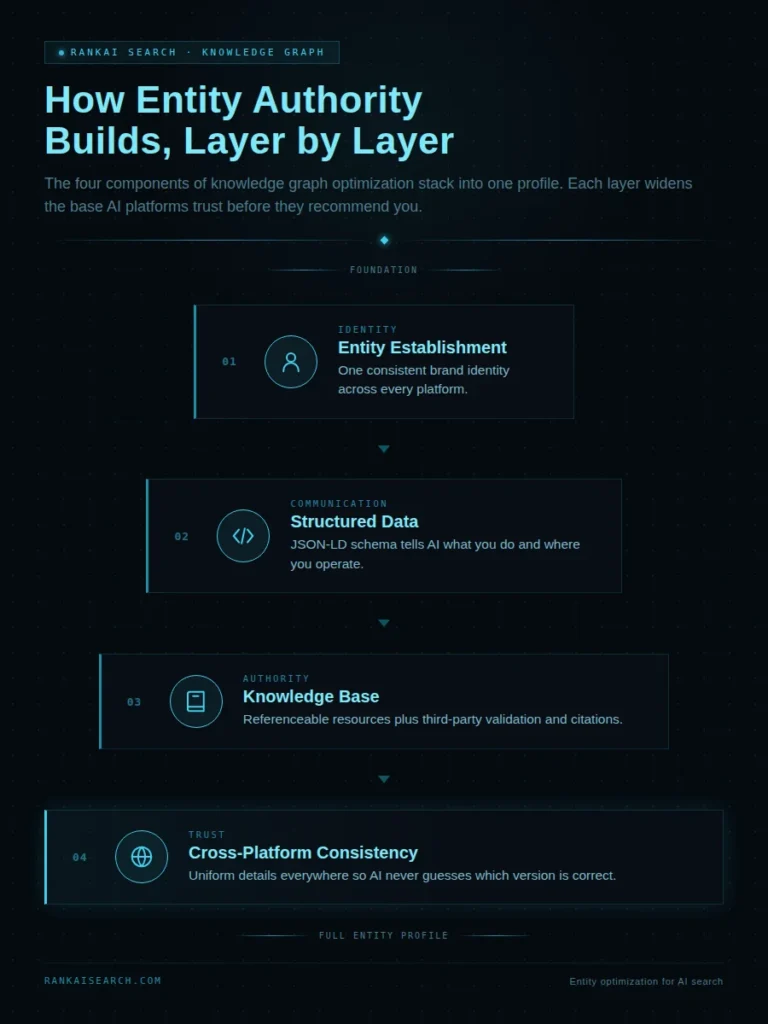
The four core components are entity establishment, structured data, knowledge base authority, and cross-platform consistency. Each one feeds the others, and a gap in any single area weakens the whole profile. This section breaks down what each component requires.
Entity Establishment and Brand Identity Signals
Entity establishment is the work of making your brand recognizable as one consistent identity everywhere it appears. Your company name, core offerings, and industry classification must read identically on LinkedIn, your website, and every directory.
Authority comes from demonstrated expertise in trusted contexts. AI platforms weigh how frequently and prominently your brand appears alongside established industry topics. Connecting your entity to relevant concepts guides the platform toward the right recommendation scenarios: an email marketing tool should hold clear relationships with automation, campaign management, and customer engagement.
Structured Data Implementation and Schema Markup
Schema markup is code that tells AI platforms directly what your business does, where you operate, and what you offer. Organization, Product, Service, and FAQ schemas each communicate a specific layer of entity information in a format machines can parse without ambiguity.
The evidence on schema’s impact is mixed, which is why implementation quality matters more than coverage. A controlled Search Engine Land experiment in September 2025 found that among three near-identical pages, only the one with well-implemented JSON-LD appeared in a Google AI Overview, while the page with no schema failed to index at all (Source: Search Engine Land via GWContent, 2025). Follow these practices:
- Use JSON-LD only. Every major AI engine parses it more reliably than Microdata or RDFa.
- Choose the most specific schema type available. Generic markup gives AI less to work with.
- Prioritize Organization and entity markup. Entity disambiguation markup improves both AI Mode citations and Knowledge Panel accuracy.
- Keep markup current. Update it whenever your business details change.
Schema alone does not guarantee citations. It improves extraction accuracy on platforms that confirm they use it, including Google AI Overviews and Microsoft Copilot, but credibility still comes from the content and relationships behind the markup.
Knowledge Base Development and Authority Building
Knowledge base development is the creation of comprehensive, referenceable resources that give AI systems authoritative material to cite. Detailed service pages, educational content, and industry guides establish your brand as a primary source on its topics.
Two external signals carry outsized weight:
- Wikipedia presence. It serves as a foundational data source for many AI platforms, making it one of the strongest available entity signals for brands that qualify.
- Consistent NAP citations. Identical name, address, and phone information across directories and review sites verifies your legitimacy and physical presence.
Cross-Platform Entity Consistency
Cross-platform consistency means your brand information is uniform across Google Business Profile, social media, and every directory. Inconsistent details force AI platforms to guess which version is correct, which can lead to inaccurate recommendations or full omission.
Consistency requires regular audits. When your address, offerings, or contact details change, every platform needs updating at the same time. Disambiguation matters most when similar brand names exist: unique descriptions and distinct attributes help AI tell your entity apart from competitors.
How Do You Audit Your Brand’s Knowledge Graph Presence?
Audit your presence by testing how each major platform currently recognizes, describes, and connects your brand, then documenting every gap. Start with your own brand name and work outward to competitors. The four checks below cover recognition, accuracy, competitive position, and relationship strength.
| Audit Step | What to Check | Gap Signal |
| Knowledge panel review | Search your brand on Google; inspect the panel | Missing or incorrect details |
| AI platform testing | Ask ChatGPT, Perplexity, and Google AI Overview about your brand | Inaccurate or absent descriptions |
| Competitor analysis | Note which rivals appear consistently and who links to them | Authoritative sources you lack |
| Relationship mapping | Examine which topics and organizations connect to you | Weak or irrelevant associations |
Knowledge panel review shows what Google already believes about you. Missing or wrong details point directly to the entity gaps that need attention.
AI platform testing reveals how generative engines describe you in practice. Ask each system about your company and services, then record where you appear, how you are described, and whether the information holds up. Competitor analysis turns those gaps into a roadmap by showing what strong entity positioning looks like in your industry.
What Strategies Strengthen Your Knowledge Graph for AI Recommendations?
The strategies that work all build genuine authority rather than manipulate signals: authoritative backlinks, expert content, co-citations, prominent SERP positions, and verified partnerships. Quality of source matters far more than volume in every case.
- Build authoritative backlinks. Links from educational institutions, government sites, industry associations, and respected publications signal that your brand deserves trust.
- Create expert content. Comprehensive guides, research reports, and original data establish topical authority that makes you a natural recommendation.
- Earn co-citations. When trusted sources mention your brand alongside industry leaders, AI reads the association as endorsement.
- Secure featured snippets and knowledge panels. Prominent positions feed the datasets AI platforms draw from.
- Develop verified partnerships. Memberships, certifications, and collaborations create connections AI platforms value.
Original data is the strongest lever among these. A brand that publishes proprietary research, promotes it externally, and earns backlinks tends to get cited because the citations follow the content’s credibility, not the markup around it (Source: Citedy, 2026).
Knowledge Graph Optimization vs Traditional SEO: What Changed?
The core change is a move from matching keywords in documents to understanding entities and their relationships. Traditional SEO ranked pages for search terms. AI search identifies which entities exist, how they relate, and which one best answers a question.
| Dimension | Traditional SEO | Knowledge Graph Optimization |
| Primary target | Keywords and rankings | Entity identity and authority |
| Unit of optimization | Individual pages | The whole brand entity |
| Core mechanism | Document retrieval | Entity understanding and relationships |
| Success outcome | Click from a results page | Inclusion in a generated answer |
This shift forces a strategic reorientation. Organic click-through rates fell 61% on queries where an AI Overview appeared (Source: Seer Interactive via Omnibound, 2026). When the click is disappearing, presence inside the AI answer becomes the visibility that counts.
The entity-centric model rewards different investments: structured data, cross-platform consistency, and authoritative knowledge sources, rather than keyword density on individual pages.
What Are the Most Common Knowledge Graph Optimization Mistakes?
The most common mistakes all weaken the entity profile by leaving AI systems without clear, verifiable signals. They cluster into five recurring errors.
- Inconsistent brand information. Different names or details across platforms make AI unable to confirm which entity is correct.
- Neglected structured data. Without schema, AI must piece together details from less reliable, unstructured sources.
- No authority beyond your own site. AI needs third-party validation; self-published content alone keeps entity signals weak.
- Ignored entity relationships. Without connections to relevant topics, AI cannot tell when to recommend you.
- Overlooked third-party mentions. External recognition is a direct input to perceived authority.
The pattern connecting these is over-reliance on owned content. Among the domains AI platforms cite most, the top 20 capture 66% of all citations, which shows how heavily generative engines favor sources with broad external validation (Source: The Digital Bloom, 2025). A brand that never earns independent mentions struggles to enter that set regardless of website quality.
How Does RankAISearch Approach Knowledge Graph Optimization?
RankAISearch (rankaisearch.com) is a global agency specializing in AEO, GEO, AIO, LLMO, and SEO, focused on making brands visible and citable across AI answer engines. Its knowledge graph work runs across five connected workstreams rather than one-off fixes.
| Workstream | What It Delivers |
| Entity audits | Assessment of recognition strength, accuracy, and competitive position across major AI platforms |
| Structured data | Schema implementation tailored for entity recognition and AI extraction |
| Authority building | Content, relationship development, and mention generation from high-value sources |
| Consistency management | Monitoring of listings, profiles, and directories for uniform entity signals |
| Ongoing optimization | Tracking of knowledge graph changes and recommendation frequency as platforms evolve |
The audit stage anchors everything else by identifying the specific gaps that block AI visibility. From there, structured data builds the technical foundation, authority building earns the trust signals, and consistency management protects them. Ongoing optimization keeps the profile aligned as AI platforms change, and a strategy call is the fastest way to map these workstreams to your brand.
How Do You Measure Knowledge Graph Optimization Success?
Measure success through entity recognition accuracy, mention frequency, and appearance rate in AI answers, tracked over time rather than at a single point. These metrics show whether AI systems understand your brand better and recommend it more often.
| Metric | What It Measures | Where to Track It |
| Entity recognition accuracy | How correctly AI describes your brand | ChatGPT, Perplexity, AI Overview tests |
| Knowledge panel completeness | Accuracy and depth of your Google panel | Google Search |
| Brand mention frequency | How often AI names you in relevant answers | AI search monitoring tools |
| Appearance rate | Share of relevant queries where you appear | Repeated query testing |
| Entity search visibility | How often users search your brand directly | Google Search Console impressions |
Appearance rate is the metric closest to revenue. Rising frequency in AI-generated answers shows platforms increasingly treat your brand as authoritative for the queries that matter.
Set realistic timing expectations when measuring. Initial entity recognition improvements typically appear within 2 to 3 months of fixing structured data and consistency, while regular appearance in AI recommendations usually takes 6 to 12 months of sustained work.
How Do You Future-Proof Your Brand Through Knowledge Graph Excellence?
Future-proof your brand by building genuine, adaptable authority rather than chasing quick wins, because the foundations that work today survive algorithm changes. As answer engines grow more sophisticated, they rely even more on entity understanding and relationship analysis.
- Invest in durable knowledge resources. Valuable content and authentic mentions retain their value across platform changes.
- Treat entity authority as a compounding asset. Each new signal reinforces existing ones, making your position harder to displace.
- Adapt continuously. Follow AI search developments and test strategies across emerging platforms as they appear.
The compounding nature of entity authority is the central reason to start now. Adoption is already broad: 94% of B2B buyers used generative AI tools during their purchase process (Source: 6sense, 2025). Brands that establish strong entity signals while the field is still forming gain advantages that later entrants find difficult to overcome.
Frequently Asked Questions
What is a knowledge graph and how do AI search engines use it?
A knowledge graph is a structured database that maps relationships between entities like brands, people, places, and concepts. AI search engines reference it to understand context, verify information, and identify relevant entities before formulating an answer, which makes brands with clear entity definitions easier to include.
How does knowledge graph optimization differ from traditional SEO?
Traditional SEO ranks web pages for specific keywords. Knowledge graph optimization establishes your brand as a recognized entity across interconnected data sources, building authority through structured data, consistent cross-platform presence, and authoritative relationships so AI platforms recommend you regardless of exact keyword usage.
What are the most important elements of knowledge graph optimization?
The most critical elements are consistent entity information across all platforms, comprehensive structured data, authoritative third-party mentions, clear topical associations, and verified business details. AI platforms need to identify your brand, understand your offerings, and confirm your authority before recommending you.
How long does it take to see results from knowledge graph optimization?
Initial entity recognition improvements typically appear within 2 to 3 months of implementing structured data and improving cross-platform consistency. Building strong authority signals and appearing regularly in AI recommendations usually takes 6 to 12 months, depending on your current entity presence, industry competition, and strategy comprehensiveness.
Can small businesses benefit from knowledge graph optimization?
Yes. Small businesses gain particular advantages by establishing clear entity presence in their geographic areas, building strong signals through consistent local citations, Google Business Profile optimization, and focused topical authority in specific niches.
Which AI platforms rely most heavily on knowledge graphs?
Google AI Overview, Perplexity, and ChatGPT all rely heavily on knowledge graphs. Google uses its proprietary Knowledge Graph built from billions of data points, Perplexity combines multiple knowledge sources to verify information, and ChatGPT was trained on datasets that include structured knowledge, while Microsoft Copilot and other emerging platforms similarly depend on entity knowledge.
What role does structured data play in knowledge graph optimization?
Structured data provides direct, verified information to AI platforms about your brand entity. Schema markup tells answer engines what your business does, where you operate, and what you offer, helping AI systems extract and represent your information accurately instead of interpreting unstructured content and risking omission.
What is the relationship between entity-based SEO and knowledge graph optimization?
Entity-based SEO and knowledge graph optimization are closely related but focus on different aspects. Entity-based SEO optimizes content and technical elements so search engines understand your brand as an entity, while knowledge graph optimization builds the authority signals, relationships, and structured data that populate knowledge graphs; the two work together to establish strong entity recognition.