

How to Audit Your Website for AI Search Readiness
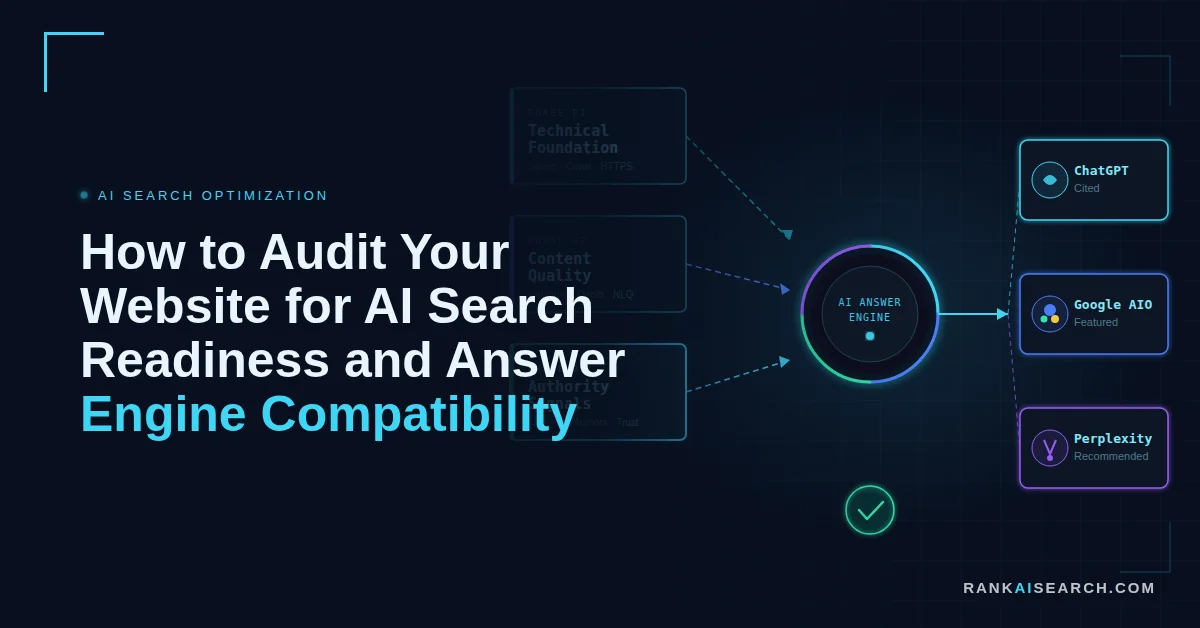
Your competitor’s brand appears in a ChatGPT response. Yours doesn’t. A potential client asks Perplexity for a service recommendation in your industry, and the AI lists three businesses by name, none of them yours. The problem isn’t your product or your pricing. It’s that your website isn’t structured, citable, or authoritative enough for AI answer engines to recommend. An AI search readiness audit identifies exactly where those gaps are and gives you a clear plan to close them.
This guide walks through every phase of an AI search readiness audit: technical infrastructure, content structure, authority signals, high-impact quick wins, and long-term transformation initiatives.
Why Do AI Search Readiness Audits Matter in 2026?
AI search readiness audits matter because AI answer engines evaluate websites differently from traditional search engines, and most sites are built for the wrong audience. Traditional SEO factors like keyword density and backlink quantity have little influence over whether ChatGPT, Perplexity, or Google AI Overview cites your content.
AI platforms treat your website as a structured knowledge source. They scan for clear hierarchies, factual accuracy, and verifiable authority signals. A site that ranks well in organic search can still be completely invisible to AI answer engines if it lacks proper schema markup, direct question-answer formatting, or credible citations.
| What Traditional Search Engines Prioritize | What AI Answer Engines Prioritize |
| Keyword density | Content structure and hierarchy |
| Backlink quantity | Schema markup and entity clarity |
| Meta tag optimization | Factual accuracy and citation-worthiness |
| Page authority score | Direct question-answer formatting |
| Anchor text distribution | Author expertise and trust signals |
(Source: BrightEdge Research, 2024)
What Do AI Answer Engines Look for When Evaluating Websites?
AI answer engines evaluate three core elements: technical accessibility, content structure, and authority signals. A site that fails on any one of these three dimensions is unlikely to appear in AI-generated responses, regardless of how strong it performs on the others.
These three dimensions are interdependent. Technical issues block AI crawlers before they can read your content. Structural problems prevent AI from extracting clean, citable quotes. Weak authority signals cause AI platforms to deprioritize your site in favor of more established sources.
Technical Infrastructure
Fast load times are non-negotiable for AI crawling efficiency. AI platforms allocate limited crawl budgets per site, and pages that load in over two seconds risk being skipped or partially crawled. Pages missed during a crawl remain invisible to AI answer engines regardless of their content quality.
The minimum technical requirements for AI accessibility are:
- Page speed: Load times under two seconds; Core Web Vitals scores in the green range
- Mobile responsiveness: All content must render correctly on every device type
- HTTPS: Active, valid security certificate with no mixed content warnings
- Crawlability: No critical pages blocked by robots.txt or noindex directives
- XML sitemap: Submitted, accepted, and covering all indexable pages
API accessibility gives high-authority sites an additional advantage. JSON-LD feeds allow some AI platforms to pull structured data directly without crawling. This significantly improves ingestion speed and accuracy for sites that implement it.
Content Formatting Standards
Clear hierarchical headings are the single most important content formatting factor for AI readability. Each H2 must introduce a distinct topic, and each H3 must break that topic into a specific, well-defined subtopic. Vague or clever headings that rely on wordplay confuse AI parsing and reduce citation likelihood.
Concise, self-contained paragraphs outperform long explanatory blocks. AI platforms extract individual paragraphs as citations. A paragraph structured with the main point in the first sentence and supporting evidence in the following one or two sentences is far more likely to be cited than a dense five-sentence block.
Consistent formatting patterns across the site train AI systems to identify high-value content faster. Use the same list format throughout. Mark statistics the same way every time. Repeated patterns allow AI to learn where your key information lives and extract it with higher accuracy.
How Do You Conduct a Step-by-Step AI Search Readiness Audit?
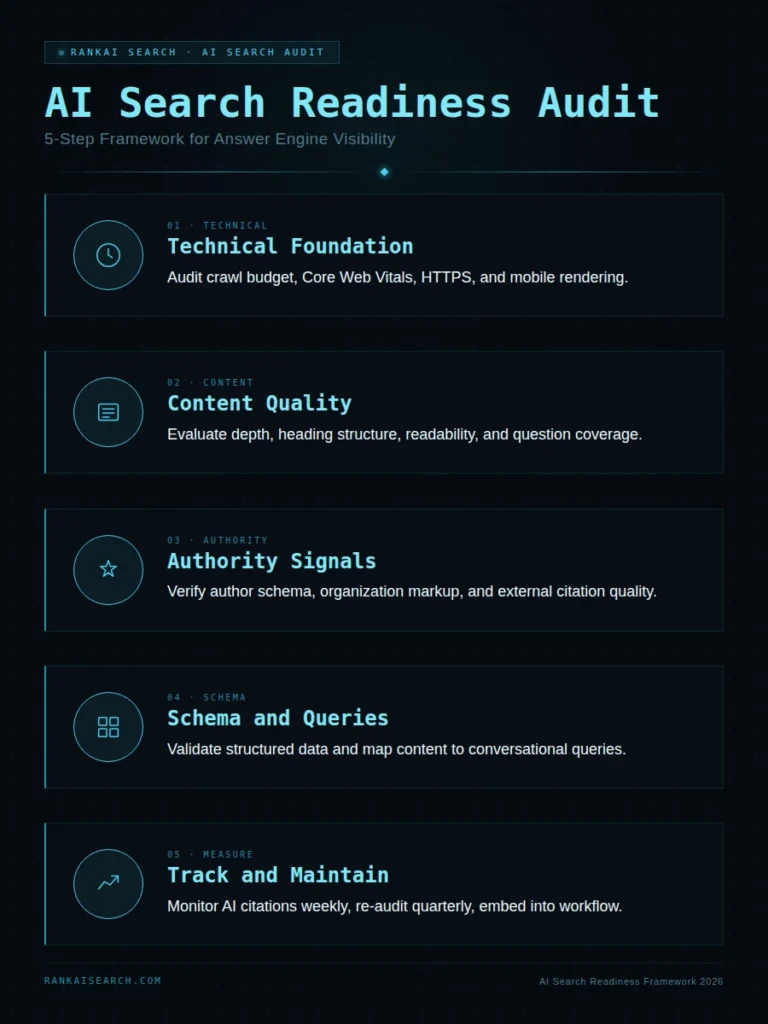
A complete AI search readiness audit runs in three sequential phases: technical foundation, content quality, and authority signals. Completing them in this order prevents wasted effort on content optimization when technical problems are still blocking AI access.
The phases are cumulative. Phase 1 ensures AI can reach your site. Phase 2 ensures AI can read and extract your content. Phase 3 ensures AI trusts your content enough to recommend it.
Phase 1: Technical Foundation Assessment
Crawl budget analysis is the starting point for any technical audit. Check server logs to confirm which AI bots are visiting your site and which pages they access. Pages that AI crawlers never reach represent immediate visibility gaps, regardless of the quality of the content on those pages.
The Phase 1 technical checklist:
- Crawl log audit: Identify unvisited important pages and locate navigation or internal linking gaps causing them
- Indexing verification: Use Google Search Console to confirm all key pages are indexed and the sitemap is accepted
- Site architecture review: Map content hierarchies and identify orphan pages disconnected from main topic clusters
- Core Web Vitals: Confirm LCP, CLS, and INP scores are all in the green range
- Mobile rendering test: Verify all content displays correctly across simulated mobile viewports
(Source: Google Search Central: Crawling and Indexing Overview)
Phase 2: Content Quality and Structure Evaluation
Content depth is measured against what AI platforms already cite in your category. Search your core topics directly in ChatGPT and Perplexity. Note which sources they reference and what those sources cover that your content does not. Those gaps are your highest-priority content additions.
The Phase 2 content evaluation framework:
| Evaluation Area | What to Check | Target Standard |
| Heading structure | H2s and H3s are descriptive, not clever | Every heading states the exact content below it |
| Paragraph structure | First sentence states the main point | No paragraph longer than 3 sentences |
| Reading level | Sentence and word complexity | 8th to 10th grade Flesch-Kincaid score |
| Question coverage | Explicit answers to industry questions | Every major question answered directly |
| Entity recognition | Brand and product accuracy in AI responses | Test in ChatGPT and Perplexity directly |
Readability scoring tools like Hemingway Editor identify sentence complexity issues quickly. Aim for short sentences and common vocabulary even on technical topics. Simpler language helps AI extract meaning more accurately and reduces the risk of misquotation.
Phase 3: Authority and Trust Signal Review
Author expertise signals directly influence whether AI platforms treat your content as credible. Add author bios with verifiable credentials, implement author schema markup, and link each author profile to external professional pages such as LinkedIn or published work portfolios. These signals tell AI systems who is behind the content and whether they are qualified to speak on the topic.
Key authority signals to audit in Phase 3:
- External citation quality: Outbound links point to government sites, academic institutions, or recognized industry sources
- Author schema: Each content creator has schema-marked credentials and linked professional profiles
- Organization schema: Your brand is defined with name, domain, service areas, and founding details
- Brand entity consistency: Your brand name, description, and category are identical across all indexed pages
- Engagement proxies: Content depth and formatting correlate with the dwell time signals AI platforms infer from crawl behavior
(Source: Schema.org Author Documentation)
What Are the Critical Checkpoints for Answer Engine Optimization?
Answer Engine Optimization (AEO) is the discipline of structuring website content so that AI answer engines can extract, verify, and cite it in response to user queries. The highest-impact AEO checkpoints are structured data validation, natural language query alignment, and citation-ready content formatting.
Most websites skip explicit AI optimization because they assume AI will interpret their content structure automatically. AI platforms prefer explicit signals. Schema markup, descriptive headings, and direct question-answer formatting must be implemented deliberately.
Structured Data and Schema Validation
Schema markup is the primary mechanism through which AI platforms understand what each page contains and how it relates to other pages on your site. The required schema types vary by business model.
| Business Type | Essential Schema Types |
| E-commerce | Product, Offer, Review, BreadcrumbList |
| Service business | Service, LocalBusiness, FAQPage, Organization |
| Content publisher | Article, Author, Organization, BreadcrumbList |
| All sites | WebSite, WebPage, SiteLinksSearchBox |
Use Google’s Rich Results Test and Schema Markup Validator to check every implementation before AI platforms crawl your markup. Broken schema is actively worse than no schema: a syntax error signals misconfiguration and can suppress citation eligibility entirely.
Advanced schema strategies increase context depth for AI systems. Nested schema shows relationships between entities. SpeakableSchema highlights content formatted for voice-response AI outputs. BreadcrumbList clarifies your site hierarchy and helps AI map content relationships accurately across the domain.
Natural Language Query Alignment
Conversational query mapping reveals whether your content matches how users actually ask questions in AI interfaces. Tools like AnswerThePublic and AlsoAsked surface the exact phrasings people use. Compare those phrasings against your current headings to identify structural content gaps.
Long-tail conversational queries significantly outperform short keyword-targeted content in AI search. A page targeting “how do I audit my website for AI search readiness” is far more likely to appear in ChatGPT responses than a page targeting “website audit.” Long-tail queries mirror the natural language users type directly into AI platforms.
Map all major industry questions against your existing content in a tracking spreadsheet. Flag questions that require a reader to infer an answer from surrounding context rather than finding it stated directly. Those are your highest-priority content updates.
Citation-Worthy Content Blocks
Every major statistic, definition, and core claim should be visually distinct and structurally isolated. Put key statistics in callout boxes or bold inline text. Begin definitions with the term being defined. Use numbered lists for sequential steps. These formatting signals help AI identify your most citable content quickly and extract it without pulling in irrelevant surrounding text.
Scannable content sections increase citation accuracy. Begin each section with a topic sentence that functions as a standalone claim. AI platforms can then extract that specific section to answer a user query without requiring additional context from surrounding paragraphs.
Balance depth with density. Each paragraph should contribute one new piece of information. Remove any filler sentences that restate what the previous sentence already said. AI platforms prefer content that delivers maximum information in minimum words with no repetition.
What Tools Should You Use for an AI Search Audit?
AI search audits require a combination of automated technical tools and manual content evaluation. No single platform covers every factor AI answer engines evaluate, and content quality assessment requires human judgment that automated tools cannot replicate.
| Tool Category | Purpose | Examples |
| Technical crawling | Identify indexing, speed, and architecture issues | Screaming Frog, Sitebulb |
| Structured data testing | Validate schema markup syntax and completeness | Google Rich Results Test, Schema Markup Validator |
| Query research | Surface conversational query gaps | AnswerThePublic, AlsoAsked |
| Performance monitoring | Track Core Web Vitals continuously | Google Search Console, PageSpeed Insights |
| AI citation testing | Manually verify brand mentions in AI responses | ChatGPT, Perplexity, Google AI Overview |
Set up ongoing monitoring alongside periodic audits. Check Core Web Vitals weekly. Review every new piece of content for proper formatting before publication. Track AI brand mentions through direct query testing in major AI platforms at least monthly.
How Do You Interpret Audit Results and Prioritize Fixes?
Categorize every audit finding into a 2×2 matrix using impact level (high or low) and implementation effort (easy or complex). High-impact, low-effort fixes are always first. This approach delivers the fastest return on optimization effort and builds momentum before tackling complex structural changes.
| Priority | Impact | Effort | Action |
| 1 | High | Low | Fix immediately |
| 2 | High | High | Schedule next sprint |
| 3 | Low | Low | Batch and fix when convenient |
| 4 | Low | High | Defer or deprioritize |
High-Impact Quick Wins
Adding FAQ schema to existing question-answer content takes under an hour and significantly increases AI citation chances. Updating title tags and meta descriptions to include natural language questions requires no development work. Both changes can show results within days as AI platforms re-crawl your site.
Additional immediate quick wins:
- Reformat existing statistics into callout boxes or bold inline text
- Add descriptive alt text to all images currently missing it
- Create author bio pages with proper schema markup
- Replace vague headings with descriptive ones that state the section’s core point
- Break any paragraph over three sentences into two shorter paragraphs
(Source: Google Search Console Help: Rich Results)
Medium-Term Strategic Improvements
Structural improvements require moderate development resources but deliver sustained AI visibility gains. Implementing breadcrumb navigation, building topic cluster architecture with pillar and subtopic pages, and adding internal search functionality all improve how AI platforms map content relationships across your site.
Content expansion projects address the gaps identified in Phase 2. Create comprehensive guides for topics where your current coverage is thin. Add case studies, verifiable statistics, and concrete examples to underdeveloped pages. Each expansion increases the likelihood that AI platforms select your content over a competitor’s thinner version of the same topic.
Technical upgrades in this phase include migrating to HTTPS if not yet implemented, deploying a CDN for global load time improvement, and replacing a non-responsive theme with one that passes mobile rendering tests.
Long-Term Transformation Initiatives
Rebuilding information architecture around user questions rather than product or service categories is the most impactful long-term structural change. It requires planning, development resources, and content migration. The outcome is a site hierarchy that aligns precisely with how AI platforms organize and retrieve information.
Shifting your content strategy from keyword-focused to question-focused writing requires organizational change, not just a tactic adjustment. Train content creators to lead with user intent. Build editorial calendars around the questions your audience types into AI platforms. This shift sustains AI visibility as platforms evolve.
Emerging techniques to experiment with in this phase include voice optimization, multimodal content combining text with annotated images or video transcripts, and real-time data integration for time-sensitive topics. These approaches position your site as an advanced, high-authority source in your category.
What Mistakes Should You Avoid During an AI Search Audit?
The most common AI audit mistake is treating a traditional SEO audit as a substitute for an AI-specific one. Traditional audits evaluate ranking factors like backlinks and keyword density. AI platforms weight content structure, factual accuracy, and citation-worthiness far more heavily, and those factors require a purpose-built evaluation process.
Three additional mistakes consistently reduce AI search visibility:
- Over-optimizing for exact question matches: Creating dozens of thin pages targeting slight question variations lowers overall content quality. AI platforms prefer comprehensive pages that address related questions together on a single, well-structured page.
- Sacrificing readability for AI visibility: Forcing unnatural question-answer formats or marking every sentence as a potential citation makes content robotic. AI platforms recognize over-optimized content and deprioritize it.
- Skipping entity testing: Assuming AI platforms already understand your brand accurately is a costly assumption. Test your brand name directly in ChatGPT and Perplexity. If the description is outdated or incorrect, entity signals need immediate correction through structured data and consistent brand mentions across the web.
How Do You Measure Improvement in AI Search Visibility After an Audit?
Track AI search improvement through direct platform testing, brand monitoring, and attribution analysis. Traditional SEO metrics like keyword rankings and organic traffic do not capture AI-specific visibility gains, and relying on them alone will understate the impact of your optimization work.
| Metric | How to Track | Frequency |
| AI brand mentions | Query key topics in ChatGPT, Perplexity, Google AIO | Weekly |
| Citation accuracy | Verify your content is quoted correctly in AI responses | Monthly |
| AI referral traffic | Segment AI platform referrals in analytics | Monthly |
| Customer discovery source | Survey new leads on how they found you | Quarterly |
| Schema coverage | Audit schema implementation completeness across key pages | Quarterly |
Technical fixes typically show results within days as AI platforms re-crawl your site. Content improvements take two to four weeks to reflect in AI responses. Major structural changes may need two to three months before full impact is visible.
How Do You Maintain AI Search Readiness as Platforms Evolve?
Maintain AI search readiness through a tiered audit schedule, continuous platform monitoring, and embedded content workflow standards. AI platforms update their evaluation criteria regularly, and one-time optimizations degrade without ongoing maintenance.
The recommended audit cadence:
- Monthly mini-audits: Check new content for proper formatting; catch technical regressions before they compound
- Quarterly comprehensive audits: Review structural issues, schema coverage, and emerging content gaps
- Annual strategic reviews: Realign your overall approach with the current direction of major AI platforms
Monitor new AI platforms as they gain traction. New answer engines launch regularly, each with slightly different evaluation criteria. Early adoption delivers first-mover advantages before competition for AI citations increases. Test your content on new platforms at launch rather than waiting until they reach mainstream scale.
Embed AI readiness permanently into your content production workflow. Create formatting checklists for content creators covering heading structure, schema implementation, and direct question-answer formatting. Regular team training ensures optimization becomes automatic rather than a recurring remediation exercise.
Frequently Asked Question about Website Audit for AI
How often should I audit my website for AI search readiness?
Run a comprehensive AI search audit every three to six months. Conduct monthly mini-audits to check new content for proper formatting and catch technical regressions before they compound into larger visibility losses. Sites that publish frequently or make regular structural changes should audit more often.
What are the most critical elements AI answer engines evaluate?
AI answer engines prioritize three elements: technical accessibility including fast load times and valid HTTPS, content structure with descriptive headings and concise paragraphs, and authority signals including proper schema markup and credible external citations. Failing on any one of the three reduces citation likelihood significantly.
Can traditional SEO tools cover an AI search audit?
Traditional SEO tools cover technical basics like site speed and mobile responsiveness, but they miss AI-specific factors such as schema validation, citation-worthiness scoring, and question-answer alignment. Use SEO tools for the technical foundation layer, then supplement with manual AI-focused evaluation of content structure and formatting.
How long does it take to see results after implementing audit recommendations?
Technical fixes can show results within days as AI platforms re-crawl your site. Content improvements typically take two to four weeks to appear in AI platform responses. Major structural changes require two to three months before full impact is visible. Monitor progress weekly to track incremental improvements.
What is the difference between auditing for traditional search versus AI answer platforms?
Traditional search audits focus on ranking factors: keyword optimization, backlinks, and meta tags. AI platform audits evaluate content structure, factual accuracy, and citation-worthiness. The overlap exists in technical infrastructure, but the content and authority evaluation criteria are fundamentally different disciplines.
Do small businesses need the same depth of AI search auditing as large enterprises?
Small businesses need thorough AI search audits but can prioritize the highest-impact elements first. Focus on technical foundations, basic schema markup, and clear content structure before tackling advanced implementations. Large enterprises require more complex audits covering multiple site sections, international considerations, and advanced schema strategies.
Which AI platform should I prioritize when conducting a website audit?
Prioritize Google AI Overview first due to its user base scale, followed by ChatGPT and Perplexity. Most optimization principles apply universally across all three platforms. Focus on universal best practices rather than platform-specific tricks, as AI evaluation criteria converge more than they diverge.
How do I verify that my structured data is properly formatted for AI search engines?
Use Google’s Rich Results Test and Schema Markup Validator to identify syntax errors and implementation gaps before AI platforms crawl your markup. Fix all validation errors immediately, as broken schema can suppress citation eligibility. Additionally, query your brand and key topics directly in ChatGPT and Perplexity to confirm structured data is improving citation accuracy in practice.