

How to Get Your Brand Cited by Google Gemini
A potential customer asks Gemini for the best solution in your category. If your brand is missing from the answer, the problem is usually not Gemini alone. It is often weak crawlability, unclear authority, thin answer passages, or a brand entity Google does not fully connect to the topic.
Getting cited by Google Gemini starts with becoming a source Google already trusts. This guide explains how to improve your content, technical SEO, structured data, and off-site authority for Gemini visibility.
How Do You Get Your Brand Cited by Google Gemini?
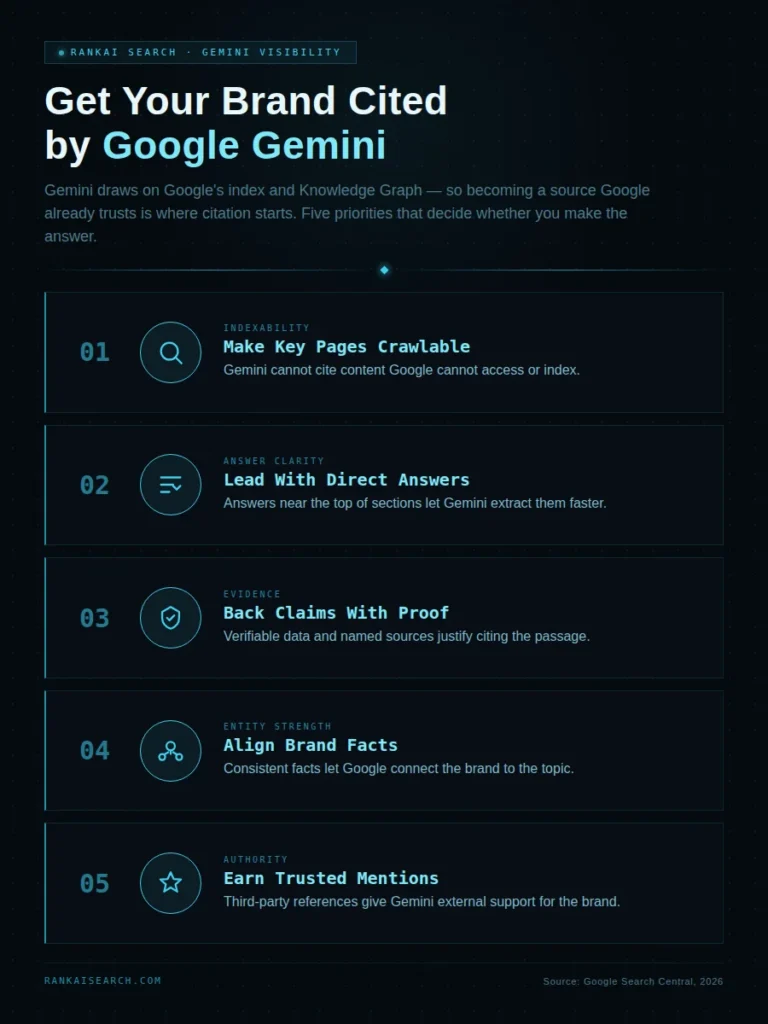
To get cited by Google Gemini, build content that Google already trusts: strong E-E-A-T signals, solid indexing, structured data, and clear answer passages. Because Gemini draws on Google’s index and Knowledge Graph, traditional authority feeds directly into Gemini citations.
Google says generative AI features in Search rely on core Search systems, retrieval-augmented generation, query fan-out, and pages from the Search index. This makes technical SEO and content quality the starting point for Gemini visibility. (Source: Google Search Central, 2026)
| Priority | What To Do | Why It Helps Gemini |
|---|---|---|
| Indexability | Make key pages crawlable and indexed | Gemini cannot cite content Google cannot access |
| Answer clarity | Put direct answers near the top of sections | Gemini can extract the answer faster |
| Evidence | Add verifiable data, examples, and sources | Gemini can justify citing the passage |
| Entity strength | Align brand facts across the web | Google can connect the brand to topics |
| Authority | Earn mentions from trusted third-party sites | Gemini has more external support for the brand |
How Does Gemini Choose and Cite Sources?
Gemini cites sources when it uses web-grounded information that supports a response. Google says Grounding with Google Search connects Gemini to real-time web content and allows Gemini to cite verifiable sources beyond its knowledge cutoff. (Source: Google AI for Developers, 2026)
Gemini citation behavior is not identical to standard rankings. A page can rank well and still not be cited if another source provides a clearer, more direct, or better supported answer.
| Source Selection Factor | What Gemini Needs | Brand Action |
|---|---|---|
| Relevance | The page must answer the exact prompt | Build pages around buyer questions |
| Trust | The page must appear reliable | Show authorship, evidence, and citations |
| Extraction | The answer must be easy to isolate | Use concise answer blocks |
| Freshness | The information must be current when needed | Update pages with visible review dates |
| Entity fit | The brand must be connected to the topic | Use consistent brand facts everywhere |
Gemini can also surface related sources in its consumer experience when a response uses web content, direct quotes, code repositories, or images from the web.
Is Your Website Crawlable and Indexed by Google?
Your website must be crawlable, indexable, and eligible for snippets before it can reliably appear as a supporting source in Google AI experiences. Google states that pages must be indexed and eligible to show a snippet to appear as supporting links in AI Overviews or AI Mode. (Source: Google Search Central, 2026)
A crawlable page is not automatically an indexed page. Google can crawl, process, and still decide not to index a URL.
| Technical Check | What To Verify | Tool |
|---|---|---|
| Index status | Page appears in Google index | URL Inspection |
| Robots access | Googlebot is not blocked | robots.txt Tester |
| Meta robots | Page does not use accidental noindex | Page source or crawler |
| Canonical tag | Canonical URL points to the preferred page | SEO crawler |
| Sitemap | Important URLs are listed | XML sitemap |
| Snippet eligibility | Page can show a Search snippet | Search Console |
Google’s URL Inspection tool shows Google’s indexed version of a page and tests whether a URL may be indexable. This makes it the fastest diagnostic step for Gemini citation readiness.
How Do You Write Content Gemini Can Easily Cite?
You write Gemini-citable content by making each section answer one clear question with a direct, evidence-backed passage. Google says content should be organized with paragraphs, sections, and headings that help readers navigate the page.
Gemini needs passages that can stand alone. The best passages define the topic, answer the prompt, and support the claim without requiring the surrounding article.
| Content Element | Citation-Ready Standard |
|---|---|
| Heading | Written as the user’s natural question |
| First sentence | Direct answer in plain language |
| Body | One idea per paragraph |
| Evidence | Statistics, examples, or named sources |
| Formatting | Tables, bullets, and short sections |
| Scope | One page answers one search intent |
Use Question-Based Headings
Question-based headings map directly to how users prompt Gemini. A heading like “How do you get cited by Google Gemini?” is easier to match to a user prompt than a vague heading like “Gemini Optimization Strategy.”
Use headings that match real decision points:
- How do you get cited by Google Gemini?
- What sources does Gemini cite?
- How do you improve E-E-A-T for Gemini?
- Which schema helps Google understand a brand?
- How do you track Gemini citations?
Put the Direct Answer First
The direct answer belongs in the first sentence under the heading. Gemini can extract the answer more easily when the claim appears before context, examples, or caveats.
Use this structure:
| Section Part | Purpose |
|---|---|
| Sentence 1 | Direct answer |
| Sentence 2 | Qualification or scope |
| Paragraph 2 | Evidence |
| Table or bullets | Steps, examples, or comparison |
| Closing line | Practical implication |
Create Self-Contained Answer Passages
A self-contained answer passage is a short block that makes sense outside the article. It should include the entity, action, condition, and outcome.
Strong answer passages usually include:
- The brand, product, or category name
- The direct answer to the prompt
- A qualifying condition
- A supporting reason
- A next step or implication
Support Claims With Reliable Evidence
Gemini is more likely to trust a passage when the claim is supported by named evidence. Use primary sources, original data, expert quotes, public documentation, case studies, and transparent methodology.
Evidence should support the exact claim being made:
| Claim Type | Strong Evidence |
|---|---|
| Market trend | Industry report or dataset |
| Product capability | Product documentation |
| Legal or compliance claim | Official regulator source |
| Brand performance | Case study with methodology |
| Expert guidance | Named author with credentials |
How Do You Strengthen E-E-A-T Signals?
You strengthen E-E-A-T signals by showing firsthand experience, qualified expertise, third-party authority, and clear evidence that your content and brand can be trusted. Google states that trust is the most important part of E-E-A-T, while experience, expertise, and authoritativeness contribute to trust. (Source: Google Search Central, 2026)
E-E-A-T is not a single ranking factor. It is a quality framework that helps teams build content Google can evaluate with more confidence.
| E-E-A-T Signal | What To Add |
|---|---|
| Experience | Firsthand testing, client examples, screenshots, workflows |
| Expertise | Author bios, credentials, methodology, subject-matter review |
| Authoritativeness | Backlinks, press mentions, industry references |
| Trust | Clear ownership, policies, citations, update history |
Show Who Created the Content
Authorship information tells readers and search systems who is responsible for the content. Add a named author, editor, reviewer, role, bio, and relevant qualifications where the topic requires expertise.
A strong author block includes:
- Full name
- Role or credential
- Topic experience
- Linked profile
- Editorial review date
- Contact or company page
Demonstrate Firsthand Experience
Firsthand experience proves that the content is not a generic rewrite. Google specifically encourages content based on what the creator knows from direct experience, not recycled information.
Use assets that only your brand can provide:
- Original screenshots
- Client workflow examples
- Internal benchmarks
- Product tests
- Before-and-after examples
- Lessons from implementation
Build Brand-Level Trust
Brand-level trust comes from consistent proof across your website and the wider web. Edelman’s 2025 Brand Trust Special Report used 15,000 respondents across 15 countries, which shows that brand trust is measured as a distinct business asset, not just a content attribute. (Source: Edelman, 2025)
Trust signals should be visible on commercial pages and educational pages:
| Trust Asset | Best Placement |
|---|---|
| Case studies | Service pages and proof pages |
| Reviews | Product or service pages |
| Policies | Footer and checkout paths |
| Leadership bios | About and author pages |
| Certifications | Relevant service pages |
| Media mentions | Press or authority pages |
Which Structured Data Should You Add?
You should add structured data that clearly identifies your organization, content, products, services, authors, and page relationships. The most relevant types include Organization, Article, Product, LocalBusiness, FAQPage, BreadcrumbList, and WebPage schema.
Structured data is machine-readable markup that helps Google understand page entities, content types, and their relationships. Google says most Search structured data uses Schema.org vocabulary, but its Search Central documentation is the definitive source for how structured data affects Google Search. (Source: Google Search Central, 2026)
Structured data does not guarantee a Gemini citation. It reduces ambiguity and helps Google understand what the page is about.
| Structured Data Type | Best Use |
|---|---|
| Organization | Brand identity, logo, sameAs profiles, contact details |
| Article | Editorial content, author, date published, date modified |
| Product | Product pages with price, availability, reviews |
| LocalBusiness | Local service businesses with service areas |
| FAQPage | Pages with visible FAQs where eligible |
| BreadcrumbList | Site hierarchy and page context |
| WebPage | Main entity and page purpose |
How Do You Strengthen Your Brand Entity?
You strengthen your brand entity by keeping your company name, website, descriptions, services, team information, and profiles consistent across your website and third-party platforms. These aligned signals help Google identify your brand and connect it to the topics, products, and services it represents.
A brand entity is the structured identity of your company as Google understands it across names, URLs, profiles, products, people, and topics. Strong entity signals make it easier for Google to connect your brand to relevant prompts and distinguish it from similar or vaguely defined companies.
| Entity Asset | What To Standardize |
|---|---|
| Brand name | Exact spelling across the web |
| Website | One canonical domain |
| Description | One clear category and positioning |
| Social profiles | Consistent handles and bios |
| Founder or team | Linked people and credentials |
| Services | Clear service taxonomy |
| Reviews | Verified customer feedback |
| Press mentions | Consistent company description |
Entity consistency matters because Gemini has to choose between similar brands, vague names, and conflicting facts. A brand with aligned profiles, clear descriptions, and repeated third-party validation is easier to identify.
How Do You Build Authority Beyond Your Website?
You build authority beyond your website by earning credible mentions from sources that already influence your market. AI search systems often consult third-party content, so brand-owned pages alone are not enough.
A 2026 Ahrefs study of 863,000 SERPs found that 38% of AI Overview citations came from pages that ranked in the top 10 organic results. (Source: Ahrefs, 2026)
| Authority Source | Why It Matters |
|---|---|
| Industry publications | Validates expertise outside your site |
| Expert roundups | Connects the brand to a category |
| Podcasts | Creates quotable expert material |
| YouTube | Adds multimodal citation opportunities |
| Review sites | Supports commercial claims |
| Partner pages | Reinforces business relationships |
| Data studies | Creates original evidence |
| Digital PR | Expands entity mentions |
Authority building should be targeted, not random. The goal is to appear where Gemini would expect to find trusted evidence for your category.
How Do You Track Gemini Mentions and Citations?
You track Gemini mentions by monitoring prompts, citations, Search Console AI performance reports, and third-party AI visibility tools. Google launched dedicated Search Console generative AI performance reports in June 2026 for AI Overviews and AI Mode impressions, but the rollout is limited and does not cover every Gemini surface. (Source: Google Search Central Blog, 2026)
Tracking must separate three outcomes: being mentioned, being cited, and being used as answer evidence.
| Tracking Layer | What It Measures | Tool Type |
|---|---|---|
| Prompt visibility | Whether Gemini mentions the brand | Manual prompt tracking or AI visibility tool |
| Citation visibility | Whether Gemini links to your page | Prompt monitoring |
| Search AI impressions | AI Overview and AI Mode exposure | Search Console |
| Entity accuracy | Whether Gemini describes the brand correctly | Brand audit |
| Competitive share | Which brands appear for target prompts | GEO tracker |
| Source influence | Which pages feed the answer | Citation analysis |
Track prompts by buyer intent:
- “Best [category] agency for [problem]”
- “Who offers [service] for [industry]?”
- “What is the best tool for [use case]?”
- “Compare [your brand] vs [competitor]”
- “How do I solve [problem]?”
What Prevents Brands From Being Cited by Gemini?
Brands fail to get cited by Gemini when Google cannot access, trust, extract, or verify their content. The most common blockers are technical, editorial, and authority gaps.
Google says a robots.txt file controls crawler access but is not a mechanism for keeping a page out of Google, while noindex is the proper indexing block. This distinction matters because brands often confuse crawl control with citation readiness. (Source: Google Search Central, 2026)
| Citation Blocker | Why It Hurts |
|---|---|
| Noindex tags | Page cannot appear in Google Search |
| Blocked crawling | Google cannot access the content |
| Thin pages | Gemini has little extractable evidence |
| Vague headings | The page does not match prompts clearly |
| Anonymous content | Trust signals are weak |
| Unsupported claims | Gemini lacks verification |
| Conflicting brand facts | Entity recognition weakens |
| No third-party mentions | Authority is limited |
Avoid these habits:
- Publishing generic “ultimate guides” with no original insight
- Creating pages for every prompt variation
- Hiding key content behind scripts or logins
- Using unsupported superlatives
- Adding fake reviews or inauthentic mentions
- Treating schema as a substitute for substance
What Should You Prioritize First?
Prioritize technical eligibility, answer clarity, and entity trust before advanced GEO experiments. Google says there is no special AI markup required for Google Search generative AI features, and standard SEO fundamentals remain the foundation.
The best first move is to fix pages that already target high-value buyer questions. These pages have the shortest path from indexed content to Gemini citation.
| Priority Order | Action | Expected Outcome |
|---|---|---|
| 1 | Verify indexing and snippet eligibility | Content becomes technically eligible |
| 2 | Rewrite H2s as buyer questions | Content maps to prompts |
| 3 | Add direct answer blocks | Passages become easier to cite |
| 4 | Add authorship and proof | Trust improves |
| 5 | Add Organization and Article schema | Entity clarity improves |
| 6 | Earn third-party mentions | Authority grows |
| 7 | Track prompt results monthly | Citation progress becomes visible |
Start with pages that meet all three conditions:
- The topic has commercial value.
- The page already ranks or receives impressions.
- The content can be improved with firsthand evidence.
Ready to Get Your Brand Cited by Gemini?
Getting cited by Gemini starts with stronger content, cleaner technical SEO, clearer entity signals, and trusted third-party authority. These improvements help Google understand when your brand is relevant and credible enough to support an AI-generated answer.
RankAISearch helps brands strengthen these signals through SEO, AEO, GEO, AIO, and LLMO strategies. Explore how RankAISearch can help improve your visibility across Gemini and other AI search platforms.
Frequently Asked Questions About Google Gemini Citations
Can you submit your website directly to Google Gemini?
No, you cannot submit a website directly to Gemini for citations. You can submit URLs and sitemaps to Google Search, then make pages crawlable, indexable, and citation-ready.
Use Search Console to check indexing and request recrawling after major updates. Google states that you can request recrawling for URLs you manage after adding or changing a page.
Does structured data guarantee a Gemini citation?
No, structured data does not guarantee a Gemini citation. It helps Google understand page information, but citation selection still depends on relevance, quality, trust, and usefulness.
Use structured data to reduce ambiguity. Do not use schema as a replacement for clear answers and evidence.
Must your page rank first to be cited by Gemini?
No, a page does not always need to rank first to be cited by Gemini or Google AI features. AI citation systems can pull from sources outside the top organic result when those sources better support the generated answer.
A strong ranking still helps because it signals relevance and visibility. A clear answer passage can help the page compete for citation even when it is not the top blue link.
Are backlinks important for Gemini citations?
Yes, backlinks still matter because they support authority and discovery. Strong third-party references also help confirm that the brand is connected to the topic.
Backlinks are not the only authority signal. Mentions, reviews, expert profiles, citations, and trusted media coverage also strengthen entity confidence.
How long does it take to get cited by Gemini?
Gemini citation gains usually take weeks to months because Google must crawl, index, evaluate, and use the improved content. A new or revised page cannot be cited reliably until Google can access and process it.
Track progress monthly, not daily. AI citation results can change as prompts, source sets, and Google systems update.
Can Gemini cite a product or service page?
Yes, Gemini can cite a product or service page when the page directly answers the user’s question and provides useful evidence. Google says generative AI responses can include product listings, product information, and local business information where appropriate.
Commercial pages need more proof than slogans. Add pricing context, use cases, comparisons, FAQs, schema, reviews, and implementation details.
Should you create content for every Gemini prompt?
No, you should not create separate pages for every Gemini prompt variation. Google warns that producing many pages primarily to manipulate rankings or generative AI responses can violate scaled content abuse policies.
Build one strong page per intent cluster. Use sections to cover related prompt variations inside a single useful resource.
Can small brands get cited by Google Gemini?
Yes, small brands can get cited when they provide clearer, more specific, and better supported answers than larger competitors. Gemini needs source quality and answer fit, not only brand size.
Small brands should publish original data, firsthand examples, niche expertise, and precise service pages. Those assets make the brand more citable than generic content from a larger competitor.