

How to Structure Content So AI Quotes It Directly
A strong article can lose citations because its best ideas are hard to separate. The answer may be mixed with examples, transitions, repeated phrasing, or vague setup. AI-quotable content puts the answer first and keeps each passage focused on one usable idea.
That does not mean every sentence must sound like a definition. The writing still needs rhythm, context, and human clarity. This guide explains how to write content that is easier for AI engines to extract, quote, and cite.
How Do You Structure Content AI Will Quote?
To structure content so AI quotes it, answer the main question in the first 40-60 words, use question-format headings, state facts with concrete specifics, and keep each passage self-contained. AI engines extract short, factual, standalone passages.
AI tools need content that can be retrieved, understood, and reused without losing meaning. Google says content that is unique, compelling, and useful is more likely to influence visibility in generative AI features on Search than any single technical tactic. (Source: Google Search Central, 2026)
The best quotable passage has a direct subject, a clear claim, and enough context to make sense outside the original page. It should not depend on the previous section, a vague pronoun, or a hidden definition.
AI citation behavior is passage-level. A page can be excellent overall and still lose citations if its best ideas are buried inside long paragraphs.
| Citability Element | What It Means | Why It Helps AI |
|---|---|---|
| Direct answer | The first sentence answers the question | Reduces extraction work |
| Self-contained passage | The passage makes sense alone | Supports citation reuse |
| Question heading | The heading mirrors a user prompt | Improves query match |
| Concrete specifics | The claim includes facts, dates, examples, or criteria | Increases confidence |
| Clear attribution | Evidence is tied to a named source | Supports verification |
| Tight structure | One paragraph covers one idea | Prevents mixed claims |
| Natural language | The answer sounds like a real user query | Matches AI prompts |
What Makes a Passage Easy for AI to Quote?
A passage is easy for AI to quote when it has complete meaning, clear context, specific wording, and a direct answer that does not need surrounding copy. The passage should work as a standalone answer inside another system’s response.
AI systems need to identify where the answer starts and ends. Perplexity says its answers include citations linking to original sources, which means the cited source needs passages that can support the answer clearly. (Source: Perplexity Help Center, 2026)
A quotable passage should not force AI systems to merge five paragraphs into one answer. The stronger structure gives the answer, the qualifier, and the evidence in a compact unit.
The most quotable passages usually answer one narrow question. Broad passages create more ambiguity because the system must decide which part supports the user’s prompt.
| Passage Trait | Strong Version | Weak Version |
|---|---|---|
| Meaning | Explains the full idea | Requires previous context |
| Subject | Names the thing being discussed | Uses “this,” “it,” or “they” vaguely |
| Scope | States when the claim applies | Sounds universal without support |
| Evidence | Includes a source or concrete proof | Makes a broad claim |
| Length | Short enough to extract | Too long or crowded |
| Structure | One idea per paragraph | Multiple claims mixed together |
Complete Standalone Meaning
Complete standalone meaning means a passage can be understood without the heading, previous paragraph, or surrounding page. The reader should know the topic, action, and condition from the passage itself.
A weak passage says, “This improves visibility.” A stronger passage says, “Question-format headings improve AI visibility by matching how users ask prompts and by giving answer systems a clear retrieval target.”
| Weak Passage | Quotable Passage |
|---|---|
| “This makes it easier to cite.” | “A self-contained answer is easier for AI systems to cite because it includes the subject, claim, and context in one passage.” |
| “They help readers understand it.” | “Comparison tables help readers and AI systems understand differences between options across the same criteria.” |
| “It should be specific.” | “A specific claim gives AI systems clearer evidence than a vague statement because it includes a fact, condition, date, or example.” |
Clear Subject and Context
Clear subject and context tell AI systems exactly what the passage is about. A sentence should name the product, process, concept, company, metric, or action instead of relying on pronouns.
Context also prevents the quote from being misleading. A claim about “AI search” should clarify whether it refers to AI Overviews, AI Mode, Perplexity, ChatGPT Search, Claude with web search, or AI answer engines generally.
| Ambiguous Wording | Clear Wording |
|---|---|
| “It helps citations.” | “FAQ schema can help AI systems interpret visible Q&A content.” |
| “This works faster.” | “Retrieval-based AI tools can surface new content faster than pretrained model knowledge.” |
| “They need proof.” | “AI answer engines need source evidence before they can cite a claim confidently.” |
How Should You Write the Opening Answer?
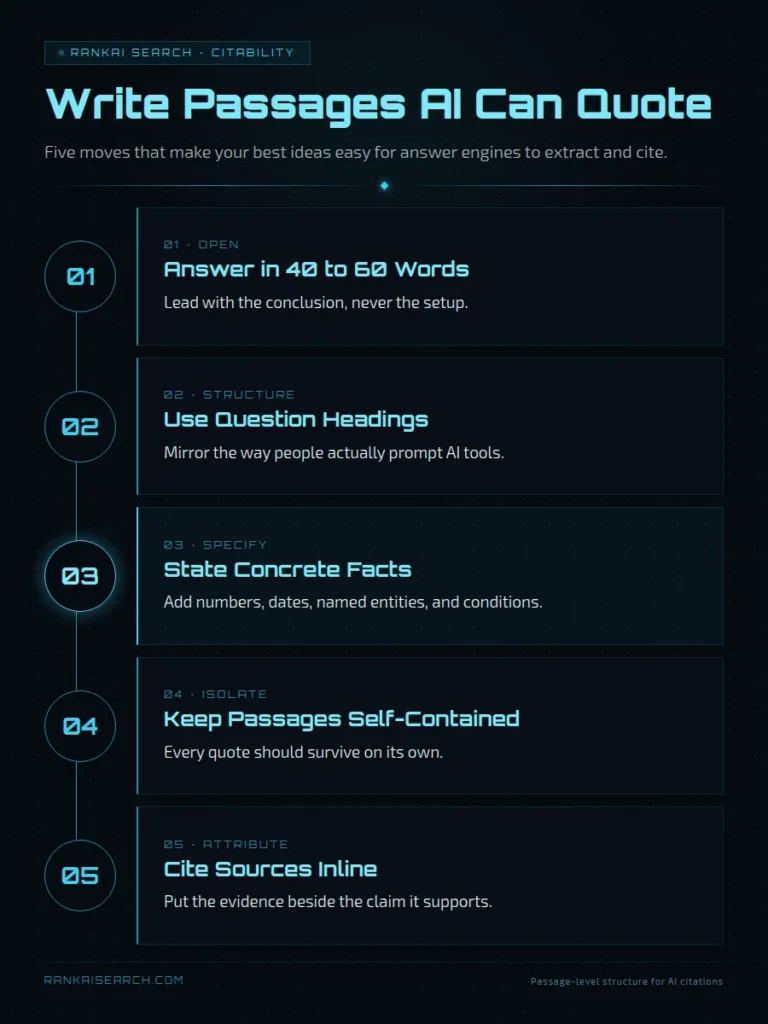
You should write the opening answer as a 40-60 word passage that directly answers the page’s main question. It should define the topic, state the conclusion, and include the most important criteria without drifting into background.
The opening answer matters because AI systems often look for concise summary passages near the top of a page. A strong opening answer should be specific enough to quote and short enough to reuse. It should not start with a story, a statistic, or a soft introduction.
The first answer block should also guide the rest of the article. Each later section should expand one part of that opening answer.
| Opening Answer Element | What To Include |
|---|---|
| Main answer | Direct response to the title question |
| Method | Core steps or criteria |
| Scope | Who or what the answer applies to |
| Benefit | Why the method works |
| Limit | One condition if needed |
| Plain language | No jargon string or filler |
Why Should Each Section Focus on One Question?
Each section should focus on one question because AI systems and human readers both need clean answer boundaries. A section that answers one question is easier to retrieve, summarize, and cite.
Question-focused sections match how users prompt AI tools. A user may ask “How long should an AI-quotable passage be?” or “Do statistics help AI citations?” rather than searching for a broad keyword.
Each section should answer the question first, then add support. The answer should not be hidden after context.
| Section Structure | Why It Works |
|---|---|
| H2 question | Matches user and AI prompt language |
| First sentence answer | Gives a clear extractable claim |
| Short context paragraph | Explains why the answer is true |
| Table or bullets | Breaks details into extractable units |
| Source citation | Supports verification |
| Clear next section | Prevents topic mixing |
Single-question sections also reduce redundancy. If a paragraph starts answering a different question, it needs its own section.
How Can You Make Claims More Specific and Verifiable?
You can make claims more specific and verifiable by adding numbers, dates, named entities, defined terms, source attribution, examples, and clear conditions. Specific claims are easier for AI systems to cite because they provide evidence and boundaries.
A vague claim says, “AI tools prefer clear content.” A stronger claim says, “AI answer systems can extract a passage more reliably when the passage names the subject, answers one question, and includes a verifiable source.”
Specificity also protects accuracy. A claim with clear scope is less likely to be misquoted as a universal rule.
| Vague Claim | More Verifiable Claim |
|---|---|
| “AI likes structure.” | “Question headings help AI systems match passages to natural-language prompts.” |
| “Short answers work better.” | “A 40-60 word opening answer gives enough context for extraction without becoming dense.” |
| “Sources matter.” | “A named source and date make a factual claim easier to verify.” |
| “Tables help.” | “Tables help compare options across the same criteria.” |
Numbers, Dates, and Defined Terms
Numbers, dates, and defined terms make a passage easier to verify. They turn broad ideas into precise claims.
A definition should be written in one sentence when possible. A number should state what was measured, who measured it, and when the data applies.
| Specific Element | Example |
|---|---|
| Number | “64.7% of question-form queries triggered AI Overviews in the study.” |
| Date | “Google updated its generative AI optimization guidance in 2026.” |
| Definition | “GEO means generative engine optimization.” |
| Entity | “Perplexity includes citations that link to original sources.” |
| Scope | “This applies to retrieval-based AI tools.” |
| Condition | “Use FAQ schema only when the Q&A content is visible.” |
Evidence and Source Attribution
Evidence and source attribution make claims easier to trust. AI systems and readers need to know where a claim came from.
A source should support the exact claim near the sentence where it appears. Do not group all citations at the end if the goal is passage-level citability.
| Evidence Type | Best Use |
|---|---|
| Official documentation | Platform behavior and technical rules |
| Research study | Measured trends and citation patterns |
| Industry report | Market and buyer behavior |
| Product help page | Feature behavior |
| Dataset | Benchmarks and measurements |
| Expert quote | Interpretation from a named authority |
How Should You Organize Supporting Details Around the Main Answer?
You should organize supporting details in descending order of importance: direct answer, reason, proof, example, and action. This order helps AI systems extract the core claim before extra context.
Supporting details should not compete with the main answer. A paragraph that contains three unrelated claims is harder to quote accurately.
A strong support structure makes each paragraph do one job. One paragraph can explain the reason, one table can compare criteria, and one bullet list can show steps.
| Detail Order | Purpose |
|---|---|
| Direct answer | States the conclusion |
| Reason | Explains why the answer is true |
| Evidence | Supports the claim |
| Example | Shows the idea in practice |
| Action | Tells the reader what to do next |
Which Formatting Elements Improve Passage-Level Citability?
Formatting elements that improve passage-level citability include question headings, short paragraphs, tables, bullets, definition blocks, answer-first sections, and clear source attribution. These elements help AI systems identify the structure and purpose of each passage.
Formatting does not replace substance. It makes useful content easier to scan, retrieve, and quote. Formatting should follow the logic of the answer. A comparison belongs in a table, a simple set of steps belongs in bullets, and a definition belongs in a short paragraph.
| Formatting Element | Best Use | Citability Value |
|---|---|---|
| Question H2 | Main user prompt | Creates answer boundary |
| Question H3 | Sub-question | Narrows the passage |
| Short paragraph | One idea | Improves extraction |
| Table | Multi-attribute comparison | Structures facts |
| Bullet list | Parallel actions or traits | Improves scanning |
| Definition sentence | Technical term | Makes meaning quotable |
| Inline citation | Factual claim | Supports verification |
| Code or example block | Technical instruction | Preserves exact format |
Good formatting should make the page easier to read even if no AI system quotes it. Human usefulness remains the baseline.
How Can You Remove Ambiguity From Quotable Passages?
You can remove ambiguity from quotable passages by naming the subject, defining the scope, avoiding vague pronouns, stating conditions, and separating similar ideas. AI systems need clear reference points before they can quote a passage safely.
Ambiguity often appears in short passages that depend too much on the previous sentence. Words like “this,” “that,” “they,” and “it” can weaken extraction when the quoted passage stands alone.
A quotable passage should not hide the actor. Replace “It improves accuracy” with “Source attribution improves citation accuracy by showing which evidence supports the claim.”
| Ambiguity Problem | Better Fix |
|---|---|
| Vague pronoun | Repeat the noun |
| Missing scope | Add who, where, or when |
| Mixed claims | Split into separate paragraphs |
| Unsupported superlative | Add evidence or remove it |
| Undefined term | Define the term immediately |
| Hidden comparison | Name both items being compared |
| Broad claim | Add condition or limitation |
Review each passage out of context. If the passage becomes unclear when copied into another document, it is not ready for AI quoting.
When Should You Use Examples, Lists, and Tables?
You should use examples when a concept needs illustration, lists when several parallel items need scanning, and tables when two or more items need comparison across shared criteria. The format should match the information type.
Examples make abstract advice concrete. Lists make steps and traits easier to parse. Tables help AI systems and readers compare options without reassembling details from prose.
Format choices should reduce cognitive load. Do not turn a nuanced explanation into bullets if the idea needs context.
| Content Need | Best Format | Example |
|---|---|---|
| Define one concept | Short paragraph | “GEO means…” |
| Show steps | Numbered list | “Audit, rewrite, validate, track” |
| Compare tools | Table | Tool, use case, limitation |
| Show traits | Bullets | Specific, current, sourced |
| Explain a scenario | Example paragraph | Buyer prompt and answer |
| Show code | Code block | JSON-LD or HTML |
| Summarize criteria | Table | Criterion, meaning, action |
How Do You Keep Quotable Content Natural for Human Readers?
You keep quotable content natural by writing clear answers that help people first, then structuring those answers so AI systems can extract them. The passage should sound useful, not robotic.
AI citability should not create repetitive or awkward writing. A page that repeats the same answer in every section becomes weaker for readers and less trustworthy overall.
Natural quotable writing uses plain words, direct syntax, and meaningful variation. Each section can answer first without sounding identical.
| Robotic Pattern | Natural Alternative |
|---|---|
| “The answer is…” in every section | Start with the actual answer |
| Repeated keyword phrase | Use natural synonyms where clear |
| Forced statistic | Use a source only where it supports the point |
| Overbuilt paragraph | Keep one idea and cut the rest |
| Same sentence rhythm | Vary sentence structure naturally |
| Generic CTA language | Give a useful next action |
Write for a real reader who needs the answer quickly. AI extraction works best when the human answer is already clear.
How Can You Test Whether a Passage Works on Its Own?
You can test whether a passage works on its own by copying it into a blank document and checking whether the subject, claim, scope, and evidence remain clear. If the passage needs the previous paragraph to make sense, it is not self-contained.
A standalone test reveals hidden ambiguity. It also shows whether the passage can support a citation without extra explanation.
You can also test the passage against likely prompts. Ask whether the passage answers the prompt directly and whether a competing passage would be easier to quote.
| Test | Pass Condition |
|---|---|
| Blank-document test | Passage makes sense alone |
| Prompt test | Passage answers the exact question |
| Pronoun test | No unclear “it,” “this,” or “they” |
| Evidence test | Claim has source or specific support |
| Scope test | Conditions are clear |
| Quote test | Passage can be copied without distortion |
| Competitor test | Passage is clearer than competing answers |
Run this test before publishing high-value pages. It is especially useful for answer blocks, FAQs, definitions, comparison summaries, and product explanations.
Which Writing Habits Make Content Harder for AI to Quote?
Writing habits that make content harder for AI to quote include burying the answer, using vague language, mixing claims, overusing pronouns, adding filler, making unsupported claims, and writing long paragraphs. These habits make answer boundaries harder to identify.
The most common problem is delayed answering. If the first paragraph introduces the topic instead of answering the question, an AI system may extract a competitor’s clearer passage.
A hard-to-quote page can still rank or attract readers. The issue is that the best passage may not be clean enough to cite.
| Hard-To-Quote Habit | Better Practice |
|---|---|
| Long setup before the answer | Answer in sentence one |
| Vague adjectives | Use specific facts |
| Multiple ideas per paragraph | Split into separate paragraphs |
| Unsupported superlatives | Add evidence or remove claim |
| Hidden definitions | Define terms immediately |
| Repeated phrasing | Use concise variation |
| No visible sources | Cite claims inline |
| Overwritten transitions | Move directly to the point |
What Should You Remember About Writing Quotable Content?
You should remember that AI-quotable content is direct, self-contained, specific, sourced, and organized around one question at a time. The goal is to make each important passage useful without forcing AI systems to reconstruct the meaning.
| Principle | Practical Action |
|---|---|
| Answer first | Put the conclusion in sentence one |
| Keep passages standalone | Name the subject and scope |
| Use question headings | Match natural prompts |
| Add specifics | Use numbers, dates, examples, and definitions |
| Cite evidence | Attribute claims near the claim |
| Format clearly | Use tables and bullets where useful |
| Remove ambiguity | Replace vague pronouns and broad claims |
Quotable content still needs human value. A passage is not citation-worthy unless it helps a real reader understand or decide something.
Are You Ready to Make Your Content Easier for AI to Quote?
AI tools can extract and reuse content more easily when each passage answers one focused question with clear context, specific details, and supporting evidence. Strong question headings, answer-first paragraphs, and self-contained claims make your most valuable ideas easier to identify without weakening the experience for human readers.
RankAISearch can help refine your content structure, remove ambiguity, and strengthen the passages most likely to support AI citations. This includes improving opening answer blocks, organizing supporting details, and connecting factual claims to clear sources.
Request a content review from RankAISearch to uncover buried answers, unclear passages, and structural gaps that may be limiting your content’s citation potential.
Frequently Asked Questions About Structuring Content for AI Quotes
How long should a passage be for AI to quote it?
A quotable passage should usually be short enough to extract without editing and long enough to preserve meaning. A 40-60 word opening answer often works well for main answer blocks. Shorter passages can work for definitions. Longer passages need tight structure so the main claim does not get buried.
Does every section need a direct answer at the beginning?
Yes, every important section should start with a direct answer. This helps readers and AI systems identify the section’s main point immediately. The support can follow after the first answer sentence. Evidence, examples, tables, and lists should reinforce the answer, not delay it.
Can AI quote content that does not use question headings?
Yes, AI can quote content that does not use question headings. Clear passages, strong source support, and useful answers can still be extracted. Question headings improve prompt match. They are especially useful for how-to, definitional, comparison, and FAQ-style content.
Should definitions be written differently from how-to answers?
Yes, definitions should identify the term and meaning in the first sentence. A definition should be self-contained enough to quote without the heading. How-to answers should state the action first. They should then list steps, criteria, or conditions.
Do statistics make a passage more likely to be cited?
Statistics can make a passage more citable when they are relevant, current, and sourced. A statistic gives AI systems a concrete fact to reference. A weak or unrelated statistic can hurt clarity. Use data only when it supports the answer directly.
Can overly short answers reduce context and accuracy?
Yes, overly short answers can reduce context and accuracy. A one-sentence answer may be easy to quote but too thin to support a nuanced claim. Add one supporting sentence when the claim needs scope. The goal is concise accuracy, not minimal word count.
How can you update a quotable passage without changing its meaning?
You can update a quotable passage by preserving the core answer and refreshing the evidence, date, example, or condition. This keeps the passage stable while improving accuracy. Do not change the conclusion unless the facts changed. If the meaning changes, update the heading, internal links, and supporting context too.
How do you know which passages AI tools are already extracting?
You know which passages AI tools are extracting by testing target prompts across AI platforms and recording cited URLs, quoted language, and answer summaries. Compare the AI answer with the page to identify which passage likely supported it. Track the same prompts over time. AI answers can change as indexes, sources, and model behavior update.