

What Are Competitive Prompts, and How Do You Find the Ones Competitors Are Winning?
Your competitor may already be showing up in AI answers for questions your audience is asking. Those questions can include comparisons, recommendations, problem-solving prompts, and buying decisions. Competitive prompts are the AI search queries where another brand appears, gets cited, or receives stronger recommendation context.
This makes prompt research similar to keyword research, but the output is different. Instead of only checking search volume and rankings, you check brand mentions, cited sources, answer position, and recommendation language. This guide explains how to build a prompt list and identify the prompts competitors are winning.
What Are Competitive Prompts in AI Search?
Competitive prompts are the questions people ask AI tools where your competitors already appear as a cited source. Finding them works much like competitive keyword research: you test relevant prompts across ChatGPT, Perplexity, and AI Overviews, then note which brands keep showing up and where the gaps are.
A competitive prompt is not just a keyword. It is a full question or request that can trigger an AI answer, recommendation, comparison, citation, or brand mention. Finding competitive prompts works much like competitive keyword research. You test relevant prompts across ChatGPT, Perplexity, and AI Overviews, then note which brands keep showing up.
Semrush Prompt Tracking lets users monitor daily visibility for custom prompts across AI search platforms such as ChatGPT, Google AI Mode, and Gemini. It also includes a Sources report for finding pages AI platforms cite for tracked prompts. (Source: Semrush, 2026)
Competitive prompts matter because AI answers often compress the choice set. If a competitor appears and your brand does not, the buyer may form a shortlist before reaching a traditional search result.
| Term | Meaning | Example |
|---|---|---|
| Keyword | A search phrase used in search engines | best payroll software |
| Prompt | A natural-language AI request | What is the best payroll software for a 50-person company? |
| Competitive prompt | A prompt where competitors appear | Compare Gusto, Rippling, and ADP for small businesses |
| Brand mention | A brand named in the AI answer | Gusto appears in the recommendation |
| Citation | A source linked or referenced in the answer | A review page or product page is cited |
| Prompt gap | A valuable prompt where no brand leads clearly | The answer names sources but no strong winner |
Why Do Competitive Prompts Matter for AI Visibility?
Competitive prompts matter because they show which questions already influence AI-generated recommendations, citations, and brand comparisons. They help a business understand where competitors are being trusted before the user visits any website.
AI visibility is not limited to rankings. It includes whether a brand appears, how often it appears, which sources support it, and whether the answer describes it accurately.
Ahrefs defines AI visibility metrics around mentions, citations, impressions, and AI Share of Voice. These metrics show that AI search performance is measured by brand presence and source use, not only website clicks. (Source: Ahrefs, 2026)
Competitive prompt research also reveals the language AI systems use to describe a category. That language can show which claims, features, use cases, or third-party sources influence the answer.
| Why It Matters | What It Reveals |
|---|---|
| Competitor visibility | Which brands appear repeatedly |
| Source influence | Which pages are cited |
| Category framing | How AI describes the market |
| Buyer intent | What users ask before deciding |
| Content gaps | Which answers your site lacks |
| Authority gaps | Which sources support competitors |
| Messaging gaps | Which claims AI repeats |
| Measurement gaps | Which prompts need tracking |
A business should not wait until AI tools misrepresent the category. Competitive prompts show where to improve before the answer becomes a buyer’s first impression.
Which Types of Prompts Should You Investigate?
You should investigate prompts that reflect how people ask AI tools for recommendations, comparisons, decisions, problem-solving help, and product or service evaluation. The most useful prompts mirror real buying and research situations.
A prompt list should include broad category questions and specific decision questions. Broad prompts show who owns the market narrative, while specific prompts show who wins when the user is closer to action.
Google says AI Mode uses a query fan-out technique that divides a question into subtopics and searches across multiple data sources. This means one detailed prompt can trigger several related searches behind the answer. (Source: Google Search Help, 2026)
Competitive prompt research should cover the full decision path. A buyer may start with a problem, compare options, ask for recommendations, and then validate a final choice.
| Prompt Type | Example | What It Reveals |
|---|---|---|
| Category prompt | What is the best CRM for startups? | Category leaders |
| Comparison prompt | HubSpot vs Salesforce for small teams | Competitive positioning |
| Recommendation prompt | Recommend an SEO agency for SaaS companies | Shortlist visibility |
| Problem prompt | How do I reduce churn in a subscription app? | Problem authority |
| Use-case prompt | Best analytics tool for ecommerce attribution | Audience-specific fit |
| Decision prompt | Which platform should I choose for B2B lead tracking? | Purchase-stage influence |
| Local prompt | Best accountant for startups in Austin | Local AI visibility |
| Risk prompt | What should I avoid when hiring an SEO agency? | Trust and objection coverage |
These prompt types should be tested across several AI systems. Different tools may cite different sources, mention different competitors, and frame the same category in different ways.
Category, Comparison, and Recommendation Prompts
Category, comparison, and recommendation prompts reveal which brands AI systems treat as market options. These prompts are valuable because they influence shortlists and perceived category leadership.
A category prompt asks for the best or leading options. A comparison prompt asks for differences between named choices. A recommendation prompt asks the AI system to choose based on a use case.
| Prompt Class | Best Use |
|---|---|
| Category | Find recurring leaders |
| Comparison | See how competitors are framed |
| Recommendation | Test shortlist inclusion |
| Alternative | Find replacement opportunities |
| Best-for prompt | Test audience-specific positioning |
| Pricing prompt | See commercial decision support |
| Review prompt | Find trust sources |
Problem, Use-Case, and Decision Prompts
Problem, use-case, and decision prompts reveal whether competitors own the questions that come before a buyer knows which brand to choose. These prompts often surface educational pages, guides, reviews, forums, and category resources.
A problem prompt starts with pain. A use-case prompt adds context. A decision prompt asks which solution fits the situation best.
| Prompt Class | Best Use |
|---|---|
| Problem | Find educational authority gaps |
| Use case | Match specific buyer needs |
| Decision | Identify conversion-stage answers |
| Objection | Find trust barriers |
| Implementation | Find support and setup gaps |
| Industry | Test vertical-specific relevance |
| Audience | Test role-specific visibility |
How Do You Build a Useful Prompt List?
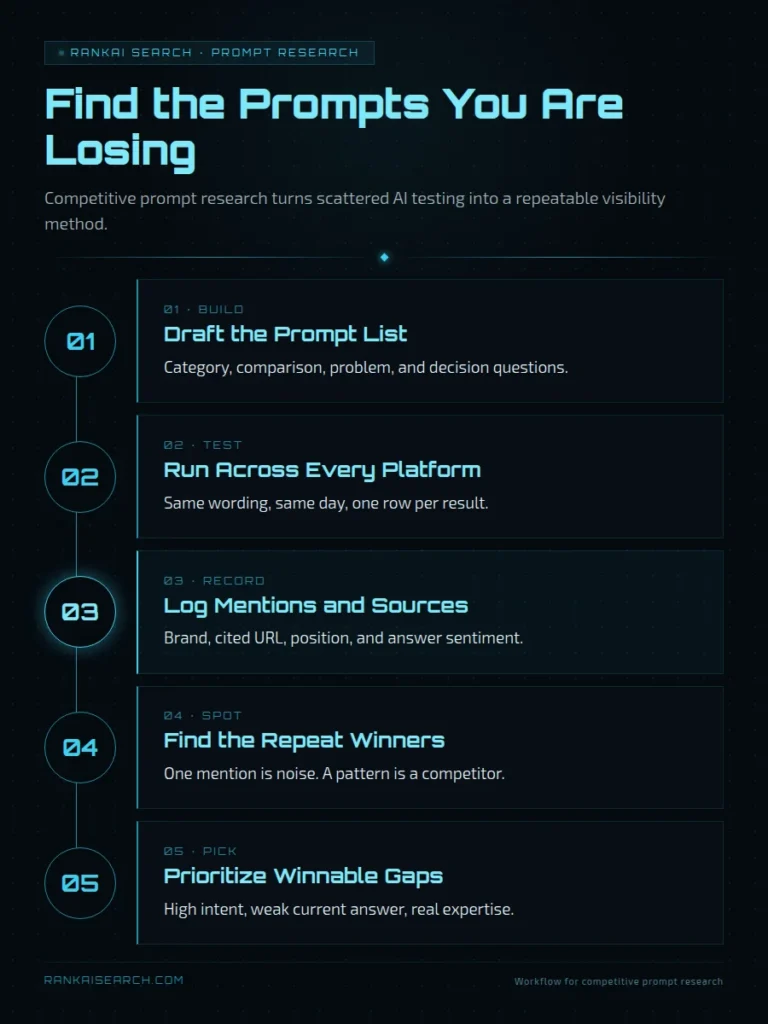
You build a useful prompt list by combining real user questions, sales questions, search keywords, competitor names, product categories, comparison angles, and AI answer patterns. The list should represent the questions a buyer would ask before choosing a brand.
A useful prompt list should not contain only broad prompts. Broad prompts are competitive, but narrow prompts often reveal easier opportunities.
OpenAI says ChatGPT Search responses may include inline citations, and users can click those citations to see the source. This makes prompt testing useful because each prompt can reveal both the answer and the sources behind it. (Source: OpenAI Help Center, 2026)
Start with prompts that match real decisions. The strongest list includes category, comparison, feature, pricing, trust, local, and problem-based questions.
| Prompt Source | How To Use It |
|---|---|
| Existing keywords | Convert short phrases into full questions |
| Customer questions | Turn common questions into prompts |
| Competitor pages | Test prompts around their strongest topics |
| Review sites | Extract comparison and pain-point language |
| Sales objections | Create decision and risk prompts |
| Internal search logs | Find site-specific demand |
| FAQs | Convert follow-ups into AI prompts |
| Forum threads | Capture natural wording |
A useful prompt list should include variations. AI answers can change when the user adds audience, location, budget, industry, or goal.
How Can You Find Which Competitors Appear Most Often?
You can find which competitors appear most often by testing the same prompt set across multiple AI tools and counting repeated brand mentions, citations, and recommendation positions. The strongest competitors are the ones that appear across many prompts and platforms.
Frequency matters because a single mention may be accidental. Repeated mentions across prompt types show stronger AI visibility.
A competitor count should separate brand mentions from cited sources. A competitor may be mentioned often because third-party pages describe it, even when its own website is not cited.
| Competitor Signal | What To Count |
|---|---|
| Brand mention | Competitor name appears in the answer |
| Citation to competitor site | Competitor page is used as a source |
| Citation to third-party source | Review, article, or directory supports competitor |
| Recommendation position | Competitor appears first, second, or later |
| Prompt coverage | Competitor appears across many prompts |
| Platform coverage | Competitor appears across many AI tools |
| Sentiment | Answer describes competitor positively or negatively |
| Use-case fit | Competitor is recommended for specific needs |
The goal is not only to find the largest competitor. The goal is to find the competitor that owns the prompts your business should win.
What Should You Record When Testing AI Answers?
You should record the prompt, AI tool, date, answer summary, brand mentions, cited URLs, recommendation order, answer sentiment, and whether your brand appears. This turns subjective AI testing into repeatable visibility research.
Competitive prompt results can change because AI systems may retrieve different sources, update their indexes, personalize answers, or respond differently to small wording changes. Recording the conditions makes the results easier to compare.
Perplexity says each response includes citations and links to original sources so users can verify information and explore topics in more depth. This shows why citation URLs should be recorded beside brand mentions. (Source: Perplexity Help Center, 2026)
The record should be simple enough to maintain. A spreadsheet works for manual testing, while a dedicated AI visibility tool works better when prompt volume grows.
| Field To Record | Why It Matters |
|---|---|
| Prompt | Shows the tested question |
| Prompt type | Groups category, comparison, and decision prompts |
| AI tool | Separates ChatGPT, Perplexity, Gemini, and AI Overviews |
| Date | Tracks answer changes over time |
| Location or market | Controls local differences |
| Brands mentioned | Shows competitor visibility |
| Recommendation order | Shows answer prominence |
| Cited URLs | Shows source influence |
| Cited domain type | Separates owned and third-party sources |
| Sentiment | Shows positive, neutral, or negative framing |
| Your brand status | Shows gap or win |
| Notes | Captures unusual answer behavior |
Brand Mentions and Citation Sources
Brand mentions and citation sources show two different layers of AI visibility. A brand mention shows whether the business appears, while a citation shows which source supports the answer.
A competitor can appear without its own site being cited. The answer may rely on review platforms, media coverage, analyst pages, directories, videos, or community discussions.
| Visibility Layer | What It Shows |
|---|---|
| Mention only | Brand appears but source is unclear |
| Owned citation | Brand website supports the answer |
| Third-party citation | External source supports the brand |
| Review citation | Customer feedback influences the answer |
| Media citation | Editorial coverage supports credibility |
| Directory citation | Listing or category page shapes inclusion |
| No citation | Answer may be less verifiable |
Answer Position and Recommendation Context
Answer position and recommendation context show whether a brand is merely mentioned or actively favored. A brand listed first in a recommendation answer has a different value than a brand mentioned in a caveat.
The context around the mention matters. Record whether the AI answer recommends the brand for price, features, reliability, enterprise use, local relevance, ease of use, or another attribute.
| Context Signal | What To Record |
|---|---|
| First recommendation | Brand leads the answer |
| Shortlist inclusion | Brand appears among options |
| Best-for label | Brand is tied to a use case |
| Warning or limitation | Brand appears with a concern |
| Comparison language | Brand is judged against competitors |
| Source support | Citation supports the claim |
| Missing attribute | Answer ignores an important strength |
How Do You Identify Prompts Your Competitors Are Winning?
You identify prompts competitors are winning by looking for prompts where the same competitor appears repeatedly, receives positive framing, earns citations, and appears in high-visibility positions. A competitor is winning when AI systems treat it as a reliable answer for that question.
A winning prompt is not only a prompt where a competitor appears once. It is a prompt where the competitor has repeated presence, strong context, and source support.
Semrush’s AI Visibility Overview Report tracks mentions, citations, cited pages, and visibility across a prompt database of more than 289 million AI queries. That type of measurement shows why prompt-level visibility should be counted over time, not judged from one answer. (Source: Semrush, 2026)
A prompt is especially competitive when multiple AI tools return the same brand. Cross-platform consistency suggests stronger entity recognition and source support.
| Winning Prompt Signal | Meaning |
|---|---|
| Competitor appears repeatedly | Strong prompt association |
| Competitor appears first | High answer prominence |
| Competitor is cited | Source-backed visibility |
| Third-party sources support competitor | External validation |
| Positive context | Favorable recommendation |
| Competitor appears across tools | Cross-platform strength |
| Your brand is absent | Clear visibility gap |
| Prompt matches buyer intent | Business value is high |
A prompt win should be tagged by intent. A competitor winning a low-value informational prompt may matter less than a competitor winning a high-intent comparison prompt.
How Can You Spot Gaps Where No Brand Clearly Leads?
You can spot prompt gaps by finding valuable prompts where AI answers are vague, inconsistent, weakly cited, outdated, or missing a clear brand recommendation. These gaps show where better content and stronger sources can compete.
A gap can exist even when competitors appear. If the answer mentions several brands without confidence, the prompt may still be open.
Gaps are most useful when they match your strengths. A business should not chase every open prompt, only the prompts where it can provide better evidence, examples, or expert guidance.
| Prompt Gap Type | What It Means |
|---|---|
| No brand is named | AI lacks a clear recommendation |
| Weak citations | Sources do not support the answer well |
| Outdated sources | Answer relies on stale information |
| Generic answer | No specific decision guidance |
| Missing use case | Answer ignores an important audience |
| Inconsistent results | Different tools give different winners |
| Competitor weakness | Listed brands have poor fit |
| Missing evidence | No source gives data or proof |
A prompt gap should lead to a content or authority action. The action may be a new page, updated guide, original research, comparison page, case study, review campaign, or digital PR push.
Which Competitive Prompts Should You Prioritize First?
You should prioritize competitive prompts that combine buyer intent, business relevance, achievable authority, weak current answers, and clear content gaps. The best prompts are valuable and realistically winnable.
Not every prompt deserves the same effort. A broad prompt like “best software” may be too competitive, while a prompt tied to a specific audience or use case may be easier to win.
Google’s AI Overviews help documentation says AI Overviews appear when Google’s systems determine generative AI can be especially helpful, such as when users want to understand information from a range of sources. This makes research and comparison prompts important targets. (Source: Google Search Help, 2026)
A priority score helps prevent scattered work. Score each prompt based on value, difficulty, source weakness, and current brand visibility.
| Priority Factor | High-Value Signal |
|---|---|
| Buyer intent | Prompt affects a decision |
| Revenue fit | Prompt relates to a product or service |
| Competitor presence | Competitors already appear |
| Citation gap | Sources are weak or incomplete |
| Content gap | Your site lacks a strong answer |
| Authority fit | Your brand can credibly answer |
| Specificity | Prompt includes audience or use case |
| Measurability | Prompt can be tracked repeatedly |
Start with prompts that sit close to a decision. A prompt that asks for the best option for a specific use case usually has more business value than a broad definition prompt.
How Do You Create Content for a High-Value Prompt?
You create content for a high-value prompt by answering the prompt directly, covering the required subquestions, adding proof, and making the page easy to cite. The page should be more useful than the sources AI systems already use.
The prompt should shape the page structure. If the prompt asks for a comparison, the page needs comparison criteria. If the prompt asks for a recommendation, the page needs use-case guidance and proof.
A page built for a competitive prompt should include a direct answer, evidence, entity clarity, source links, internal links, and a reason for users to click after reading an AI summary.
| Content Element | How It Supports the Prompt |
|---|---|
| Direct answer | Gives AI a clear answer passage |
| Question heading | Matches natural prompt wording |
| Comparison table | Supports evaluation prompts |
| Evidence | Builds citation confidence |
| Use-case section | Matches specific buyer needs |
| Examples | Makes the answer concrete |
| Original data | Creates unique source value |
| Expert review | Adds trust |
| Internal links | Builds topical depth |
| Clear CTA | Supports user action |
Do not copy the AI answer. Build the best source page that an AI answer would want to cite.
How Can You Track Changes in Competitive Prompt Results?
You can track changes in competitive prompt results by testing the same prompts on a fixed schedule and recording mentions, citations, recommendation order, source changes, sentiment, and competitors. A consistent process shows whether visibility is improving or declining.
AI answers can change as sources update, platforms change retrieval behavior, and competitors publish new content. One test is a snapshot, not a stable truth.
Semrush says its AI Visibility Toolkit includes main metrics such as mentions, cited pages, citations, monthly audience, and AI visibility. Prompt Tracking can also monitor visibility for specific prompts over time. (Source: Semrush, 2026)
Track prompts at a cadence that matches business value. High-value prompts deserve weekly or daily monitoring, while lower-value prompts may only need monthly review.
| Tracking Cadence | Best Use |
|---|---|
| Daily | High-value prompts under active optimization |
| Weekly | Competitive prompts tied to revenue |
| Monthly | Category and awareness prompts |
| Quarterly | Broad market narrative prompts |
| After major updates | New content, PR, reviews, or product launches |
| After competitor moves | New competitor reports, pages, or campaigns |
A trend matters more than one result. A brand that appears in three tools over several weeks is more stable than a brand that appears once.
Which Mistakes Can Make Competitive Prompt Research Unreliable?
Competitive prompt research becomes unreliable when prompts are too few, wording is inconsistent, screenshots are missing, tools are mixed without labels, and results are recorded without dates. The research needs repeatability to be useful.
A weak process can make random answer variation look like a real trend. Small prompt changes can also change the answer because AI systems interpret context differently.
Research should control the prompt, platform, location, date, and output record. Without those controls, results are hard to compare.
| Mistake | Better Practice |
|---|---|
| Testing one prompt | Test a prompt set |
| Changing wording every time | Keep a fixed prompt library |
| Ignoring citations | Record cited URLs |
| Counting only mentions | Record context and position |
| Mixing tools together | Label each platform |
| No date recorded | Add timestamp to every test |
| No competitor list | Define comparison brands |
| No source review | Check whether citations support the answer |
| No repeat testing | Track trends over time |
Avoid treating AI answers as static. Competitive prompt research should be repeated because AI visibility changes with content, platform behavior, and source availability.
What Should You Remember About Competitive Prompts?
You should remember that competitive prompts are AI questions where competitors already appear, and they reveal where your brand is missing from AI-driven recommendations, comparisons, and citations. They are a practical way to turn AI visibility into a measurable search strategy.
| Competitive Prompt Principle | Practical Action |
|---|---|
| Prompts are not keywords | Test full natural-language questions |
| Mentions matter | Count where competitors appear |
| Citations matter | Record which URLs support the answer |
| Context matters | Track how brands are described |
| Gaps matter | Find prompts with weak answers |
| Consistency matters | Repeat tests over time |
| Intent matters | Prioritize decision-stage prompts |
| Sources matter | Build stronger content and authority |
Competitive prompts should guide content, PR, SEO, and AI visibility work. The goal is not to copy competitor answers, but to become the better source for the questions buyers already ask.
Ready to Find the AI Prompts Your Competitors Already Own?
Competitive prompt research reveals where other brands are influencing recommendations, comparisons, and buying decisions before users reach your website. Tracking repeated mentions, cited sources, recommendation positions, and answer context helps identify the prompts with the greatest business value.
RankAISearch can uncover the competitor patterns, citation gaps, and high-intent questions shaping visibility in your category. These insights can guide stronger content, digital PR, positioning, and authority-building efforts around the prompts your audience already uses.
Explore your AI visibility opportunities with RankAISearch to identify winnable competitive prompts and focus your strategy where it can make the strongest impact.
Frequently Asked Questions About Competitive Prompts in AI Search
How are competitive prompts different from traditional keywords?
Competitive prompts are full AI questions, while traditional keywords are shorter search phrases. A prompt often includes intent, context, audience, goal, and decision criteria. A keyword might be best CRM software. A competitive prompt might ask, What is the best CRM for a 20-person B2B sales team with a limited budget?
Which AI tools should you use for competitive prompt research?
Use the AI tools where your audience is most likely to ask questions. Common starting points include ChatGPT, Perplexity, Google AI Overviews, Google AI Mode, Gemini, Claude, and Copilot. Use more than one tool because answers and citations differ by platform. A competitor may lead in Perplexity but be absent from ChatGPT or Gemini.
How many prompts should you test at one time?
Start with 25 to 50 prompts if the category is focused. Expand the list after you identify repeat patterns, competitor clusters, and high-value gaps. A smaller, well-labeled prompt set is better than a large messy one. The first goal is repeatable insight, not maximum volume.
Why do competitor mentions change between repeated searches?
Competitor mentions change because AI tools can retrieve different sources, interpret wording differently, use fresh information, or adjust answers by location and context. AI answers are generated, so they are not fixed like static rankings. This is why repeated testing matters. Record dates, tools, prompt wording, citations, and answer context.
Should you track cited sources as well as brand mentions?
Yes, you should track cited sources as well as brand mentions. Citations show which pages support the answer and which sources influence AI visibility. A brand mention without a citation still matters, but it is harder to diagnose. The cited URL shows what content or third-party proof the AI system used.
Can a smaller brand win a prompt dominated by larger competitors?
Yes, a smaller brand can win a prompt dominated by larger competitors when the prompt is specific and the smaller brand has better evidence. Narrow use cases, original data, clear comparisons, and expert content can create an opening. A smaller brand should avoid broad prompts first. It should start with prompts where its proof, audience fit, or product strength is strongest.
How often should competitive prompt results be reviewed?
High-value competitive prompts should be reviewed weekly or monthly. Prompts tied to active campaigns, revenue pages, or competitor movement may need closer tracking. Broad awareness prompts can be reviewed less often. The cadence should match the business value of the prompt.
What should you do after finding a prompt gap?
After finding a prompt gap, create or improve the source that should answer that prompt. The source may be a guide, comparison page, service page, research report, case study, FAQ, or third-party citation target. Then track the same prompt again. The goal is to see whether the improved source changes mentions, citations, recommendation context, or competitor presence.