

What Is AI Share of Voice and How Do You Improve It?
Open an AI answer about your industry and count the brands mentioned. Some names appear again and again, while others stay invisible. AI share of voice measures how much of that answer space belongs to your brand compared with competitors.
This metric helps marketers move beyond one-off screenshots. It shows whether AI systems connect your brand to the right category, questions, and buying intent. This guide explains how to calculate AI share of voice and grow it over time.
What Is AI Share of Voice?
AI share of voice is the percentage of relevant AI answers that mention your brand compared with competitors. If AI names you in 3 of 10 category prompts and a rival in 6, your share of voice is lower, and closing that gap is the goal.
AI share of voice measures competitive visibility inside AI-generated answers. It shows whether AI systems treat your brand as part of the category conversation, not just whether your website exists in search results.
The metric is useful because AI answers compress the consideration set. A user may see only a few recommended brands, cited sources, or comparison points before forming an opinion.
Semrush defines AI share of voice as your AI mentions divided by total AI mentions across all brands in the category, multiplied by 100. (Source:Semrush, 2026)
| Term | What It Measures | Why It Matters |
| AI mention | Whether AI names the brand | Shows answer presence |
| AI citation | Whether AI links or sources the brand | Shows source visibility |
| AI share of voice | Brand visibility versus competitors | Shows category strength |
| Sentiment | How AI describes the brand | Shows message quality |
| Position | Where the brand appears in the answer | Shows recommendation strength |
How Is AI Share of Voice Calculated?
AI share of voice is calculated by dividing your brand’s AI mentions or citations by the total mentions or citations for all tracked brands in a defined prompt set. The result is expressed as a percentage.
The calculation must start with a fixed scope. A brand needs to define the prompts, competitors, platforms, geography, language, and scoring rules before the number means anything.
A simple model counts whether the brand appears in an answer. A more advanced model can weigh first-position mentions, citations, high-intent prompts, and positive descriptions more heavily.
Prompt Set and Competitor Group
A prompt set is the fixed group of AI questions used to test brand visibility. A competitor group is the list of brands measured against your brand across those same prompts.
The prompt set should reflect real buyer behavior. Category prompts, comparison prompts, problem prompts, branded prompts, and use-case prompts each reveal a different visibility pattern.
| Input | What To Define |
| Prompt set | Exact questions to test |
| Competitors | Brands included in the category |
| Platforms | ChatGPT, Gemini, Claude, Perplexity, Copilot, Google AI |
| Geography | Target country or region |
| Language | Main customer language |
| Test cadence | Weekly, monthly, or campaign-based |
| Scoring rule | Mention, citation, position, or weighted score |
A competitor group should include brands that AI engines already mention. AI competitors may differ from the competitors listed in a sales deck.
Mentions, Citations, and Rankings
Mentions, citations, and rankings should be tracked separately because they measure different forms of visibility. A mention shows presence, a citation shows source attribution, and ranking overlap shows whether traditional search visibility supports AI visibility.
A brand can be mentioned without being cited. A brand can also be cited through a third-party page rather than its own website.
| Signal | Example | How To Count It |
| Mention | AI names your brand in a recommendation | Count once per answer |
| Owned citation | AI links to your website | Count by cited URL |
| Third-party citation | AI links to a review mentioning your brand | Count separately |
| Position | Brand appears first, third, or last | Track answer order |
| Ranking overlap | Cited page also ranks in search | Track as supporting context |
What Can AI Share of Voice Reveal About Your Brand?
AI share of voice reveals whether AI systems recognize your brand as a relevant option for the prompts that matter in your market. It also shows whether competitors have stronger source coverage, clearer category association, or better third-party validation.
The metric becomes more useful when it is tied to intent. A brand may appear often in educational prompts but disappear from vendor-selection prompts where buying decisions happen.
AI share of voice can expose content gaps. If competitors appear for comparison prompts and your brand does not, your site may lack comparison content, proof pages, external validation, or clear category language.
| Finding | What It Means | Likely Action |
| High mentions, low citations | AI knows the brand but does not source owned pages | Strengthen citable pages |
| Low mentions, strong rankings | SEO visibility is not translating into AI answers | Build AI-ready answer content |
| High competitor share | Rivals have stronger category signals | Analyze competitor sources |
| Positive mentions, wrong facts | Brand is visible but misunderstood | Fix entity and profile data |
| Strong third-party citations | External sources drive visibility | Build more trusted mentions |
Why Does Your Share of Voice Vary Across AI Engines?
Your AI share of voice varies across AI engines because each platform uses different models, retrieval systems, source sets, citation behavior, and answer formats. The same prompt can produce different brands in ChatGPT, Gemini, Claude, Perplexity, Copilot, and Google AI Overviews.
AI platforms do not behave like one shared search engine. One platform may cite a review site, another may cite a product page, and another may answer from learned context without visible sources.
This is why AI share of voice should be reported by platform. A blended average can hide strong visibility in one engine and weak visibility in another.
| AI Engine Difference | Why It Affects Share of Voice |
| Retrieval method | Different systems fetch different sources |
| Citation behavior | Some engines show links more often |
| Model knowledge | Some systems rely more on learned patterns |
| Prompt interpretation | Similar prompts can trigger different answer structures |
| Geography | Local and regional signals can change answers |
| Personalization | User context can affect recommendations |
| Source freshness | Platforms update source sets at different speeds |
How Do You Build a Reliable Tracking Process?
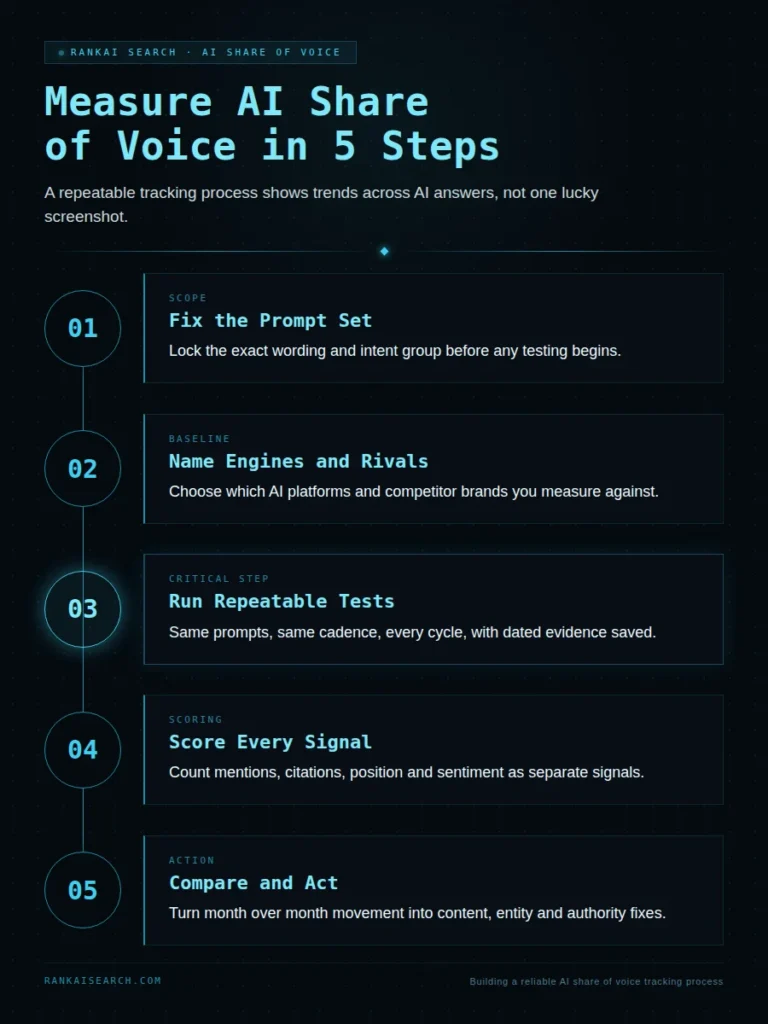
You build a reliable tracking process by using fixed prompts, fixed competitors, repeatable scoring, dated evidence, and platform-level reporting. The process must be consistent enough to show trends rather than isolated examples.
The first step is a baseline. The baseline shows current mentions, citations, positions, sentiment, accuracy, competitors, and source domains before optimization begins.
A reliable process also needs saved evidence. Screenshots, exports, cited URLs, and test dates help teams verify what changed.
| Tracking Step | What To Record |
| Select prompts | Exact wording and intent group |
| Select platforms | AI engines being tested |
| Select competitors | Brands included in the category |
| Run tests | Same prompts and same cadence |
| Capture outputs | Answer text, screenshots, and citations |
| Score results | Mentions, citations, position, sentiment |
| Compare movement | Month-over-month changes |
| Create actions | Content, entity, and authority fixes |
How Can You Increase Your AI Share of Voice?
You can increase AI share of voice by expanding useful topic coverage, strengthening category associations, and earning independent brand validation. AI engines need enough evidence to connect your brand to the prompts where competitors already appear.
AI share of voice grows when a brand becomes easier to retrieve, understand, verify, and cite. That requires stronger owned content and stronger external signals.
Improvement should start with commercial prompts. Winning a low-intent definition prompt may improve a dashboard, but winning a buyer-selection prompt is more likely to affect the pipeline.
A 2026 study of Google AI Overviews found that 38% of AI Overview citations came from pages ranking in Google’s top 10 organic results. This shows that traditional search visibility and AI citation visibility overlap but are not identical. (Source: Ahrefs, 2026)
Broader Topic Coverage
Broader topic coverage means publishing content that answers the full set of questions buyers ask around your category. AI systems need enough topical evidence to understand where your brand belongs.
Coverage should not mean thin pages for every prompt. A strong content cluster should include definitions, comparisons, use cases, examples, proof, and next steps.
| Content Gap | Content To Build |
| Missing category definition | Educational guide |
| Missing comparison prompt | Fair comparison page |
| Missing buyer prompt | Service selection guide |
| Missing proof | Case study or benchmark |
| Missing technical detail | Documentation or explainer |
| Missing FAQ | Direct answer section |
Stronger Category Associations
Stronger category associations help AI systems understand which market your brand belongs to. A brand must be clearly connected to services, products, use cases, industries, and customer problems.
Use category signals consistently:
- Homepage positioning
- Service page names
- About page description
- Author bios
- Case study language
- Structured data
- Press boilerplate
- Social profiles
- Directory listings
Independent Brand Validation
Independent brand validation means credible sources outside your website confirm your brand’s relevance. AI systems may rely on third-party sources when building recommendations, lists, and summaries.
Third-party validation gives AI systems more than a brand’s own claim. It can come from industry publications, partner pages, case studies, reviews, interviews, and trusted directories.
Useful validation sources include:
- Industry publications
- Review platforms
- Partner pages
- Customer stories
- Expert interviews
- Podcast appearances
- Research citations
- Directory profiles
- Conference pages
How Should You Respond When Competitors Dominate AI Answers?
You should respond by identifying which competitors appear, which sources support them, and which prompt intents they win. Then close the gaps with stronger content, clearer entity signals, and better external validation.
Competitor dominance is not always caused by better content volume. A competitor may win because AI engines cite a review site, marketplace page, industry list, or comparison article where your brand is absent.
The most valuable competitor analysis looks at cited sources. If the same third-party page supports competitors across several AI platforms, that source may matter more than a generic backlink opportunity.
| Competitor Advantage | What To Do |
| Better service pages | Build clearer buyer pages |
| More review visibility | Improve review and directory presence |
| Stronger category content | Expand topic coverage |
| More publisher citations | Build digital PR targets |
| Clearer brand facts | Improve entity consistency |
| Stronger proof | Publish case studies and evidence |
How Can You Turn AI Mentions Into Meaningful Business Results?
You can turn AI mentions into business results by improving the pages, offers, and conversion paths users reach after discovering your brand in AI answers. A mention creates awareness, but the business value depends on what happens next.
AI visibility can influence a buyer before a click. A user may see your brand in an AI answer, search the brand later, visit directly, or convert through another channel.
Adobe reported that traffic to U.S. retail websites from generative AI sources rose 1,200% in February 2025 compared with July 2024. This shows why AI discovery should be measured beyond brand awareness alone. (Source: Adobe, 2025)
AI mentions should connect to landing page strategy. If an AI system cites a guide, that guide should lead users toward relevant service pages, case studies, demos, or contact options.
| AI Visibility Signal | Business Follow-Through |
| Brand mention | Improve branded landing pages |
| Owned citation | Optimize cited page for conversion |
| Third-party citation | Strengthen external proof |
| Comparison appearance | Clarify differentiation |
| Positive summary | Reinforce message on-site |
| Inaccurate summary | Correct source facts |
| Referral session | Track engagement and conversion |
Connect AI share of voice to revenue signals:
- Branded search growth
- AI referral sessions
- Demo requests
- Contact form submissions
- Trial signups
- Assisted conversions
- Sales-qualified leads
- Higher-intent landing pages
Which Errors Can Distort Your Share-of-Voice Data?
Share-of-voice data becomes distorted when prompts are inconsistent, competitors are poorly chosen, mentions and citations are mixed together, or platform differences are ignored. Bad methodology can make the brand look stronger or weaker than it really is.
AI answers can vary across repeated prompts. A measurement program needs repeated tests, clean definitions, stable scoring, and saved evidence.
A 2026 study of Google AI Overviews found that 11.0% of atomic claims were unsupported by cited pages. This shows why AI visibility reporting should include accuracy and citation-quality checks. (Source: Xu, Iqbal, and Montgomery, 2026)
| Data Error | Why It Distorts Results |
| Changing prompts every month | Breaks trend comparison |
| Counting repeated mentions twice | Inflates visibility |
| Mixing citations and mentions | Blurs source authority |
| Ignoring answer position | Treats all mentions equally |
| Tracking one AI engine only | Misses platform gaps |
| Using weak competitor lists | Skews category share |
| Ignoring sentiment | Treats bad mentions as wins |
| No screenshot or export | Makes results hard to verify |
Avoid these reporting mistakes:
- Testing only prompts where the brand already appears
- Excluding strong competitors
- Changing scoring rules midstream
- Ignoring third-party citations
- Treating one answer as proof
- Reporting traffic without share-of-voice context
What Should You Remember About AI Share of Voice?
You should remember that AI share of voice measures competitive brand presence inside AI answers. It shows how often AI systems name, cite, and position your brand compared with competitors.
AI share of voice should not be read alone. It becomes more useful when paired with citation quality, answer accuracy, sentiment, referral traffic, and conversion data.
The metric should be tracked over time because AI systems change. One report gives a snapshot, while monthly measurement shows whether content, entity, and authority improvements are working.
| Principle | Practical Action |
| Define the prompt set | Track real buyer questions |
| Compare competitors | Measure category share |
| Separate mentions and citations | Avoid inflated reporting |
| Track by platform | Find engine-specific gaps |
| Score sentiment | Protect brand quality |
| Audit accuracy | Catch incorrect AI descriptions |
| Link to business results | Connect visibility to traffic and leads |
Are You Ready to Grow Your Brand’s Presence in AI Answers?
A stronger AI share of voice starts with knowing where competitors appear, which prompts matter, and what sources influence those answers. That insight makes it easier to focus your content and authority efforts where they can have the most impact.
RankAISearch can help turn those visibility gaps into a practical growth plan. See how a clearer share-of-voice strategy can support more mentions, stronger citations, and better brand recognition across AI platforms.
Frequently Asked Questions About AI Share of Voice
What is a good AI share-of-voice percentage?
A good AI share-of-voice percentage is one that grows against the competitors that matter in your category. A niche brand may start with a low percentage and still have a strong opportunity if competitors are weak in high-intent prompts, so the benchmark should be category-specific. A 20% share may be strong in a crowded category and weak in a category with only three serious competitors.
How is AI share of voice different from traditional search visibility?
AI share of voice measures brand presence inside AI answers, while traditional search visibility measures presence in search results. AI answers may mention brands, cite sources, summarize comparisons, or recommend options without following standard ranking order. Traditional rankings still matter, but AI share of voice adds a new layer that shows how brands appear inside generated responses.
Should citations and unlinked brand mentions count equally?
No, citations and unlinked brand mentions should not count equally. A citation shows source attribution, while a mention only shows that the brand appeared in the answer, so both signals should be tracked separately. A strong report can also apply a higher weight to citations because they show stronger source visibility.
Which prompts should be included in an AI share-of-voice analysis?
An AI share-of-voice analysis should include prompts that match discovery, comparison, problem-solving, and buying intent. The prompt set should reflect questions real customers ask before choosing a provider, and it should include both branded and non-branded prompts. Branded prompts test accuracy, while non-branded prompts test category visibility.
Why does AI mention different brands when the same prompt is repeated?
AI may mention different brands because answers can change based on retrieval, model behavior, source freshness, personalization, geography, and prompt interpretation. Small wording changes can also shift which brands appear, which is why repeated testing matters. A pattern across many prompts is more reliable than one answer from one run.
Can a smaller company outperform a major competitor in AI answers?
Yes, a smaller company can outperform a major competitor for narrow prompts when its content is clearer, more relevant, and better supported by sources. AI engines may choose the best source for a specific answer rather than the largest brand overall, so small brands should target focused prompts first. Specific expertise can beat broad authority when the prompt is narrow enough.
How often should AI share of voice be recalculated?
AI share of voice should be recalculated monthly as a default cadence. Monthly tracking gives enough time for content changes, source updates, and platform behavior to show movement. Weekly tracking can help during launches, rebrands, or competitive campaigns, while daily tracking can create noise unless the prompt set is highly controlled.
Does a higher AI share of voice lead to more website traffic?
A higher AI share of voice can lead to more website traffic, but it does not guarantee it, since some AI answers mention brands without sending clicks. Traffic impact depends on citations, link placement, prompt intent, landing page quality, and user behavior. Track AI referral traffic, branded search, and conversions beside share of voice.