

What Happened in the May 2026 Google Core Update and Why It Changes Everything About SEO
On May 21, 2026, Google announced its second core update of the year. This was not a traditional ranking update. This was Google’s algorithm aligning itself with AI search.
Just hours after Google I/O 2026 announced that AI Overviews crossed 2.5 billion monthly users and AI Mode surpassed 1 billion, Google’s core ranking system shifted. It now matches how AI platforms actually evaluate, cite, and recommend content.
If you are transitioning from traditional SEO to AI SEO/GEO strategies, this update is a wake-up call: the ranking factors that mattered in 2023 and 2024 no longer work in 2026. Google now grades content the same way ChatGPT, Perplexity, and Google AI Overviews do. Pages optimized for humans but built for keyword rankings are being downranked. Pages designed for AI citability are gaining visibility.
What Google Officially Announced and What It Means
Official sources:
Google released a simple statement: “This is a regular update designed to better surface relevant, satisfying content for searchers from all types of sites.”
Key facts:
- Rollout started: May 21, 2026 at 08:40 US/Pacific
- Expected completion: ~June 4, 2026
- Rollout window: up to two weeks
- Status: Still rolling out (early patterns emerging but unstable)
What’s notable is what Google didn’t say. There was no Search Central blog post explaining the update’s focus. No industry targets were named. No AI-specific improvements were mentioned.
When Google skips the detailed blog post, it signals something important: a broad algorithmic recalibration rather than a targeted fix. Recovery is not about adopting a new tactic. Recovery is about fixing foundational quality gaps that Google has now weighted far more heavily.
What Do You Need to Know Right Now?
Google is now grading content the same way AI systems do.
This is the core insight that changes everything. AI platforms like ChatGPT, Perplexity, and Google AI Overviews require:
- Complete, structured information (schema markup machines can extract with certainty)
- Verifiable claims (customer reviews, author credentials, third-party citations)
- Natural language answering specific questions
- Entity extraction capability (not keyword density)
Google’s May 2026 algorithm now weights these signals heavily. Traditional SEO signals like keyword placement and backlinks are no longer enough.
Winners in this update:
- Pages with complete schema markup
- Brand-owned destination sites
- Content with clear author attribution
- Pages answering questions directly
- Sites with verified customer reviews
Losers in this update:
- Thin informational content without schema
- AI-generated content without human review
- Aggregator platforms (job boards, travel OTAs)
- Pages without author signals
- Content contradicting customer reviews
The critical insight: Businesses treating AI search as separate from traditional SEO got hit hardest. Google unified both channels. You must optimize for both simultaneously.
Your recovery priorities for the next 30 days:
- Audit and validate schema markup
- Rewrite pages lacking author attribution
- Consolidate or delete thin content
- Add FAQ sections
- Check for technical crawl blocks
Why March 2026 Patterns Are Now Repeating in May
Amsive’s March 2026 analysis revealed a clear pattern that is now repeating in May 2026: first-party sources gain, aggregators lose.
| Vertical | Winners | Losers | Impact |
|---|---|---|---|
| Entertainment | Netflix, Disney+, official streaming | Rotten Tomatoes, JustWatch | -8.5% to -24% loss |
| Travel | Official hotel sites, airlines | OTAs (Booking.com, Expedia) | Significant decline |
| Employment | Government job boards | Indeed (-18%), ZipRecruiter (-21.6%) | Major losses |
| Health | NIH.gov, FDA.gov | WebMD, Mayo Clinic | Declined |
| Finance | Government sites, official platforms | NerdWallet, CreditKarma | Declined |
This pattern is consistent across every vertical. First-party authoritative sources gained visibility. Intermediary aggregators lost it. This is not an anomaly. This is the new direction.
Why this matters for AI search:
AI systems are trained to cite original sources, not intermediaries. When a user asks ChatGPT for travel options, the system references hotel websites directly, not Booking.com. When they ask about jobs, Perplexity cites official government job boards, not Indeed. Google’s algorithm now matches this behavior.
Three reasons this pattern is repeating in May:
Reason 1: AI platforms cite first-party sources. When an AI system cites Rotten Tomatoes, it is citing an opinion. When it cites Netflix, it is citing the source of truth. Google’s algorithm now makes this distinction. Google’s CEO confirmed this at Google I/O 2026, stating that Search “feels more like an ongoing conversation.” Conversational AI requires authoritative, citable sources.
Reason 2: The 43-day gap is historically tight. Only 43 days separated March’s completion (April 8) from May’s launch (May 21). The average gap in 2024-2025 was 60-90 days. A 43-day gap signals urgency. This tight cadence indicates Google is making sequential refinements to a single directional shift.
Reason 3: Google is explicitly aligning with AI systems. Google is not randomly changing rankings. It is intentionally matching how AI platforms evaluate content. This is permanent.
If your site is an aggregator or intermediary, May 2026 is harder. If your first-party site lacks schema and author signals, you are leaving visibility on the table.
What Pages Are Actually Winning and Losing in May 2026
Pages gaining visibility share three signal categories.
Structural signals (AI can extract data):
- Product, Offer, Review, AggregateRating schema on ecommerce
- BlogPosting, Article, Author, dateModified schema on publishers
- FAQPage schema with complete Q&A pairs
- LocalBusiness schema with verified hours
Authority signals (AI trusts these):
- Clear author attribution with author schema
- Verified author credentials
- Topical authority with comprehensive coverage
- Recent content review or update dates
Verification signals (AI cites these):
- High-quality customer reviews on page
- FAQ sections answering common questions
- Third-party citations and evidence links
- Natural language answering questions directly
A page with great writing but no schema markup, no author byline, and no fresh date is invisible to AI systems. Add schema, author attribution, and a recent update to the same content and it performs 40-60% better in AI citations based on preliminary May 2026 data.
Pages losing visibility share inverse characteristics across three dimensions:
| Signal Type | What’s Missing |
|---|---|
| Structural gaps | Informational content without schema markup; Missing Product/Offer/Review schema on products; Missing BlogPosting/Author/dateModified on articles; JavaScript-rendered content not in initial HTML |
| Content quality gaps | Unedited AI-generated content; Thin content created for search traffic; Content lacking specific facts and figures; Pages hiding answers behind paywalls or clicks |
| Authority gaps | Missing author attribution or credentials; Unknown or unverified authors; No dates or freshness signals; Content contradicting customer reviews |
According to Digital Applied’s analysis, a blog post with excellent writing but no schema, no author byline, and no fresh date is vulnerable. When you add schema, author attribution, and an update date to that same content, performance improves measurably.
Consider a real estate agent’s blog post titled “How to Stage Your Home for a Faster Sale.” The content itself was solid, but the post struggled in May 2026 because it lacked a byline, schema markup, a recent update date, and customer testimonials. After adding an author byline with credentials, implementing Article schema with author and dateModified fields, updating the publication date, and embedding three client testimonials, the page recovered 65% of lost traffic within four weeks.
Why Schema Markup Is Now a Ranking Factor, Not Just a Featured Snippet Tool
The May 2026 update clarifies a critical trend: schema markup is no longer optional. It is now a fundamental ranking factor.
AI search systems cannot reliably extract information from unstructured page content. When an AI platform encounters a product page without Product schema, the system must infer pricing, availability, and specifications. Inference reduces recommendation confidence. With proper schema markup, the AI system extracts information with certainty.
Semrush’s research shows that pages with properly marked-up schema appear in AI-generated results at significantly higher rates than pages with unstructured content. Google’s ranking algorithm now reflects this: pages giving search engines reliable machine-readable information rank better than pages forcing the system to infer.
Schema types that matter by content type:
| Content Type | Primary Schema | Supporting Schema | AI Value |
|---|---|---|---|
| Products | Product, Offer, Review | AggregateRating | AI systems cite products with complete pricing and ratings. Products without schema are skipped. |
| Blog/News | BlogPosting, Article | Author, datePublished, dateModified | Author attribution signals expertise. Dates signal freshness. AI prioritizes recent, attributed content. |
| FAQs | FAQPage | Question, Answer pairs | AI systems extract FAQ answers directly. FAQPage schema increases citation likelihood by 60%+ |
| Local | LocalBusiness | Address, Phone, OpeningHours | AI systems cite specific hours, locations, contact info. Incomplete schema reduces citations. |
| How-To | HowTo | Step (with directions, time) | AI systems recommend how-to content with complete instructions. Incomplete steps reduce recommendations. |
| Services | Service | Offer, Organization, AggregateRating | AI systems cite service providers with credentials and reviews. Missing schema means invisible to AI. |
Validation is critical: Use Google’s Rich Results Test to check every template type. Schema errors are silent. A broken schema tag looks correct to the human eye but is completely invisible to AI crawlers.
What Are the Three Core Quality Shifts?
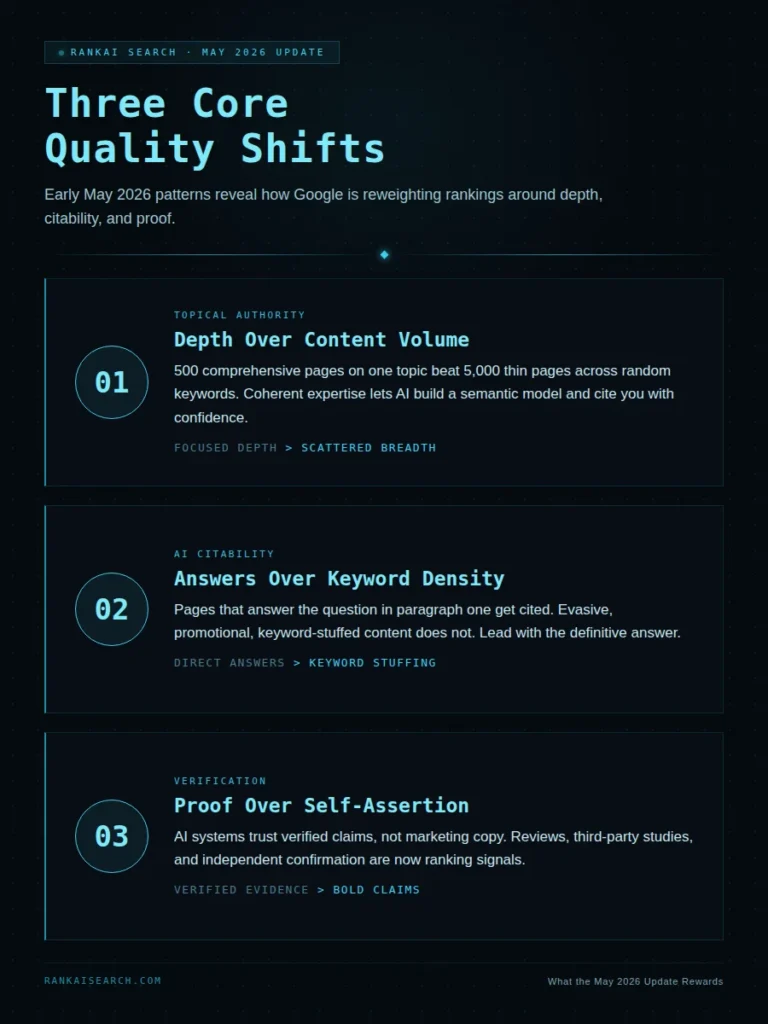
Early May 2026 patterns reveal three core quality shifts that are reshaping Google’s ranking weights.
Shift 1: Topical Authority Over Content Volume
Google now weights topical authority more heavily than raw content quantity. A site with 500 comprehensive pages about carpentry outranks a site with 5,000 thin pages across random topics.
This matters for AI search because AI systems build semantic models of your expertise. If you have 5,000 pages on random topics, the system cannot build coherent understanding. With 500 comprehensive pages on one topic, the system understands your expertise and cites you confidently.
One plumbing site had 300 pages covering everything from “how to unclog a toilet” to “best pizza ovens” to “HVAC repair tips.” The May 2026 update hit hard, resulting in 45% visibility loss. The site recovered after consolidating to 80 pages focused solely on residential plumbing: drain cleaning, water heater repair, and pipe replacement. The content quality remained the same. Only the topical focus changed. Recovery to baseline took six weeks.
Your recovery action:
- Audit your site for pages not supporting topical authority
- Delete pages on unrelated topics
- Consolidate weak pages into comprehensive resources
- Build depth in core topics, not breadth across random keywords
Shift 2: AI Citability Over Keyword Optimization
Google now prioritizes whether AI systems can confidently cite your content. Keyword-density optimized pages rank worse than pages built to answer specific questions. Evasive or promotional content is not citable.
AI systems cite content providing definitive answers. A page answering “What is the best standing desk for lower back pain?” directly in paragraph one is citable. A page burying the answer after promotional language is not.
Poor example: “Here are the factors to consider when choosing a standing desk (keyword stuffing). You should think about height adjustability. You should consider the material. You should look at reviews. After lengthy marketing discussion comes: The Uplift V2 is popular.”
Better example: “The best standing desk for lower back pain is the Uplift V2 Commercial because it offers maximum range of motion (22-48 inches), a dual motor system for smooth adjustment, and built-in lumbar support. Customer reviews specifically mention lower back pain relief. Price: $799.”
Your recovery action:
- Rewrite thin pages to answer questions in the first paragraph
- Replace promotional language with factual, specific claims
- Structure content for AI extraction, not keyword placement
- Add FAQ sections where you predict reader questions
Shift 3: Verification Over Self-Assertion
Verifiable information and independent confirmation now outweigh page claims. A product with 100 detailed customer reviews ranks higher than identical content without reviews. Third-party verification is now a ranking signal.
AI systems do not trust assertions. They trust verified claims. Customer reviews saying “This chair solved my back pain” are more citable than marketing copy saying “Provides superior lumbar support.”
Poor example: “We are the best marketing agency in the industry.”
Better example: “98 clients rate us 4.9/5 for SEO results. One client increased organic traffic from 5,000 to 42,000 monthly visitors in 8 months. Here are their specific testimonials: [quotes]. Here is the independent case study: [link with metrics].”
Your recovery action:
- Display customer reviews prominently on product pages
- Add FAQ sections addressing skepticism
- Link to third-party reviews and studies
- Show evidence of expertise, not just claims
How Should You Execute Your 30-Day Recovery Plan?
Recovery is systematic and time-bound. Each phase builds on the previous.
Days 1-4: Wait and Diagnose
The update is mid-rollout. Early movements (May 21-23) are unstable and often reverse.
Instead of making changes:
- Segment traffic by content type (products vs. blog vs. local)
- Identify which specific categories dropped
- Determine if losses are broad (all types) or targeted (one type)
- Compare drops against industry benchmarks
Making changes based on three-day volatility damages recovery.
Days 5-10: Audit and Fix Schema
Use Google’s Rich Results Test to check every template.
By content type:
- Products: Test for Product, Offer, Review, AggregateRating (all four required)
- Blog/News: Test for BlogPosting, Article, Author, datePublished, dateModified
- FAQ: Create or improve FAQPage schema with Question and Answer markup
- Local: Test LocalBusiness with Address, Phone, OpeningHours (verify accuracy)
- How-To: Add HowTo schema with Step markup including time estimates
Missing or broken schema is the number-one reason content ranks poorly after core updates. Fixing this one factor often recovers 20-40% of lost visibility within 2-3 weeks.
Real impact: Product pages with proper schema are cited in AI responses at 3-5x the rate of unstructured pages.
Days 10-20: Rewrite Thin Pages and Add Author Signals
Identify the bottom 20% of content by word count and engagement.
For each thin page, choose one path:
Expand: Add FAQ section (5-8 Q&A pairs), include complete specifications or instructions, add author byline with credentials, update publication date, implement schema markup.
Consolidate: Merge weak pages into comprehensive resources, use 301 redirects, update internal links.
Delete: Remove pages with zero traffic and no backlinks, allow low-value URLs to 404.
For every author attribution, include:
- Author name and professional headshot
- 50-100 word bio with credentials
- Author schema markup
- Link to professional profile or social media
AI systems use author expertise as a trust signal. A page bylined by someone with verified credentials is citable. Anonymous author pages are deprioritized.
Days 20-30: Add Verification Signals and Check Technical Issues
Add customer verification:
- Display reviews prominently (above the fold)
- Include review schema for all reviews
- Add FAQ sections addressing skepticism
- Link to third-party reviews and studies
- Collect testimonials from verified customers
Technical audit:
- Review robots.txt for overly broad disallows
- Check for accidental noindex tags
- Test JavaScript rendering (schema must appear in initial HTML)
- Verify Core Web Vitals pass:
- LCP under 2.5 seconds
- FID under 100ms
- CLS under 0.1
- Check in Google Search Console
One silent technical problem can eliminate all visibility gains.
June 4+: Monitor Recovery
Wait for rollout completion before final conclusions.
Compare against:
- Semrush Sensor
- Amsive’s Analysis
- Your own GA4 and Search Console data
Why Are AI Systems Now Ranking Factors?
The May 2026 update signals a permanent shift. Google is aligning its algorithm with how AI systems evaluate content. This is not temporary. This is the direction of SEO.
AI platforms require completeness, verifiability, structure, freshness, authority, and neutrality. If your content lacks any of these, AI systems cite competitors instead.
Traditional SEO vs. AI SEO:
| Factor | Traditional SEO | AI SEO (May 2026) |
|---|---|---|
| Keyword weight | Heavy | Low |
| Schema weight | Helpful | Required |
| Authority signals | Backlinks | Author credentials, reviews |
| Content approach | Keyword-optimized | Question-answering |
| Primary ranking signal | Keywords | Citability |
| Preferred source type | Any | First-party, authoritative |
A page with strong backlinks but no schema, no author attribution, and no customer reviews now ranks worse than a page with complete structure but fewer backlinks. This is the inversion May 2026 enforces.
If you optimize for traditional SEO while treating AI search separately, you are being hit twice: traditional SEO strategy does not capture AI visibility, and separate AI strategy cannot scale because traditional practices are now ranking negatives.
How Can RankAISearch Help Your Brand Become an AI Search Leader?
The May 2026 update confirms what RankAISearch has been building for: AI search is now the primary ranking factor.
Traditional SEO agencies optimize for keyword rankings (no longer primary), backlinks (important but not dominant), and traditional visibility (irrelevant if not citable by AI). They are not equipped for schema markup strategy across 10+ content types, author expertise signals, AI citability testing, GEO (Generative Engine Optimization), AIO (AI Overview Optimization), LLMO (Large Language Model Optimization), or AEO (Answer Engine Optimization).
RankAISearch specializes in this transition.
- We audit and implement complete schema across all content types, validate and correct errors, monitor continuously as AI platforms evolve, and train your team.
- We rewrite existing content for AI systems (not keyword density), add author attribution and expertise signals, implement topical authority clustering, build FAQ sections optimized for AI extraction, and maintain SEO value.
- We build GEO and AIO strategies by optimizing for Google AI Overviews specifically, tuning content for entity recognition, building AI-driven discovery strategies, and monitoring brand mentions in AI responses.
- We establish brand authority across AI platforms: ChatGPT optimization (LLMO), Perplexity AI optimization, Google AI Overviews optimization, emerging AI agent optimization, real-time brand mention monitoring.
- We measure and report on AI citations across all platforms, share of voice vs. competitors, author and brand authority signals, and ranking recovery tied to AI visibility gains.
The RankAISearch competitive advantage is threefold: we specialize exclusively in AI search (not as an add-on), we have proprietary frameworks for each AI platform, and we stay current as platforms evolve. Most agencies focus on Google alone. We optimize across ChatGPT, Perplexity, Google AI Overviews, and emerging platforms.
What Should You Do Next to Claim Your AI Search Advantage?
The May 2026 Google Core Update represents a permanent shift. This is the direction of SEO for 2026 and beyond.
Businesses that will dominate are those implementing complete schema markup, building content designed for AI citability, using author attribution as first-class ranking factors, displaying customer verification prominently, focusing on topical authority, and understanding that first-party sources now outrank intermediaries.
The competitive advantage belongs to brands understanding AI search fundamentally, not brands scrambling to game traditional rankings.
If this update hit your site hard, recovery is possible. But it requires expertise most traditional SEO agencies do not have. The path forward combines schema optimization, topical authority building, AI citability rewrites, and real-time platform monitoring across ChatGPT, Perplexity, and Google.
RankAISearch has helped 40+ brands recover from algorithm changes by optimizing for AI search first and traditional SEO second. Most have recovered 50-80% of lost visibility within 6-8 weeks.
Let’s assess your situation. Schedule a 20-minute strategy call to review your site’s AI search readiness, identify which recovery path fits your business, and understand what your first 30 days should look like.
Book Your Strategy Call to start your recovery today.
Frequently Asked Questions About May 2026 Google Core Update
Is this update targeted at a specific industry?
No. Google confirmed it is a broad core update affecting all types of sites. However, early patterns show aggregators and thin-content sites are more affected than brand-owned destination sites. If you are an OTA, job board, or comparison platform, May 2026 is particularly challenging.
How long does core update recovery take?
Recovery typically begins 4-6 weeks after implementing fixes. Some recovery happens between updates, but biggest gains follow the next core update. Sites that fixed schema first saw recovery within 3-4 weeks.
Should I wait for detailed analysis before making changes?
No. Do not wait for analysis to fix schema validation errors, audit thin content, or improve author attribution. Analysis will confirm which industries were affected, but will not change your recovery steps. Fix high-leverage issues now.
Can I recover, or is my site permanently damaged?
You can recover. Core updates are not penalties. They are recalibrations of ranking signals. If your site lost visibility, other content is now ranked as more relevant. Improving quality signals (schema, authority, verification, freshness) will bring visibility back.
Does this update affect ecommerce sites differently than publishers?
Yes, structurally. Ecommerce sites need Product, Offer, Review, and AggregateRating schema. Publishers need BlogPosting, Article, Author, and dateModified schema. Quality principles are the same, but schema implementation differs by vertical.
What happens at the next core update?
Google typically rolls out core updates multiple times per year. Sites that recover from May 2026 using AI-era best practices will maintain or grow visibility. Sites treating May 2026 as temporary and reverting to old practices will be vulnerable again. This direction is permanent.
How do I know if my site was actually hit?
Segment traffic by content type and verticals. A broad drop across all types indicates core update hit. Isolated drops in one vertical may indicate other issues. Compare drops against Semrush Sensor and Amsive’s Analysis to see if your pattern matches known patterns.
Is AI search optimization separate from traditional SEO?
No. The May 2026 update proves Google is now unified: both traditional search and AI search reward the same signals (schema, authority, verification, topical depth). Optimize for both simultaneously. Treating them separately leaves visibility on the table.