

Compete With Aggregators in AI Answers | Singapore Guide
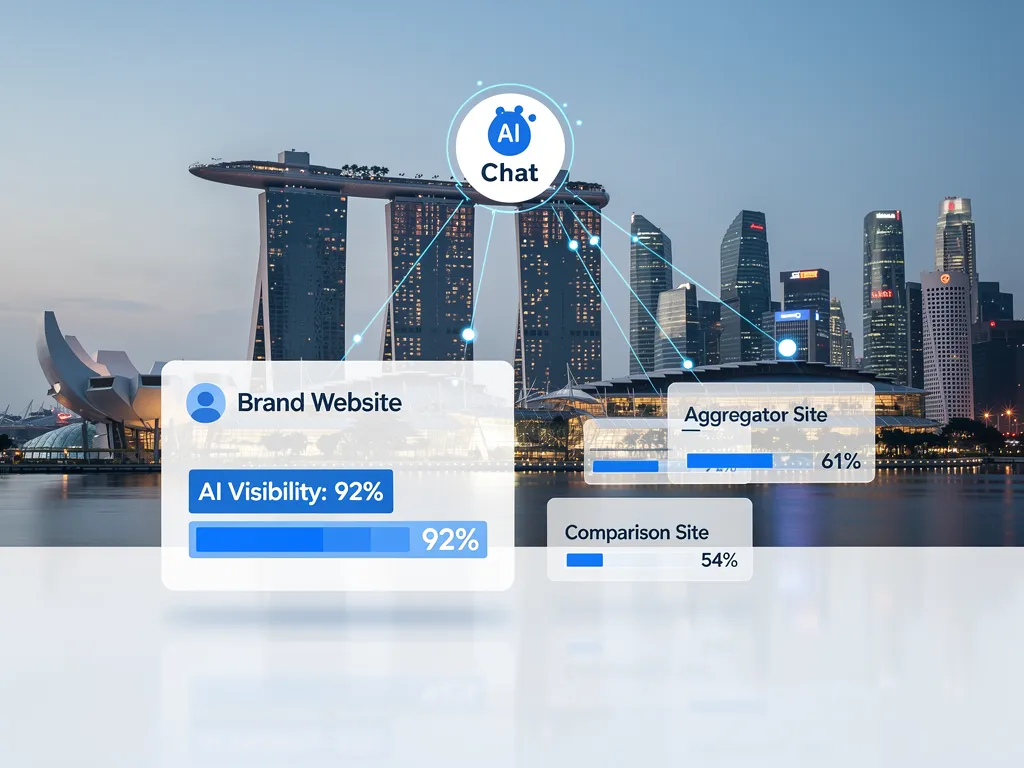
Ask ChatGPT “What’s the best credit card for cashback in Singapore?” or “Which condo launches in District 15 are worth looking at?” and you’ll often see the same thing. The answer leans on comparison sites and portals, not on the banks, developers or agencies actually selling the product.
For many Singapore businesses, that’s frustrating. You’ve built a good product and a solid website, yet AI tools keep pointing people to an aggregator first.
The good news is that you can compete. Aggregators win some prompts, but not all of them, and brands that understand why aggregators get cited can win back a meaningful share of AI recommendations. This guide explains how.
Quick answer: how do you compete with aggregators in AI answers?
You don’t need to beat aggregators everywhere. You need to work with them on broad prompts and beat them on specific ones. In practice:
Make sure your listings on major aggregators are complete, accurate and well reviewed, because AI tools quote them
Publish your own clear comparison, pricing and “who it’s for” content that AI can quote directly
Target specific, situational prompts that aggregators answer poorly
Make your key facts machine-readable with structured data
Build reviews, community mentions and press coverage that name your brand
Track your AI share of voice against aggregators, not just against direct competitors
Why AI tools love aggregators
To compete with aggregators, it helps to understand why AI tools trust them in the first place. It isn’t favouritism. Aggregators simply have qualities that make them easy to cite.
Breadth: One page covers many options, which matches how people ask AI tools for “the best” or “top” choices.
Structure: Comparison tables, filters, specs and ratings are easy for AI systems to read and summarise.
Freshness: Large platforms update rates, prices and listings constantly.
Authority: Well-known sites earn huge numbers of links, mentions and visits, which signal trust.
Perceived neutrality: A comparison site looks more impartial than a brand talking about itself.
When an AI tool needs to answer “which is best?”, an aggregator page gives it exactly what it wants: many options, clearly compared, from a trusted source.
Which Singapore sectors face the biggest aggregator challenge?
Aggregator influence is strongest in categories where buyers compare many similar options. In Singapore, that includes the sectors below.
If you work in any of these sectors, aggregators are part of your AI visibility picture, whether you engage with them or not.
The good news: brand websites still get cited
Aggregators are powerful, but they don’t own AI search. A large-scale analysis by Profound, reported by WARC in September 2026, found that brand websites make up about 57% of AI citations globally. The share varied by platform, from 47% on ChatGPT to 69% on Gemini.
In other words, AI tools are willing to cite brands directly. They do it when the brand’s own content clearly answers the question. The opportunity is to make your website the best source for the questions you can genuinely answer.
Step 1: Treat aggregators as a channel, not just a competitor
The fastest way to appear in more AI answers is often to improve how you appear on the aggregators themselves. If AI tools quote MoneySmart or PropertyGuru, you want those pages to show you accurately and favourably.
Complete every listing. Fill in all available fields, including features, prices, eligibility, locations and photos.
Keep details current. Outdated rates, prices or promotions on an aggregator can flow straight into AI answers.
Collect reviews where they count. If a platform shows ratings, encourage genuine customer reviews there.
Explore partnerships and editorial inclusion. Many comparison sites publish guides and “best of” articles. Being included, on merit, can put your brand into the sources AI tools quote most.
Correct errors quickly. If an aggregator gets your details wrong, contact them. A wrong fact on a trusted platform tends to spread.
Think of aggregators the way you think of your Google Business Profile: a third-party page you don’t fully control but should actively manage.
Step 2: Publish your own comparison and decision content
Aggregators win “which is best?” prompts because they compare options. You can do the same, as long as you’re honest.
Content that works well includes:
“Who it’s for” pages: clear explanations of which customers your product suits and which it doesn’t
Honest comparison pages: your product against alternatives, with fair, factual differences
Transparent pricing pages: real prices or ranges, what’s included and what costs extra
Decision guides: practical help such as “How to choose a home loan when your fixed rate ends”
Calculators and tools: simple tools that help buyers estimate costs or compare options
AI tools are more likely to quote content that is specific, balanced and factual. A page that only says “we’re the best” won’t be cited. A page that explains when you’re the right choice, and when you’re not, often will. Our guide on how to structure content so AI quotes it directly explains the format in more detail.
Step 3: Win the specific prompts aggregators answer poorly
Aggregators are strong on broad prompts like “best credit card Singapore”. They’re much weaker on narrow, situational questions such as:
“Which home loan is suitable for an HDB upgrader who wants to refinance in two years?”
“Best renovation firm for a 4-room BTO with a S$40,000 budget in Tengah”
“Which travel insurance covers scuba diving trips to Indonesia?”
“Is there a condo near a good primary school in Bukit Timah under S$2 million?”
These prompts are often closer to a buying decision, and they reward businesses with real expertise. Build a list of these specific prompts for your category and create content that answers them directly. Our guides on best-in-category prompts and finding the prompts competitors are winning show how to build this list.
Step 4: Make your facts machine-readable
Part of an aggregator’s advantage is structure. You can give AI tools the same clarity on your own website.
Use structured data such as Product, Offer, FinancialProduct, LocalBusiness, Service, Review and FAQPage where relevant
Put key facts, such as prices, rates, fees, eligibility and features, in plain text on the page, not only inside images or PDFs
Keep a single, authoritative page for each product or service with up-to-date details
Show “last updated” dates on pages with prices or rates
Make sure AI crawlers can access these pages without being blocked
Our guide to structured data for AI search covers which schema types matter most.
Step 5: Build proof that AI tools can find
AI tools pay close attention to what others say about you. Aggregators collect that proof in one place, so you need to build it more widely.
Reviews: Encourage detailed, genuine reviews on Google and platforms relevant to your sector. See how online reviews affect whether AI recommends a brand.
Community discussions: Singaporeans often ask for honest recommendations on r/singapore, r/askSingapore, HardwareZone forums and Seedly’s community. Take part transparently where your expertise genuinely helps.
Editorial coverage: Expert commentary in Singapore business, finance, property and lifestyle media builds the kind of mentions AI tools trust. Our digital PR for AI visibility service focuses on exactly this.
Step 6: Measure your share of voice against aggregators
Most businesses only track direct competitors. In aggregator-heavy sectors, you also need to know how often AI answers send people to comparison sites instead of to you.
Track across your prompt list:
How often your brand is named in the answer
How often your website is cited as a source
How often aggregators are cited, and whether they mention you
Whether AI tools describe your products accurately
This shows where to focus. If aggregators are cited but don’t mention you, work on your listings. If they mention you but AI never cites your site, work on your own content. Learn more about AI share of voice and how to improve it.
Sector playbooks: where to focus first
Banks, insurers and fintechs: Keep rates and terms accurate on comparison sites, publish clear product pages with eligibility and fees, and create decision guides for specific life situations. Follow MAS advertising guidelines in all content.
Property developers and agencies: Give each project or listing a detailed page with location, nearby amenities, schools and transport. Publish district and estate guides, and keep portal listings complete and current.
E-commerce brands: Strengthen product pages with specs, sizing, care details and reviews. Keep marketplace listings consistent with your own website. Our guide on optimising product pages for AI search covers the details.
Renovation and home services: Show real projects with budgets, house types and estates. Gather reviews that mention the type of job, and keep platform profiles complete.
Common mistakes to avoid
Ignoring aggregators completely. If AI tools cite them, your presence there matters.
Copying aggregator content. Thin “top 10” pages on your own site rarely get cited.
Hiding prices and facts. AI tools can’t quote what they can’t find.
Making biased comparisons. One-sided comparisons damage trust with readers and AI tools alike.
Only targeting broad prompts. Specific prompts are easier to win and closer to a sale.
Win back your share of AI recommendations
Aggregators aren’t going away, but they don’t have to own every AI answer in your category. Businesses that manage their aggregator presence, publish genuinely useful content and target specific prompts can earn a much larger share of AI recommendations.
RankAISearch helps Singapore brands in competitive, aggregator-heavy sectors measure and grow their AI visibility. Learn more about our work as a GEO agency in Singapore, or contact our team for an audit of how you compare with aggregators in AI answers.
Frequently asked questions
Why does ChatGPT recommend comparison sites instead of my business?
AI tools like ChatGPT favour comparison sites because they cover many options in one place, present them in a structured way, update often and are widely trusted. When someone asks “what’s the best”, a comparison page is an easy, complete source to quote. You can compete by improving your listings on those sites and publishing clear, specific content of your own.
Can my business outrank aggregators in AI answers?
Yes, especially on specific prompts. Aggregators are strongest on broad questions, while brands often win narrow, situational ones that need real expertise. Large-scale studies also show brand websites are cited frequently when they directly answer the question.
Should I list my business on aggregator sites?
In most aggregator-heavy sectors, yes. AI tools frequently quote these sites, so a complete, accurate and well-reviewed listing increases your chances of being mentioned. Treat aggregators as a visibility channel you actively manage.
What type of content helps brands get cited instead of aggregators?
Content that is specific, factual and balanced works best. This includes transparent pricing pages, honest comparison pages, “who it’s for” pages, decision guides for particular situations and useful calculators.
Does structured data help against aggregators?
Structured data helps AI tools understand your products, prices and services as clearly as they understand an aggregator’s comparison table. It works best combined with clear on-page facts and strong third-party mentions.
Which Singapore Industries Face the Biggest AI Aggregator Challenge?
Personal finance, insurance, property, e-commerce, travel, home renovation and education are the most affected, because buyers in these categories compare many similar options before deciding.
How do I know if aggregators are taking my AI visibility?
Test the prompts your customers ask across ChatGPT, Gemini, Perplexity and Google AI Overviews, and record which sources are named and cited. A free check with our AI visibility scanner is a quick way to see where you stand.
How long does it take to compete with aggregators in AI answers?
Fixing aggregator listings and on-site facts can affect AI answers within weeks on tools that search the web live. Building enough content and authority to win a steady share of voice usually takes three to six months.