
A few review patterns can change how a brand looks inside an AI answer. Repeated praise for fast service, easy setup, durable products, or helpful support gives AI systems language they can summarize. Reviews influence AI recommendations because they connect customer experience to specific buyer needs.
That connection matters when AI tools answer commercial questions. A buyer is not only asking which brand exists, but which brand fits their problem. This guide explains how AI answer engines use reviews and how brands can strengthen review signals ethically.
Do Reviews Affect Whether AI Recommends a Brand?
Yes. AI engines factor in review volume, average rating, and the sentiment of what reviewers say when deciding which brands to recommend. Consistent positive reviews across trusted platforms make your brand a safer recommendation for an AI to make.
Reviews help AI systems understand whether real customers trust a business, product, or service. Google says more reviews and positive ratings can help a business’s local ranking, which makes reviews a visible trust signal in local discovery systems. (Source: Google Business Profile Help, 2026)
Reviews matter because AI recommendations often compress many options into one short answer. A brand with detailed, recent, and consistent customer feedback gives AI systems more evidence than a brand with thin or outdated reviews.
A review profile also helps AI systems understand risk. A brand with repeated complaints about delivery, billing, product defects, or service quality may look less safe to recommend than a brand with stronger customer proof.
| Review Signal | What It Shows | Why It Matters for AI |
|---|---|---|
| Review volume | Number of customer experiences | Shows evidence depth |
| Average rating | Overall satisfaction level | Gives quick reputation context |
| Review recency | Freshness of customer feedback | Shows current performance |
| Review sentiment | Positive, neutral, or negative themes | Helps AI summarize customer experience |
| Review topics | Service, delivery, quality, price, support | Matches prompts to customer needs |
| Platform trust | Google, Yelp, Trustpilot, G2, Amazon, industry sites | Shows source credibility |
| Brand responses | How the brand handles feedback | Shows customer care |
How Do AI Answer Engines Use Reviews?
AI answer engines use reviews as reputation signals, customer experience evidence, and query-matching context. Reviews help AI systems decide whether a brand is credible, relevant, and safe to recommend for a specific need.
Reviews also give AI systems language from real customers. That language can describe the product fit, service speed, support quality, location experience, price value, or common problems more naturally than brand copy.
Review data becomes more useful when it appears across several trusted sources. A brand with consistent review themes on Google, Yelp, G2, Trustpilot, Amazon, or a category-specific site gives AI systems stronger corroboration.
| AI Use Case | How Reviews Help |
|---|---|
| Local recommendations | Confirms nearby customer satisfaction |
| Product recommendations | Shows quality, fit, durability, and use cases |
| Brand comparisons | Provides customer-backed pros and cons |
| Service selection | Shows reliability, response time, and outcomes |
| Risk assessment | Flags repeated complaints or trust issues |
| Sentiment summaries | Identifies common positive and negative themes |
| Query matching | Connects brands to specific needs customers mention |
Reputation Signals
Reputation signals are review-based indicators that show whether customers trust the brand. These include rating, volume, recency, sentiment, platform credibility, and response quality.
AI systems can use reputation signals to avoid recommending a weak or risky option. A brand with many recent reviews describing reliable service gives stronger recommendation evidence than a brand with a high rating but little review text.
| Reputation Signal | Strong Example |
|---|---|
| High rating | 4.6 average rating across recent reviews |
| Review depth | Hundreds of detailed reviews |
| Freshness | New reviews every month |
| Platform spread | Reviews on Google, Yelp, Trustpilot, G2, or category sites |
| Response quality | Helpful replies from the brand |
| Issue resolution | Public follow-ups on complaints |
Customer Experience Evidence
Customer experience evidence is the real language customers use to describe what happened before, during, and after purchase. It helps AI systems understand whether the brand delivers what it promises.
This evidence can include delivery speed, customer support, product quality, staff behavior, pricing clarity, installation experience, wait time, returns, or long-term durability. AI tools can summarize these patterns when answering buyer questions.
| Review Detail | What AI Can Learn |
|---|---|
| “Arrived in two days” | Delivery speed |
| “Support fixed it the same day” | Service responsiveness |
| “Runs small” | Fit and sizing issue |
| “Easy setup” | Beginner friendliness |
| “Expensive but worth it” | Price-value perception |
| “Great for small apartments” | Use-case fit |
| “Hard to return” | Purchase friction |
Which Review Factors Influence AI Recommendations Most?
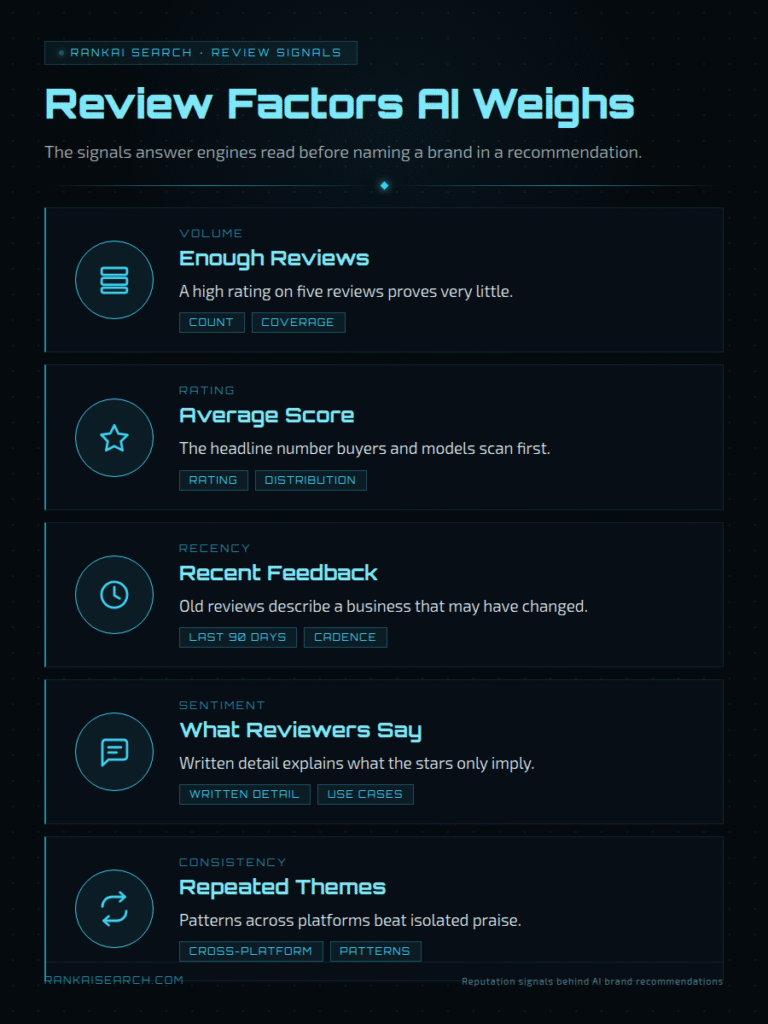
The review factors that influence AI recommendations most are volume, average rating, recency, sentiment, topic consistency, platform trust, and relevance to the prompt. These signals help AI systems judge both reputation and fit.
Review signals work together. A high rating with very few reviews is weaker than a high rating with many detailed and recent reviews.
Review expectations change by category. A restaurant, dentist, SaaS platform, ecommerce store, home service company, and hotel will not need the same review mix to appear credible.
| Review Factor | Why It Matters |
|---|---|
| Volume | Shows enough customer evidence |
| Rating | Gives a fast reputation signal |
| Recency | Shows current business quality |
| Sentiment | Explains what customers actually feel |
| Topic consistency | Shows repeated strengths or issues |
| Platform authority | Supports trust in the source |
| Verified status | Reduces authenticity concerns |
| Response quality | Shows brand accountability |
Volume, Rating, and Recency
Volume, rating, and recency show how much review evidence exists, how customers score the brand, and whether the feedback reflects current performance. These are the first review signals many platforms and users can scan quickly.
A business with fresh reviews can look more active than one with old reviews. Recency matters because staff, products, service quality, pricing, and operations can change.
| Factor | Strong Signal | Weak Signal |
|---|---|---|
| Volume | Many real reviews | Very few reviews |
| Rating | Consistently strong average | Low or unstable average |
| Recency | Reviews from recent weeks or months | Last review from years ago |
| Distribution | Mostly positive with some realistic criticism | Perfect pattern that looks unnatural |
| Detail | Specific customer stories | One-word reviews |
Sentiment and Topic Consistency
Sentiment and topic consistency show what customers repeatedly praise or criticize. AI systems can use review language to match brands to prompts such as “best for fast delivery,” “best for beginners,” or “best customer support.”
Topic consistency is stronger than isolated praise. A single review mentioning great support is useful, but dozens of reviews mentioning helpful support create a clearer pattern.
| Review Theme | AI Recommendation Context |
|---|---|
| Fast response | Emergency services or support-heavy products |
| Helpful staff | Healthcare, hospitality, local services |
| Easy setup | Software, devices, furniture, tools |
| Durable quality | Products, equipment, apparel |
| Fair pricing | Budget-conscious prompts |
| Clean location | Restaurants, clinics, gyms, salons |
| Strong communication | Agencies, contractors, professional services |
Why Does the Content of Reviews Matter More Than Star Ratings Alone?
Review content matters more than star ratings alone because written feedback explains why customers liked or disliked the brand. Star ratings show the score, but review text explains the experience.
Review text can connect a brand to specific buyer needs. A five-star review that says “the technician arrived within 30 minutes during a weekend emergency” is more useful than a five-star rating with no comment.
Review language can also reveal hidden objections. If many customers mention confusing billing, sizing issues, slow shipping, or weak onboarding, AI systems may summarize those concerns in brand comparisons.
| Star Rating Alone | Review Text Adds |
|---|---|
| Customer liked the brand | Why the customer liked it |
| Customer disliked the brand | What went wrong |
| General satisfaction | Specific use case |
| Numerical score | Sentiment themes |
| Basic comparison | Product or service details |
| Surface-level trust | Evidence behind the score |
Strong review text often includes:
- Product or service used
- Problem solved
- Location or context
- Staff or support experience
- Timing or delivery detail
- Result achieved
- Comparison with alternatives
- Limitations or concerns
Which Review Platforms Carry the Most Weight?
The review platforms that carry the most weight are the ones AI tools, search engines, buyers, and industry audiences already trust. Important platforms can include Google, Yelp, Trustpilot, G2, Capterra, Amazon, TripAdvisor, Facebook, Apple Maps, and category-specific directories.
Platform weight depends on the business type. A restaurant may rely heavily on Google, Yelp, and TripAdvisor, while a B2B software company may rely more on G2, Capterra, TrustRadius, and Gartner Digital Markets.
A brand should not chase every review platform equally. It should prioritize the sources that appear in AI answers, rank for branded searches, influence buyers, and apply to the category.
| Business Type | Review Platforms To Prioritize |
|---|---|
| Local business | Google, Yelp, Facebook, Apple Maps, Bing Places |
| Ecommerce store | Google Shopping, Trustpilot, ResellerRatings, product reviews |
| B2B software | G2, Capterra, TrustRadius, Gartner Digital Markets |
| Hospitality | Google, Yelp, TripAdvisor, booking platforms |
| Healthcare | Google, Healthgrades, Zocdoc, industry directories |
| Home services | Google, Yelp, Angi, HomeAdvisor, local directories |
| Products | Amazon, retailer reviews, brand-site reviews, YouTube reviews |
A platform carries more weight when it has real customers, detailed reviews, strong visibility, and category relevance. A low-quality directory with thin reviews is less likely to support AI recommendation confidence.
How Can Reviews Help AI Match a Brand to a Specific Query?
Reviews help AI match a brand to a specific query by using customer language to connect the brand with real needs, problems, locations, and outcomes. Review text can contain the exact use cases buyers ask about.
A review can say what a product page or service page does not. It may mention “great for small apartments,” “helpful for first-time users,” “same-day repair,” “quiet enough for a nursery,” or “easy for seniors.”
Reviews can expand the range of prompts where a brand fits. A product may be positioned for one audience, but reviews may reveal a strong fit for another.
| Buyer Prompt | Review Language That Helps |
|---|---|
| “Best dentist for anxious patients” | “The team was patient and calming” |
| “Best laptop for college students” | “Lightweight and battery lasts all day” |
| “Best plumber for emergencies” | “Came out within an hour” |
| “Best skincare for sensitive skin” | “Did not irritate my skin” |
| “Best agency for fast communication” | “They responded within the same day” |
| “Best restaurant for families” | “Great with kids and quick service” |
Use review insights to improve content:
- Add FAQs based on repeated review themes
- Update product descriptions with real use cases
- Create service pages around recurring customer needs
- Add comparison sections where reviews mention alternatives
- Build local pages where reviews mention neighborhoods
- Improve operations where reviews repeat complaints
How Do Negative Reviews Affect AI Recommendations?
Negative reviews can reduce AI recommendation confidence when they are recent, repeated, specific, unresolved, or tied to major trust issues. A few balanced negative reviews usually matter less than a clear pattern of complaints.
Negative reviews help AI systems and buyers understand risk. Repeated complaints about late delivery, poor support, hidden fees, product defects, missed appointments, or billing issues can become part of the brand summary.
Negative reviews can also reveal fixable problems. If the same issue appears repeatedly, the review profile is pointing to an operational weakness that can affect both reputation and AI recommendation confidence.
| Negative Review Pattern | AI Risk |
|---|---|
| Repeated same issue | Suggests a real operational problem |
| Recent unresolved complaints | Suggests current quality risk |
| Specific trust issue | Can affect recommendation safety |
| Poor owner responses | Shows weak accountability |
| Sudden review drop | May indicate service decline |
| Many vague one-star reviews | Needs authenticity review |
| Policy-related complaints | Can create compliance concerns |
Negative reviews are not only a visibility problem. They are a business intelligence source that shows where the customer experience needs repair.
How Can You Build Stronger Review Signals Ethically?
You can build stronger review signals ethically by asking real customers for honest feedback, making the process easy, avoiding incentives tied to sentiment, and responding to reviews professionally. Ethical review growth improves trust without risking platform penalties.
A review program should ask every eligible customer, not only happy customers. Selectively asking only satisfied customers can distort reputation signals and violate platform rules.
Ethical review growth is a process, not a campaign spike. Consistent review collection over time looks more natural and gives AI systems fresher customer evidence.
| Ethical Review Practice | Why It Helps |
|---|---|
| Ask real customers | Builds authentic proof |
| Ask consistently | Avoids cherry-picking |
| Avoid sentiment incentives | Protects review integrity |
| Make links easy | Reduces friction |
| Respond professionally | Shows customer care |
| Use feedback internally | Improves operations |
| Monitor platforms | Catches policy issues |
Review Collection and Timing
Review collection and timing should align with a real customer experience. The best time to ask is after the customer has enough experience to leave useful feedback.
Timing depends on the product or service. A restaurant can ask after the visit, while a software company may wait until onboarding is complete.
| Business Type | Good Review Timing |
|---|---|
| Restaurant | After the visit |
| Home service | After job completion |
| Ecommerce | After delivery and product use |
| SaaS | After onboarding or first success |
| Healthcare | After appointment follow-up |
| Hospitality | After checkout |
| Professional service | After milestone or project close |
Helpful Responses From the Brand
Helpful responses from the brand show that the business listens, cares, and takes feedback seriously. Responses also add context when a review is unclear or negative.
A good response should be specific, calm, and professional. It should avoid private customer details, arguments, blame, or generic copy-and-paste language.
| Review Type | Response Goal |
|---|---|
| Positive review | Thank the customer and reinforce the experience |
| Neutral review | Acknowledge feedback and invite improvement details |
| Negative review | Apologize where appropriate and offer a resolution path |
| Inaccurate review | Correct facts politely without escalating |
| Spam review | Flag through the platform and avoid public argument |
How Should You Respond to Positive and Negative Feedback?
You should respond to positive feedback with appreciation and respond to negative feedback with accountability, clarity, and a path to resolution. Review responses can strengthen trust because they show how the brand behaves after the transaction.
Positive review responses should not be robotic. A short answer that references the customer’s experience can reinforce the strength that future buyers and AI systems may notice.
Negative review responses should focus on the issue and next step. A defensive reply can make the review look worse than the original complaint.
| Feedback Type | Response Approach |
|---|---|
| Five-star review | Thank the customer and mention the service |
| Detailed praise | Reflect the specific strength mentioned |
| Minor complaint | Acknowledge and explain the fix |
| Serious complaint | Apologize and move resolution to a private channel |
| False claim | Correct facts calmly and professionally |
| Policy-violating review | Flag through the platform |
| Repeat complaint | Address the operational issue |
Review responses should support reputation, not keyword stuffing. Mentioning the service naturally is fine, but forced location or service keywords can make replies look manipulative.
How Can You Make Review Information Easier for AI to Interpret?
You can make review information easier for AI to interpret by keeping reviews visible, structured, current, source-specific, and connected to the right product, service, or location. AI systems need to know which reviews apply to which entity.
Structured data can help machines understand review content when it follows guidelines. Google’s review snippet documentation says Review and AggregateRating structured data can support review snippets for eligible content, but markup must follow item-type and policy requirements. (Source: Google Search Central, 2026)
Reviews should not be dumped into one generic testimonial page when they apply to different offers. A review about emergency plumbing should support the emergency plumbing page, not only the homepage.
A clear review architecture helps AI systems avoid entity confusion. It also helps users find the proof that matches their exact buying decision.
| Review Structure | Why It Helps |
|---|---|
| Product-level reviews | Connects feedback to the exact item |
| Service-level reviews | Connects feedback to the exact offer |
| Location-level reviews | Connects feedback to the exact branch |
| Review dates | Shows recency |
| Reviewer context | Shows use case where appropriate |
| Visible rating | Supports user and machine clarity |
| Review schema | Labels review data |
| Internal links | Connects reviews to relevant pages |
Make reviews easier to interpret by connecting them to:
- Product pages
- Service pages
- Location pages
- Case studies
- FAQs
- Comparison pages
- Buying guides
- Local landing pages
Can Fake or Incentivized Reviews Damage AI Visibility?
Yes, fake or incentivized reviews can damage AI visibility by weakening trust, violating platform policies, and creating reputation risk. AI systems and review platforms increasingly treat review integrity as part of source quality.
Fake reviews can pollute the signals that AI systems use to summarize customer sentiment. If a review profile looks manipulated, the brand becomes a riskier recommendation.
The FTC’s final rule on consumer reviews and testimonials, announced in August 2024, bans buying or selling fake reviews and prohibits incentives conditioned on reviews expressing a particular sentiment. (Source: Federal Trade Commission, 2024)
Fake reviews also create long-term cleanup problems. A business may need to remove policy-violating reviews, rebuild trust, and repair customer confidence after manipulation becomes visible.
| Risky Practice | Why It Is Dangerous |
|---|---|
| Buying reviews | Violates trust and legal standards |
| Incentivizing only positive reviews | Distorts sentiment |
| Review gating | Filters out unhappy customers |
| Posting staff reviews | Creates conflict of interest |
| AI-generated fake reviews | Creates authenticity risk |
| Review swapping | Produces unnatural patterns |
| Deleting criticism dishonestly | Weakens credibility |
| Copying reviews across platforms | Creates duplication signals |
Authentic reviews are safer and more useful. A real review profile with some criticism can look more credible than a perfect profile that appears manufactured.
How Do You Track the Impact of Reviews on AI Recommendations?
You track the impact of reviews on AI recommendations by testing AI prompts, recording brand mentions, checking cited sources, monitoring review growth, and comparing changes over time. The goal is to see whether review improvements align with stronger AI visibility.
AI recommendations are not controlled by reviews alone. A tracking plan should also include content quality, citations, brand authority, local signals, structured data, and referral traffic.
Track review impact at the prompt level. A new pattern of reviews about “fast same-day repair” may influence emergency-service prompts more than broad brand prompts.
| Tracking Field | What To Measure |
|---|---|
| Prompt | Exact AI question tested |
| Platform | ChatGPT, Gemini, Perplexity, Copilot, Claude |
| Brand mention | Whether the brand appears |
| Citation | Whether the review source appears |
| Competitors | Which brands appear instead |
| Rating trend | Average rating movement |
| Review volume | New reviews by period |
| Review themes | Repeated customer topics |
| Referral traffic | AI or review-platform traffic |
| Conversions | Leads, bookings, demos, or sales |
Review tracking should be monthly by default. High-competition brands can test priority prompts weekly during campaigns or after major review changes.
What Should You Remember About Reviews and AI Recommendations?
You should remember that reviews affect AI recommendations because they give AI systems real customer evidence about reputation, quality, fit, and trust. Reviews work best when they are recent, specific, authentic, and consistent across trusted platforms.
Reviews should not be treated as a standalone AI ranking trick. They work with website content, third-party citations, entity clarity, structured data, and local or product information.
A strong review program should improve both marketing visibility and customer experience. Better service earns stronger reviews, and stronger reviews give AI systems more credible evidence to summarize.
| Principle | Practical Action |
|---|---|
| Build authentic proof | Ask real customers for honest reviews |
| Keep reviews fresh | Collect reviews consistently over time |
| Read the text | Track themes, not only star ratings |
| Respond professionally | Show accountability and care |
| Avoid manipulation | Do not buy or gate reviews |
| Match reviews to pages | Connect reviews to products, services, or locations |
| Monitor AI answers | Track whether reviews appear in recommendations |
Are You Ready to Strengthen the Reputation Signals Behind Your Brand?
AI tools need more than a high star rating before they can confidently recommend a brand. Recent reviews, detailed customer experiences, consistent sentiment, and thoughtful responses give them stronger evidence about your reliability, product quality, service, and fit for specific buyer needs.
When review signals are weak, outdated, scattered across the wrong platforms, or dominated by unresolved complaints, your brand can become harder to evaluate. A stronger review strategy helps you build authentic customer proof while revealing which reputation issues need to be addressed first.
Speak with RankAISearch about strengthening your review signals to identify gaps in your reputation profile, prioritize the platforms that matter most, and improve the evidence AI tools use when evaluating your brand.
Frequently Asked Questions About Reviews and AI Recommendations
Do AI answer engines read the text of customer reviews?
Yes, AI answer engines can read and summarize review text when review content is available through retrieval, licensing, platform integrations, or indexed pages. Review text gives AI systems more context than a star rating alone. The text can reveal product fit, service quality, delivery issues, staff behavior, and recurring complaints. Those themes can shape how a brand is described.
Is review volume more important than average rating?
Review volume and average rating both matter, but they measure different things. Volume shows evidence depth, while rating shows the overall customer score. A high rating with very few reviews can look thin. A slightly lower rating with many detailed and recent reviews may provide stronger evidence.
How recent do reviews need to be to influence AI recommendations?
Reviews should be recent enough to reflect current customer experience. The right freshness window depends on the category, purchase cycle, and how often service quality changes. Fast-moving categories need fresher reviews. Restaurants, local services, ecommerce, software, and hospitality should collect reviews continuously.
Can a few negative reviews stop a brand from being recommended?
A few negative reviews usually do not stop a strong brand from being recommended. Repeated, recent, and unresolved complaints are more damaging. Negative reviews can also make a profile look realistic when the brand responds well. The response quality matters because it shows accountability.
Do reviews from different platforms carry equal weight?
No, reviews from different platforms do not carry equal weight. A trusted, visible, category-relevant platform usually matters more than a low-quality or obscure review site. Platform importance depends on the industry. Google and Yelp may matter more for local businesses, while G2 and Capterra may matter more for B2B software.
Does responding to reviews improve a brand’s credibility?
Yes, responding to reviews can improve credibility by showing that the brand listens and cares. Responses help buyers understand how the company handles praise, complaints, and service issues. Responses should be specific and professional. Generic or defensive replies can weaken trust.
Can product reviews and business reviews influence different AI queries?
Yes, product reviews and business reviews can influence different AI queries. Product reviews help AI answer product-fit and shopping prompts, while business reviews help AI answer service, reputation, and local recommendation prompts. A brand may need both. Ecommerce businesses need product-level proof, and service businesses need business-level customer experience evidence.
How long does it take for new reviews to affect AI-generated answers?
New reviews can take weeks to months to affect AI-generated answers. Timing depends on platform indexing, source access, review visibility, AI retrieval behavior, and the strength of competing brands. Reviews on major platforms may become visible faster than reviews on weaker sources. AI recommendation changes usually require repeated review growth and consistent source signals.